When it comes to controlling healthcare spending, few tools are as powerful as generic drugs. In Medicaid, they make up 84.7% of all prescriptions but only 15.9% of total drug spending. That’s the math states are betting on to keep their budgets from collapsing under the weight of rising drug prices. But here’s the catch: just because generics are cheap doesn’t mean they’re always affordable. Some manufacturers have raised prices on old, off-patent drugs by 500%, 1,000%, even more-sometimes with no new clinical data to justify it. And when that happens, states don’t just sit back. They fight back.
How Medicaid’s Rebate System Actually Works
The foundation of every state’s generic drug strategy starts with the Medicaid Drug Rebate Program (MDRP) a federal program requiring drug manufacturers to pay rebates to states in exchange for including their drugs in Medicaid formularies. Created in 1990, MDRP isn’t optional-it’s mandatory. For generic drugs, manufacturers must pay a rebate of at least 13% of the Average Manufacturer Price (AMP), or the difference between AMP and the "best price" they offer other buyers, whichever is higher. That’s it. No negotiation. No flexibility. Unlike brand-name drugs, where states can demand extra rebates, generics are locked into this formula.That’s why states can’t rely on MDRP alone. If they want to squeeze out more savings, they have to build their own systems on top of it. That’s where Maximum Allowable Cost (MAC) lists come in.
Maximum Allowable Cost Lists: The Real Workhorse of Cost Control
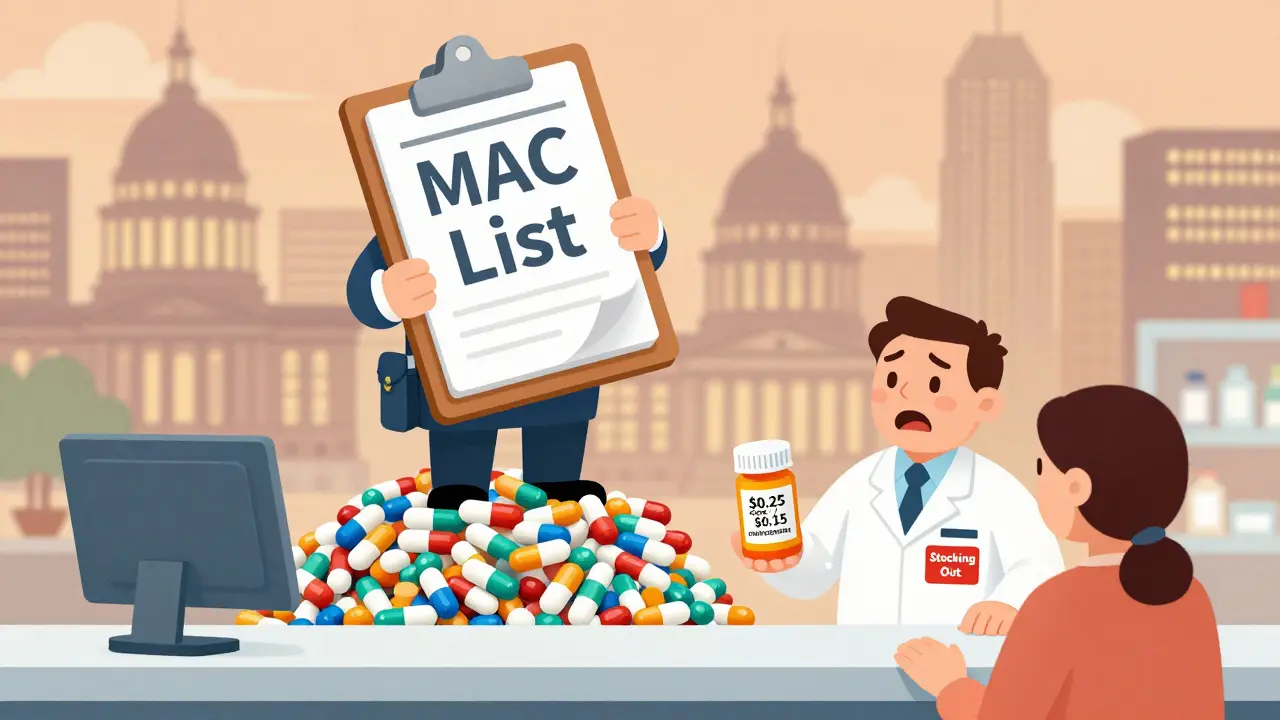
Forty-two states now use Maximum Allowable Cost (MAC) a state-set cap on how much Medicaid will reimburse pharmacies for a generic drug lists. Think of it like a price ceiling. If a pharmacy buys a generic pill for $0.10, but the state’s MAC is set at $0.15, the pharmacy gets paid $0.15. But if the pharmacy paid $0.25 for it? Too bad. The state won’t cover more than $0.15. The pharmacy eats the difference.That’s how states keep prices in check. But here’s the problem: MAC lists aren’t updated fast enough. A 2024 survey found that 68% of states update their MAC lists monthly or less often. Meanwhile, generic drug prices can swing wildly-sometimes dropping overnight after a new manufacturer enters the market. When that happens, pharmacies get stuck. They’re paid less than what they paid for the drug. Some pharmacies have stopped stocking certain generics altogether because they can’t afford the losses.
Independent pharmacies reported that 74% have faced delayed payments or claim rejections due to MAC list mismatches. That’s not just a billing glitch-it’s a barrier to care. If a patient needs a generic blood pressure pill, but their pharmacy won’t stock it because the state’s reimbursement is too low, the patient goes without.
State Laws That Target Price Gouging
Some states went further than MAC lists. They passed laws that make it illegal to jack up prices on old generics without a good reason.Take Maryland. In 2020, it became the first state to pass a law specifically targeting unjustified price hikes on generic and off-patent drugs. If a drug’s price increases by more than 50% in a year-and there’s no new clinical evidence to support it-the state can investigate and fine the manufacturer. Other states followed. California, Connecticut, and Vermont now have similar laws. The National Academy for State Health Policy (NASHP) a nonpartisan organization that helps states design health policy calls this a "model policy," and it’s gaining traction.
These laws don’t stop all price hikes, but they’ve created a deterrent. Manufacturers now think twice before raising prices on drugs like metformin, levothyroxine, or albuterol-medications millions of Medicaid patients rely on. The threat of a state investigation can be enough to keep prices stable.

Therapeutic Interchange and Preferred Drug Lists
States also use Preferred Drug Lists (PDLs) a curated list of drugs that Medicaid will cover with fewer restrictions to steer patients toward cheaper, equally effective options. For example, if there are three different statins to lower cholesterol, the state might only require prior authorization for the most expensive one. The other two? Approved automatically. That’s therapeutic interchange: swapping one drug for another with the same effect but a lower price tag.Twenty-eight states use PDLs with therapeutic interchange policies. It’s not about limiting choice-it’s about guiding it. A patient on a high-cost generic might get switched to a lower-cost version with the same active ingredient. Studies show patients don’t experience worse outcomes. In fact, adherence often improves because the co-pay is lower.
The PBM Problem: Who’s Really Getting Paid?
Here’s where things get murky. Most states don’t pay pharmacies directly. They hire Pharmacy Benefit Managers (PBMs) third-party companies that negotiate drug prices and process claims for Medicaid like OptumRx, Magellan, or Conduent to handle pharmacy benefits. These PBMs claim to save money by negotiating discounts. But here’s the twist: they often keep a cut of those discounts as "spread pricing."For example: a pharmacy buys a generic drug for $0.10. The PBM tells Medicaid it cost $0.50. Medicaid pays $0.50. The pharmacy gets $0.10. The PBM pockets $0.40. That’s spread pricing. And it’s legal-until now.
Twenty-seven states have passed new PBM transparency rules in 2024. Nineteen of them now require PBMs to disclose the actual price they paid for generic drugs. That’s a game-changer. When states can see what PBMs are really paying, they can cut out the middleman’s profit. Some states are even starting to pay pharmacies directly, bypassing PBMs entirely.
Supply Chain Risks and Stockpiling
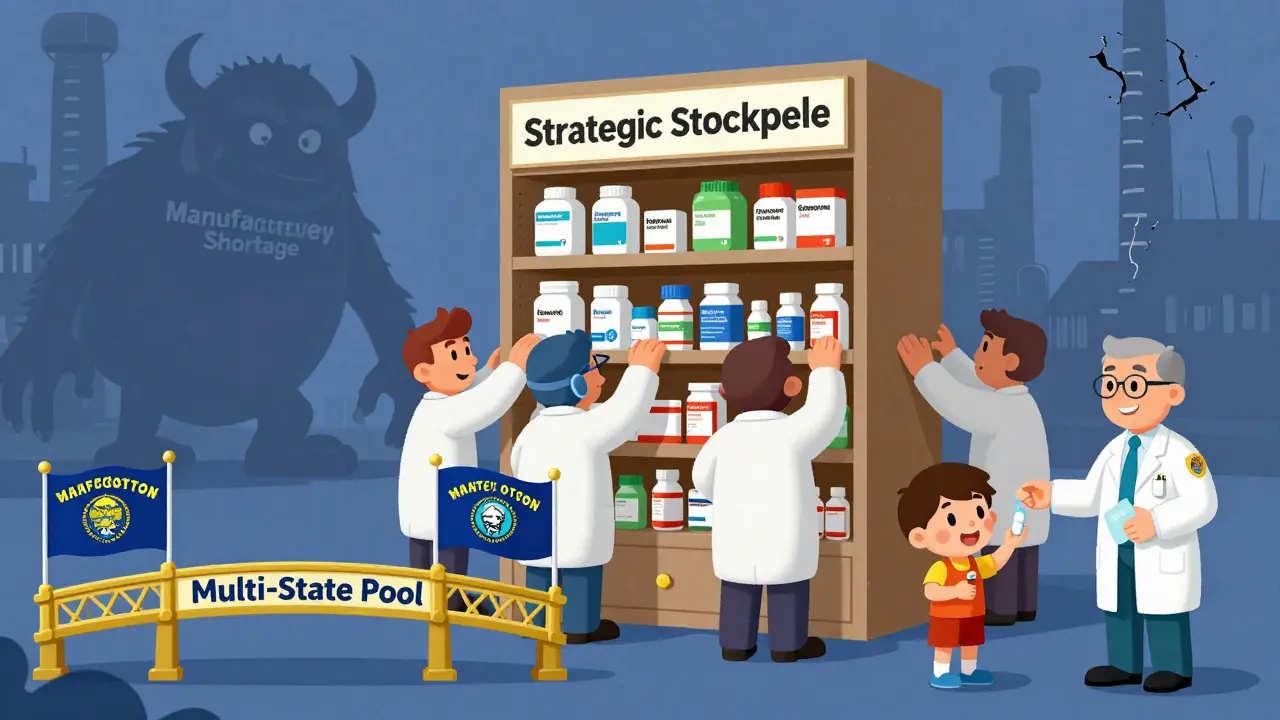
The biggest threat to generic drug access isn’t price-it’s shortage. In 2023, 23 states reported shortages of critical generic medications. Some lasted over 140 days. Why? Because generic drug manufacturing is concentrated. Three companies now control 65% of the generic injectables market. If one factory has a quality issue, the whole country feels it.Twelve states introduced legislation in 2024 to build strategic stockpiles of high-risk generics. Oregon and Texas are testing new risk pools. New Hampshire is creating a state-backed inventory of essential drugs. The goal? Prevent another crisis like the 2018 shortage of injectable epinephrine or the 2021 shortage of hydrocortisone.
The Bigger Picture: What’s Next?
The Congressional Budget Office estimates that state-level policies could reduce generic drug spending by 5-8% annually. That’s billions of dollars saved. But there’s a warning: if states push too hard, manufacturers might stop making certain drugs altogether. If a generic isn’t profitable, why produce it? The result? Shortages. And then Medicaid ends up paying more for brand-name alternatives.That’s why the smartest states are balancing cost control with access. They’re using MAC lists, anti-gouging laws, PBM transparency, and stockpiling-not as weapons, but as tools. They’re also starting to collaborate. Oregon and Washington now run a multi-state purchasing pool that negotiates supplemental rebates for 47 high-volume generics. Other states are joining.
And the federal government? It’s stepping back. In March 2025, CMS dropped its "Two Dollar Drug List" model, leaving states to lead the way. That means state policies will shape the future of generic drug pricing in America.
What’s Coming in 2025 and Beyond
Look ahead: 15 more states are expected to introduce generic drug pricing legislation in 2025. GLP-1 medications for obesity-like semaglutide-are already costing $12,000 a year. Medicaid programs are starting to cover them, but only with strict prior authorization. If federal rules force broader coverage, that could add $1.2 billion to state budgets in a single year.Meanwhile, the Medicaid and CHIP Payment and Access Commission (MACPAC) an independent agency that advises Congress on Medicaid and CHIP is pushing for changes to the MDRP rebate formula for generics during drug shortages. Right now, manufacturers pay the same rebate whether a drug is in short supply or not. MACPAC argues that during shortages, the rebate should increase to incentivize production. That’s a radical idea-and it might be the next big policy shift.
One thing is clear: states aren’t waiting for Washington to act. They’re building their own systems-layer by layer, law by law. And for the millions of low-income Americans who rely on Medicaid for their prescriptions, that’s not just policy. It’s survival.
How do Medicaid generic drug policies save money?
Medicaid saves money by using Maximum Allowable Cost (MAC) lists to cap how much it pays for generic drugs, enforcing anti-price-gouging laws, requiring therapeutic interchange to favor lower-cost options, and increasing transparency with Pharmacy Benefit Managers (PBMs). These strategies reduce net drug spending without cutting access to essential medications.
Why can’t states just negotiate lower prices for generics like they do for brand-name drugs?
Federal law under the Medicaid Drug Rebate Program (MDRP) sets a fixed rebate formula for generics-13% of the Average Manufacturer Price or the difference between AMP and best price, whichever is higher. Unlike brand-name drugs, states can’t negotiate supplemental rebates for generics. That means states have to use other tools like MAC lists and state laws to control costs.
What’s a Maximum Allowable Cost (MAC) list?
A MAC list is a state-set price ceiling for generic drugs. Medicaid will only reimburse pharmacies up to that amount. If a pharmacy pays more than the MAC, it absorbs the loss. MAC lists help prevent overpayment, but if they’re not updated often enough, pharmacies may stop stocking certain generics, leading to access issues.
Do state generic drug policies cause shortages?
They can, if they’re too aggressive. If reimbursement rates fall below the cost of production, manufacturers may stop making a drug. The Congressional Budget Office warns that overly strict price controls could reduce availability of certain generics, forcing patients onto more expensive brand-name drugs. That’s why the best policies balance cost control with supply stability.
Which states are leading in generic drug cost control?
Maryland, California, Oregon, and Texas are among the leaders. Maryland passed the first anti-price-gouging law for generics. Oregon and Washington run a multi-state purchasing pool for high-volume generics. Texas and Oregon have discontinued risky cost-mitigation programs for hepatitis C drugs after costs stabilized. California and Minnesota use upper payment limits tied to federal inflation rules.
How do Pharmacy Benefit Managers (PBMs) affect generic drug costs?
PBMs act as middlemen between states and pharmacies. They negotiate discounts but often keep a portion as "spread pricing"-charging Medicaid more than they pay the pharmacy. Twenty-seven states have passed new PBM transparency laws requiring them to disclose actual drug acquisition costs. Some states are now bypassing PBMs entirely to pay pharmacies directly.
Are generic drug shortages getting worse?
Yes. In 2023, 23 states reported shortages of critical generic drugs, with an average duration of 147 days per shortage. The problem is tied to manufacturing consolidation-three companies control 65% of the generic injectables market. Twelve states are now passing laws to build strategic stockpiles of essential generics to prevent future disruptions.
What’s the future of Medicaid generic drug policies?
Expect more states to adopt anti-gouging laws, expand MAC lists, and increase PBM transparency. The Congressional Budget Office predicts 15 more states will introduce generic pricing legislation in 2025. Long-term, states will focus on supply chain resilience, with 22 states expected to have strategic stockpiling programs by 2026. Federal policy is stepping back, so states are now the main drivers of change.

lisa Bajram
Wow, this is the kind of policy deep dive that actually matters. MAC lists are the unsung heroes of Medicaid savings - but holy hell, if they’re updated monthly, pharmacies are getting wrecked. I know a small-town pharmacist who just quit stocking metformin because the state paid $0.12 and he paid $0.21. He’s not greedy - he’s just trying to keep the lights on. We need real-time pricing feeds, not spreadsheets from 2022.
anthony martinez
So let me get this straight - states are fighting price gouging with laws while letting PBMs pocket 40 cents on every dollar. That’s like banning shoplifting but giving the store owner a cut of the stolen goods.
Jaqueline santos bau
Oh my god, I just read this and I’m crying. My mom’s on levothyroxine and the pharmacy almost ran out last month because the state’s MAC was $0.08 and the drug cost $0.15. She had to drive 45 minutes to a Walmart that had stock. This isn’t policy - it’s a nightmare dressed up as a budget spreadsheet. Someone needs to fix this before someone dies.
Aurora Memo
It’s interesting how states are stepping in where the federal government has stepped back. The MAC system isn’t perfect, but it’s a pragmatic response to a broken system. I think the real win here is collaboration - like Oregon and Washington’s multi-state pool. That’s how you scale impact without chaos.
Faith Edwards
One must observe, with considerable alarm, that the current paradigm of state-driven generic drug regulation is not merely a fiscal maneuver - it is, in fact, a moral failure of systemic proportion. The commodification of life-sustaining pharmaceuticals, even in their generic form, constitutes a grotesque abdication of the state’s fiduciary duty to its most vulnerable citizens. The notion that a $0.10 pill can be capped at $0.15 while PBMs siphon $0.40 is not merely inequitable - it is, in the truest sense, an affront to human dignity.
Jay Amparo
Back in India, generics are sold for pennies - like, ₹5 for a month’s supply of metformin. But here? You’ve got billionaires owning drug companies and states playing whack-a-mole with price hikes. It’s not about cost. It’s about greed. And the sad part? We all pay for it - even if you don’t use Medicaid, your insurance premiums are higher because of this mess.
Lisa Cozad
Love the PBM transparency laws. Finally. I’ve been saying this for years - if you’re not telling me what you paid for the drug, you’re not a middleman, you’re a thief. And the fact that 19 states are now forcing disclosure? That’s the kind of quiet revolution that actually changes lives.
Saumya Roy Chaudhuri
You guys are missing the real issue - the FDA. They approve generics based on bioequivalence, but they don’t test for manufacturing consistency. One batch of levothyroxine can be 10% stronger than the next. That’s why some patients get hyperthyroid symptoms. It’s not the price - it’s the quality. And no state law fixes that.
Ian Cheung
MAC lists are a bandaid but they’re the only bandaid we got. PBMs are the real cancer. I work in pharma logistics - I’ve seen the spreadsheets. The gap between what PBMs charge and what pharmacies pay? That’s not profit. That’s theft with a corporate logo. Time to cut them out. Pay pharmacies direct. Simple.
Ashlee Montgomery
If we’re going to regulate prices, shouldn’t we also regulate production? If a single factory controls 65% of injectables and it shuts down for a month - we all suffer. Maybe the real policy isn’t about cost. Maybe it’s about resilience. Decentralization. Redundancy. These aren’t just economic questions. They’re philosophical ones.
Ritwik Bose
Respectfully, the concept of therapeutic interchange is not without merit. However, one must acknowledge that patient autonomy must be preserved. While cost-efficiency is laudable, the transition from one generic to another - even if bioequivalent - may induce psychological distress in elderly or chronically ill populations. A balanced approach, with physician discretion, remains paramount.
Paul Bear
Let’s be precise: the 13% MDRP rebate for generics is a statutory floor, not a ceiling. The failure lies in state legislatures’ inability to innovate beyond MAC lists and passive transparency laws. The real leverage point? Amend the rebate formula to include volume-based incentives during shortages. That’s not policy - that’s market engineering. And if states don’t push for it, they’re not saving money - they’re just delaying the inevitable collapse.
chandra tan
My cousin in Texas got her insulin covered because her state made a stockpile. She didn’t even know it existed. That’s the quiet win. Not the laws. Not the spreadsheets. The person who got the pill when she needed it. That’s what matters.