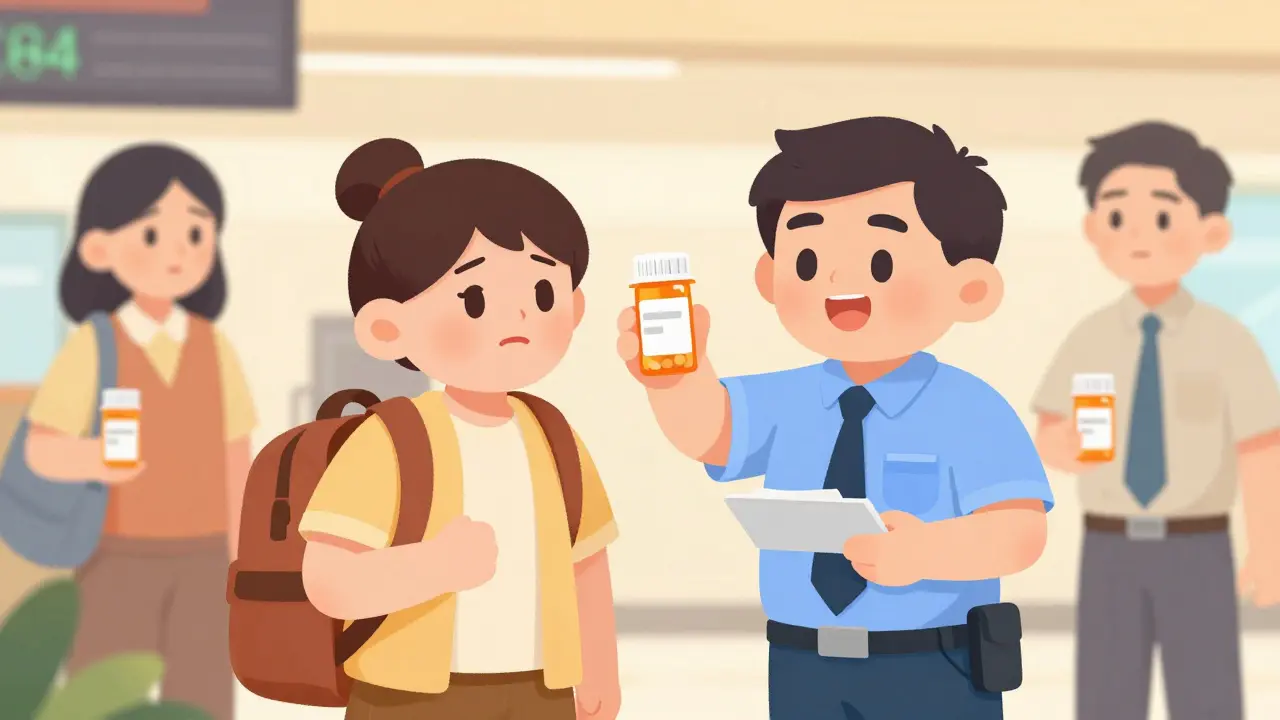
When you’re packing for a trip, your meds should be one of the first things you think about-not the last. It’s not just about remembering your pills. It’s about how you carry them. And if you’ve ever been stopped at security because your pills were in a pill organizer with no labels, you know how stressful that can be. The truth? Carrying medications in original containers isn’t just a good idea-it’s often the only way to avoid delays, confusion, or even legal trouble, especially when crossing borders.
Why Original Containers Matter More Than You Think
The TSA doesn’t legally require you to keep your pills in their original bottles. That’s what their website says. But here’s the catch: just because something isn’t illegal doesn’t mean it’s safe. Most travelers assume TSA is the final word, but they’re not. State laws, international customs, and airline policies all play a role. And if you’re caught with unlabeled pills in a foreign country, you could face serious consequences-even if you’re just carrying your own prescription. Think about it this way: a TSA officer doesn’t know if that little white pill in your pill case is your blood pressure medicine or something you bought online. But a pharmacy-labeled bottle? That’s clear. It shows the drug name, dosage, prescribing doctor, and pharmacy info. That’s proof you’re not smuggling anything. And when you’re flying internationally, that label becomes your best defense.What the TSA Actually Allows (And What They Don’t)
TSA lets you bring any amount of solid medication in your carry-on. No limits. No need to declare it unless you’re asked. You can use a pill organizer, a Ziploc bag, or even a small box. But again, that doesn’t mean you should. Here’s what they do require:- Medications must be screened-just like your laptop or shoes.
- Liquid meds over 3.4 ounces (100 ml) are allowed, but you must tell a TSA officer at the start of screening.
- Never pack meds in checked luggage. Temperature changes, lost bags, or delays can ruin your supply.
State Laws in the U.S. Are a Patchwork
Here’s where it gets messy. The U.S. has 50 states, and 37 of them require prescription medications to be in their original containers with pharmacy labels when transported-even if you’re just driving across state lines. That includes big states like California, New York, Texas, and Florida. Why? Because unmarked pills can look like illegal drugs. A bottle of Adderall without a label? In some states, that’s treated like possession of a controlled substance. If you’re driving to a state with strict laws, and you get pulled over? A cop could confiscate your meds, even if they’re yours. And yes, that’s happened. The National Association of Boards of Pharmacy says 25 states have explicit laws requiring labeled containers during transport. So even if you’re not flying, you still need to follow the rules.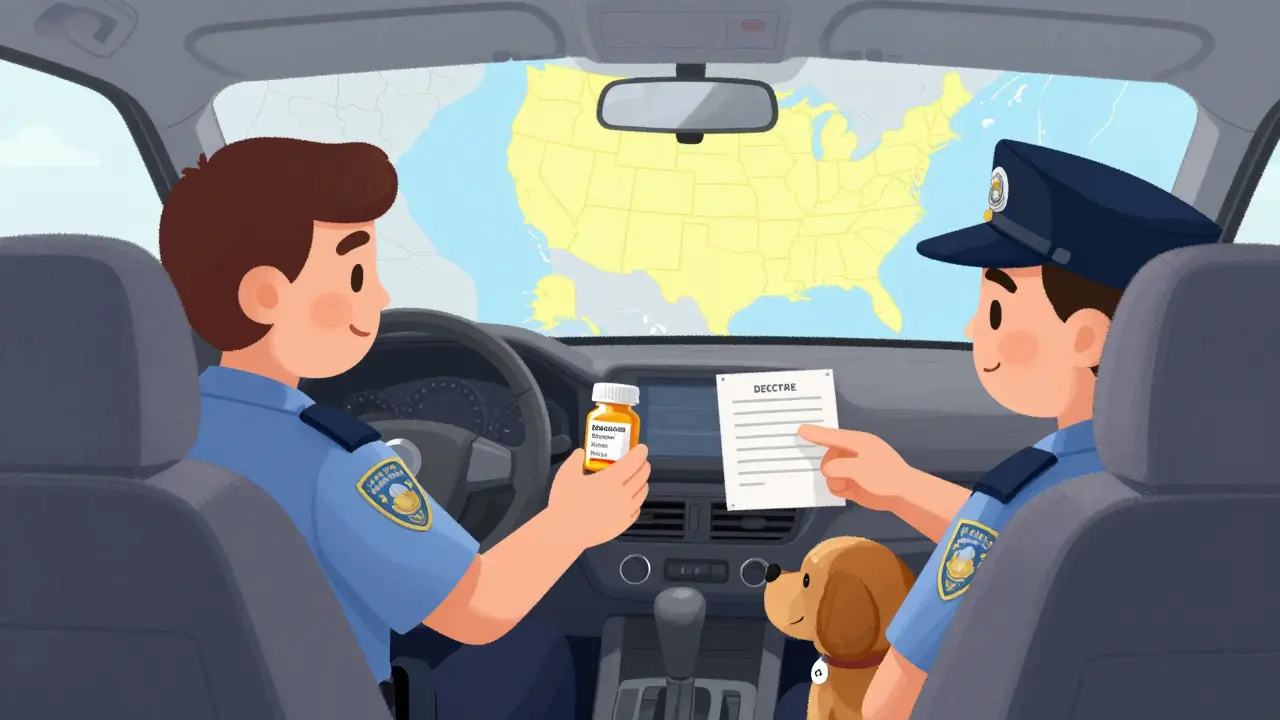
International Travel? It’s a Different World
This is where things get dangerous if you’re unprepared. Over 187 countries have rules about bringing in medications. Some are strict. Some are impossible. And many don’t care if you have a U.S. prescription. Here are real examples:- Japan: Pseudoephedrine (in Sudafed) is banned. Codeine is illegal without a special permit.
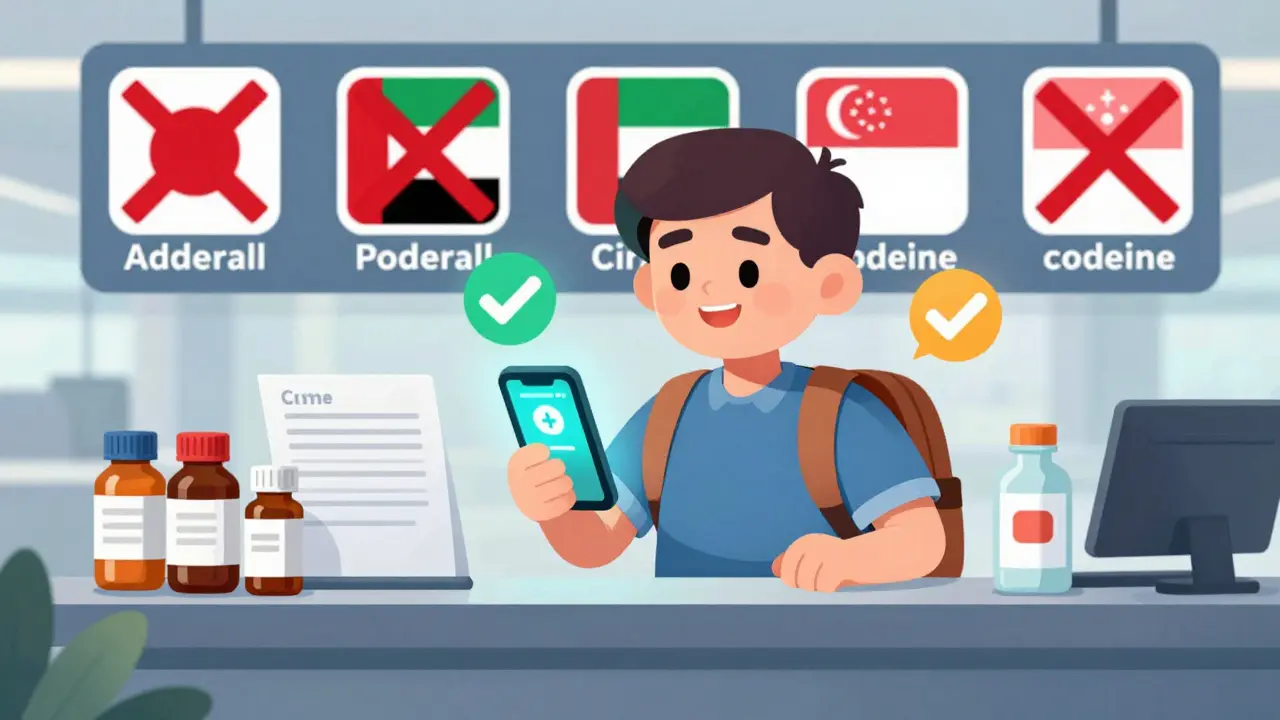
- UAE and Singapore: Adderall and Ritalin are classified as narcotics. Bringing them without authorization can lead to arrest.
- Thailand: Any medication containing codeine or tramadol requires a doctor’s letter and prior approval.
- United Kingdom: You can only bring a 30-day supply of most prescriptions without special paperwork.
- European Union: Since 2020, they’ve required all medications to be verified through their digital system. A U.S. bottle with a U.S. label might not be enough.
What to Pack: The Checklist
Here’s what you actually need to bring-not what you think you need:- Original bottles: Keep each medication in its pharmacy-labeled container. Don’t transfer them unless you have to.
- Doctor’s letter: On official letterhead. Include your name, diagnosis, medication names (both brand and generic), dosage, and why you need them. Add the doctor’s license number and contact info.
- Extra supply: Bring at least 10% more than you think you’ll need. Flights get delayed. Borders get closed. Your meds shouldn’t be the reason you’re stuck.
- Copy of your prescription: Print it out. Have it in your email too.
- For liquids: Keep them in your carry-on. Declare them to TSA before screening. Use a clear bag.
- For temperature-sensitive meds: Talk to your pharmacist. Ice packs are allowed, but you must declare them. Some airlines offer refrigerated storage-ask ahead.
What Happens If You Get Caught?
In the U.S., you’ll likely just get extra screening. It’s annoying, but you’ll probably get through. Internationally? It’s not the same. In Japan, you could be detained for days while officials check if your meds are legal. In the UAE, you could face jail time for carrying Adderall-even if it’s yours. The U.S. Department of State reports that 68% fewer travelers had issues entering Mexico when they used labeled containers. That’s not luck. That’s following the rules. The FDA warns that 11.7% of medications bought abroad are fake or contaminated. If you run out and try to buy more overseas? You might end up with something dangerous. That’s why carrying your own supply in labeled containers isn’t just smart-it’s a safety net.What’s Changing? Digital Health Passes Are Coming
In 2024, the Department of Homeland Security started testing digital medication verification at 12 major U.S. airports. By 2025, the International Air Transport Association plans to roll out a global digital health pass for travelers. That means you might soon be able to scan a QR code on your phone to show customs officials your meds are legit. But here’s the catch: those systems aren’t live yet. And even when they are, they’ll only work if your meds are already labeled and documented. The tech won’t fix bad habits. It will just make good habits faster.Final Rule: When in Doubt, Pack the Bottle
You don’t need to carry every single bottle if you’re only taking three pills a day. But you need enough labels to prove they’re yours. The original container is your passport for your meds. It’s not about being perfect. It’s about being protected. If you skip this step, you’re gambling. With your health. With your trip. With your freedom. Pack your meds like you’d pack your passport. Because in many ways, they’re just as important.Can I carry my medications in a pill organizer instead of original bottles?
Yes, the TSA allows pill organizers. But if you’re flying internationally or driving through certain U.S. states, you risk legal trouble. A labeled pill case is better than nothing, but it’s not enough proof. Always carry the original bottles with pharmacy labels, and use the organizer as a convenience-not your primary storage.
Do I need a doctor’s letter to fly with my meds?
For domestic flights in the U.S., it’s optional but highly recommended. For international travel, it’s essential. The letter should include your name, diagnosis, medication names (generic and brand), dosage, prescribing doctor’s name and license number, and contact info. Print it on official letterhead. Some countries require it by law.
Are there any medications that are completely banned on international flights?
Yes. Adderall, Ritalin, codeine, pseudoephedrine, and some benzodiazepines are illegal or tightly restricted in countries like Japan, UAE, Singapore, Thailand, and South Korea. Even if you have a U.S. prescription, these drugs may be treated as narcotics. Always check the U.S. Department of State’s travel advisories for your destination before you go.
Can I put my medications in checked luggage if I don’t need them during the flight?
Never. Checked bags can be lost, delayed, or exposed to extreme temperatures that ruin your meds. United Airlines, the CDC, and the International Air Transport Association all warn against it. Even if you think you won’t need your pills mid-flight, keep them in your carry-on. You never know when you’ll need them.
What if my medication is a liquid over 3.4 ounces?
TSA allows any amount of liquid medication in your carry-on, as long as it’s medically necessary. You must declare it to a TSA officer before screening. Don’t wait until you’re at the checkpoint. Say it as soon as you walk up. Keep it in a separate clear bag. Ice packs for cold-sensitive meds are allowed too-but you must declare them.
Do I need to declare my medications at U.S. customs when returning from abroad?
Yes. U.S. Customs and Border Protection requires you to declare all medications you’re bringing back. Even if they’re yours. If you bought something abroad, you must declare it-even if it’s legal in the U.S. The FDA warns that 11.7% of meds bought overseas are fake. Declaring them helps avoid penalties and ensures you’re not bringing in counterfeit drugs.

Matt Alexander
Just carry your meds in the original bottles. Seriously. I used to dump them into a pill organizer for convenience, then got pulled aside at LAX because they couldn’t verify what was in there. Took 20 minutes. My flight nearly got delayed. Now I keep the bottles in a ziplock with my passport. Easy. No drama.
Pro tip: If you’re flying internationally, slap a printout of your prescription on the outside of the bottle with tape. TSA doesn’t care, but customs overseas does.
Gretchen Rivas
Original containers aren’t optional if you’re crossing state lines. California just fined someone $500 for carrying unmarked Adderall in a pill case-even though it was theirs. Don’t be that person.
Mike Dubes
Man i didnt even know about the uae thing. i thought if you had a prescription you were fine. i had ritalin in my bag last year and just threw it in my carry on like a champ. got questioned for 45 mins in dubai. they took my med and made me fill out a form in arabic. no joke. never again. always pack the bottle. even if it looks dumb. better than jail.
also dont forget the doctor letter. i printed mine on actual letterhead and it saved me. trust me.
John Cyrus
People who use pill organizers are asking for trouble. Its not complicated. If you cant follow basic rules then dont travel. This isnt a suggestion. Its a law in half the states. You think you know better than the FDA and TSA? You dont. Stop being lazy. The bottle is there for a reason.
John Smith
Let me tell you what happens when you ignore this shit. I had a buddy in Thailand get locked up for 3 days because he brought his Xanax in a Ziploc. No label. No letter. Just a plastic bag with little blue pills. He thought he was cool. Turns out tramadol is a Class A narcotic there. He cried in a cell. Now he carries his meds in a gold-plated bottle with a notarized letter. And hes still paranoid. So dont be that guy. Pack the damn bottle.
Shivam Pawa
As someone who travels frequently between India and the US, I can confirm that the digital verification system is coming. But until then, the original container remains the only reliable proof. Indian customs are especially strict with psychotropics. Even a small bottle of melatonin without a label caused delays last year. A doctor's note is non-negotiable.
Renee Jackson
Thank you for this comprehensive and vital guidance. Adhering to these protocols is not merely a matter of convenience-it is an essential act of self-advocacy, legal compliance, and personal safety. The consequences of noncompliance are severe and disproportionate to the minimal effort required to prepare properly. Please ensure that all travelers are made aware of these requirements well in advance of departure.
Dean Jones
There’s a deeper philosophical question here: why should our bodies’ needs be subject to bureaucratic proof? Why does a pill need a label to be legitimate? We live in a world where trust is replaced by documentation, and autonomy is replaced by compliance. The original bottle isn’t just a container-it’s a symbol of institutional control. But here’s the thing: I still pack it. Because the system doesn’t care about your philosophy. It only cares about your paperwork. So you play the game. You carry the bottle. You write the letter. You smile through the screening. Because sometimes, survival isn’t about changing the system. It’s about navigating it without breaking.
marjorie arsenault
So many people stress about this, but it’s really simple: if you’re flying, keep your meds in the original bottles. Always. I used to think I was being smart by consolidating everything into a pill case. Then I missed a flight because they held my bag for 2 hours. Don’t be like me. Bring the bottles. Bring the letter. Bring the extra. It’s not a hassle-it’s peace of mind.
Also, if you’re traveling with someone who takes meds, help them pack. It’s a small thing that makes a big difference.
Divya Mallick
Why do Americans think their prescriptions mean anything abroad? You carry your meds like they’re sacred, but in India, we don’t even need a prescription for most things. You think your Adderall is special? In Mumbai, you can buy it at a roadside pharmacy. You think you’re safe because you have a bottle? That bottle means nothing to customs officers in Dubai or Singapore. You’re just lucky you haven’t been arrested yet. Stop acting like the U.S. is the center of the medical world.
Pankaj Gupta
While the original container is indeed the most reliable method of identification, it is also worth noting that some pharmacies now provide tamper-evident, travel-friendly vials with QR codes that link directly to digital prescriptions. These are increasingly accepted by international customs and may soon replace traditional bottles. However, until such systems are universal, the physical label remains indispensable.
Alex Brad
Carry the bottle. Bring the letter. Don’t overthink it. Simple.
RacRac Rachel
Yessssss this is sooo important!! 😍 I just got back from Bali and I had all my meds in the original bottles with the doctor’s letter tucked in my passport sleeve. Zero issues. Literally zero. And I even had a TSA agent compliment me on how organized I was 😊 You’re not being extra-you’re being smart. Save yourself the stress. Pack smart, travel free 💪✈️
Levi Viloria
I’ve been flying for 20 years. I’ve seen people get detained, fined, deported. I’ve also seen people with labeled bottles breeze through customs like they were carrying a sandwich. The difference? Preparation. You don’t need to be paranoid. You just need to be ready. The system is flawed, but it’s the one we’ve got. So you adapt. You carry the bottle. You print the letter. You keep your meds in your carry-on. You don’t make it complicated. You just do the thing. And then you get on your flight. And that’s it.