When your doctor prescribes a medication, but the pharmacy can’t fill it because it’s out of stock, you’re not alone. In the U.S., drug shortages happen more than 300 times a year. Some of these shortages last for weeks. Others drag on for months. And when that happens, the go-to solution isn’t always another brand - it’s a compounding pharmacy.
What Exactly Is a Compounding Pharmacy?
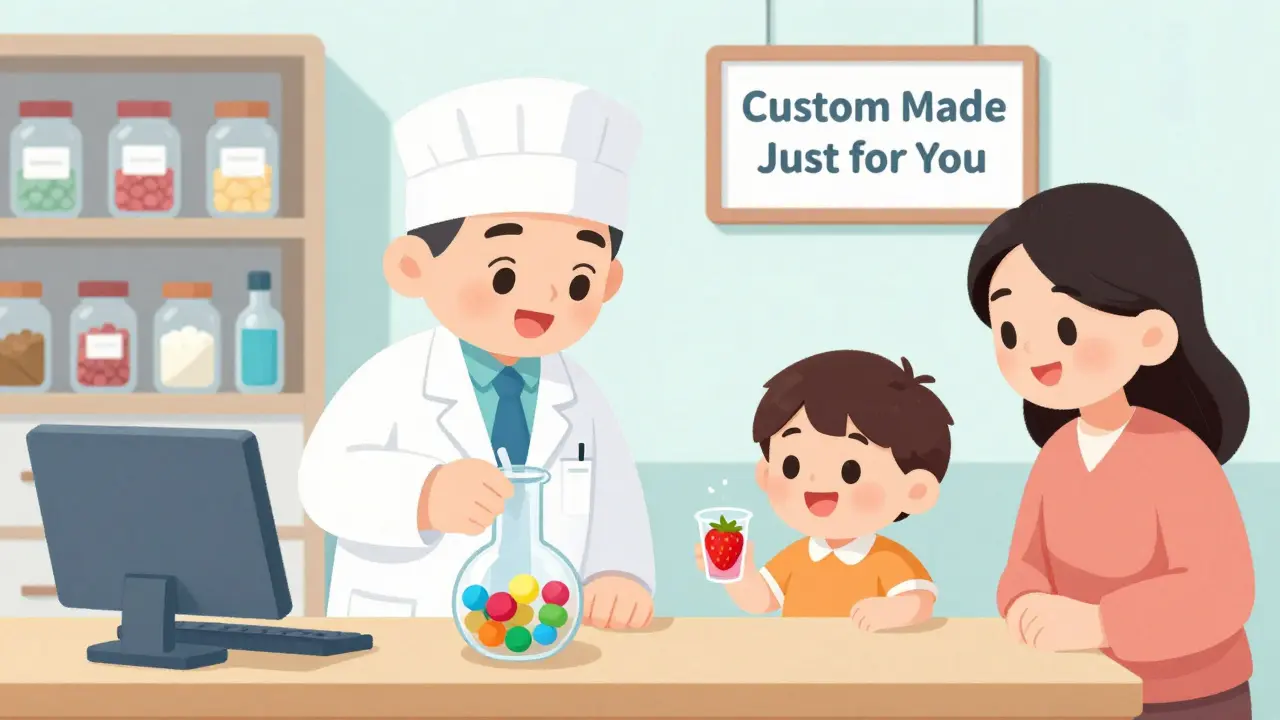
A compounding pharmacy doesn’t just hand out pre-made pills from a shelf. It makes medicine from scratch. Think of it like a kitchen where a chef tailors a meal to your exact taste and dietary needs - except here, the ingredients are pharmaceutical-grade chemicals, and the meal is a pill, liquid, cream, or gel made just for you.
These pharmacies work with licensed pharmacists who mix, crush, blend, or reformulate drugs to meet specific patient needs. They’re not trying to replace FDA-approved drugs. They step in when those drugs aren’t an option - because they’re out of stock, because you’re allergic to a dye or preservative, or because you can’t swallow a pill.
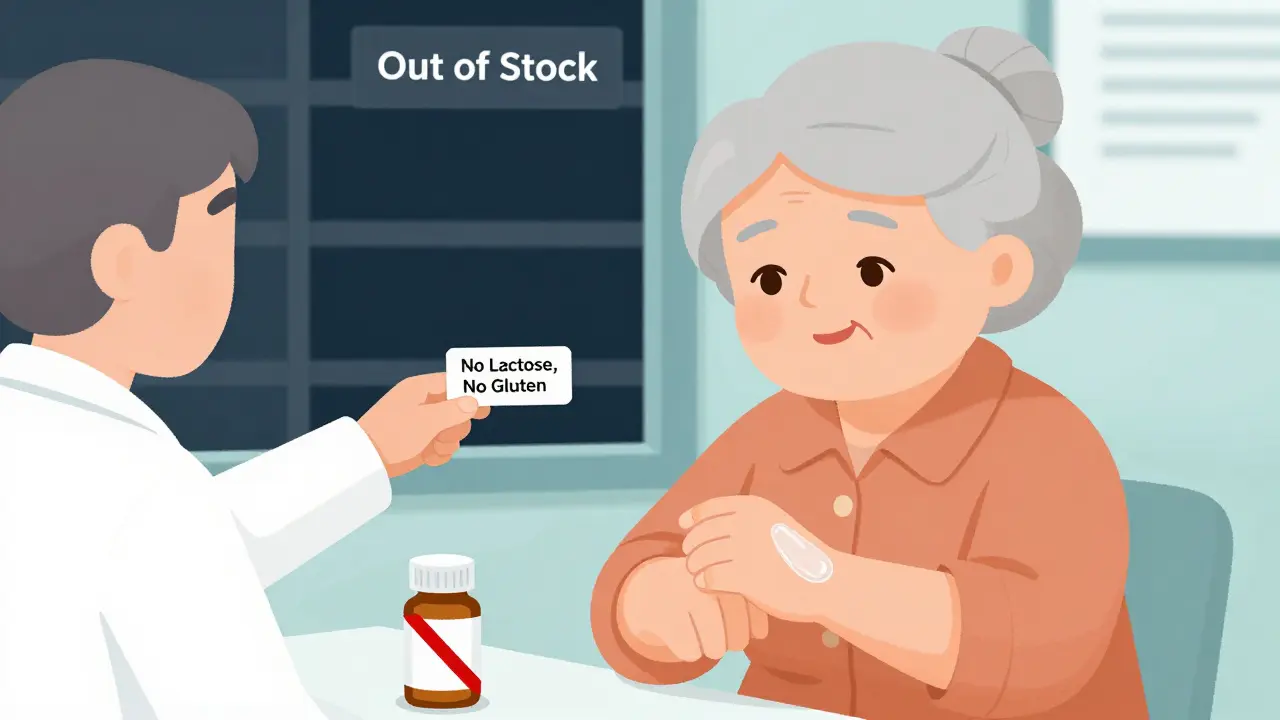
For example, if you’re a child who can’t take a tablet because it’s too big or tastes bitter, a compounding pharmacist can turn that same medicine into a strawberry-flavored liquid. If you’re an older adult with trouble swallowing, they can make a topical cream you rub on your skin instead. If you’re allergic to lactose or gluten - which affects about 1 in 5 people - they can remove those ingredients entirely.
When Do You Actually Need One?
Not every shortage requires a compounded solution. But here are the top five real-world situations where compounding makes a real difference:
- Drug shortages - When manufacturers stop making a drug, or supply chains break down, compounding pharmacies can recreate it using the same active ingredient. In 2023 alone, over 350 drugs were listed as unavailable by the FDA - many of them common antibiotics, heart medications, and hormone therapies.
- Allergies or sensitivities - Commercial pills often contain dyes, gluten, lactose, or preservatives. A compounding pharmacy can remove those and still deliver the same treatment. One study showed 85% improvement in medication adherence when patients switched to allergen-free compounded versions.
- Special dosing needs - Some patients need doses that aren’t commercially available. A child might need 2.5 mg of a drug, but the smallest pill made is 10 mg. A compounding pharmacy can make a 2.5 mg capsule or liquid.
- Alternative delivery methods - If you can’t take a pill by mouth, you might need a cream, suppository, or nasal spray. Compounding pharmacies can turn oral drugs into transdermal gels or troches (lozenges that dissolve under the tongue).
- Pediatric and geriatric care - About 40% of kids struggle with swallowing pills. Around 30% of seniors have trouble too. Compounding offers flavored liquids, easy-to-swallow capsules, or even medicated lollipops.
How Does It Work? The Process Explained
It’s not as simple as walking in and asking for a custom pill. Here’s how it actually works:
- Your doctor identifies that your current medication isn’t working - maybe because it’s unavailable, or because you had a bad reaction.
- Your doctor writes a prescription that says: “Compound [drug name] in [dosage] as [form] without [allergen].”
- You take that prescription to a compounding pharmacy - not your local CVS or Walgreens.
- The pharmacist reviews the formula, checks ingredient availability, and prepares the medication in a clean room (sterile for injections, non-sterile for creams or liquids).
- It usually takes 24 to 72 hours to prepare. Some complex formulas take longer.
- You pick it up, and your pharmacist explains how to use it.
Not all pharmacies do this. Only about 7,500 U.S. pharmacies specialize in compounding, and roughly 32,000 offer it as a side service. But if you need it, you’ll know - because your doctor will refer you.
What’s the Catch?
Compounding isn’t magic. It’s powerful - but it comes with limits.
First, insurance doesn’t always cover it. About 45% of patients pay out-of-pocket for compounded meds, compared to just 15% for regular prescriptions. Costs can range from $30 to $300 per prescription, depending on complexity.
Second, they can’t make everything. You can’t compound biologics - like insulin, monoclonal antibodies, or vaccines. These require advanced manufacturing that only big labs can handle. Compounding pharmacies stick to simpler chemical compounds.
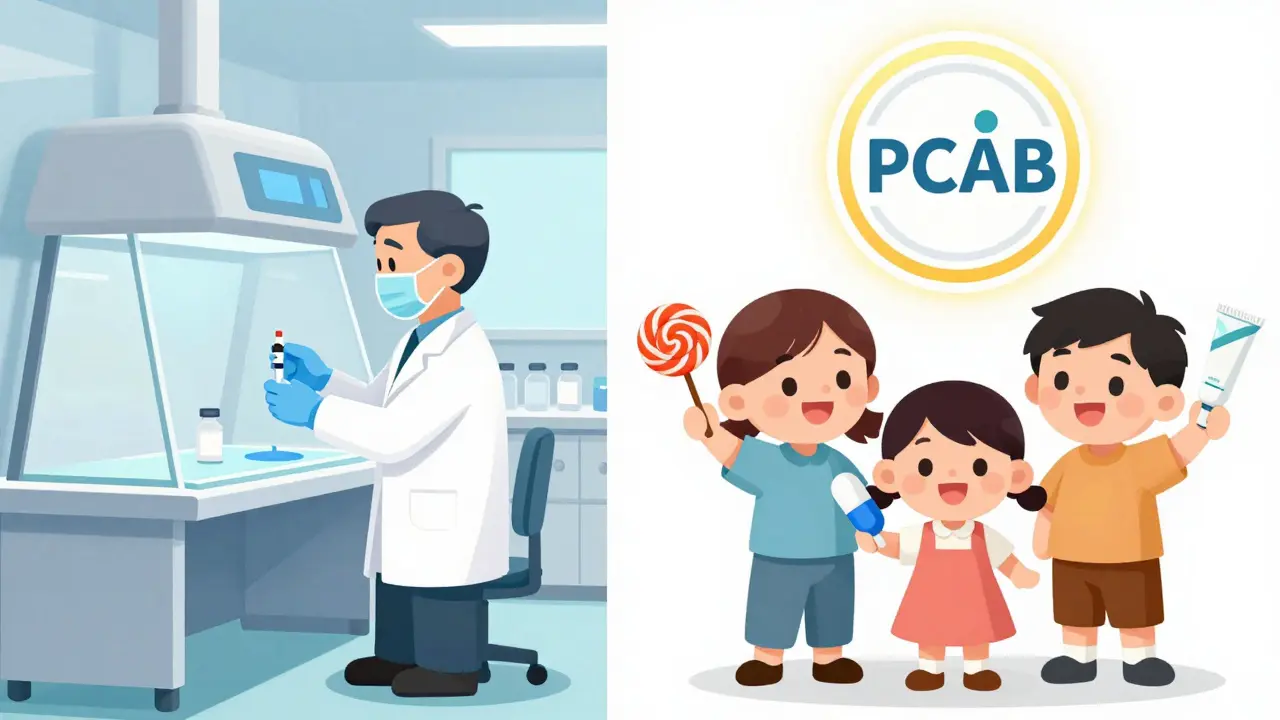
Third, they’re not FDA-approved. That means no large-scale clinical trials. The FDA doesn’t test these drugs before they’re made. Instead, they rely on strict standards - USP <795> for non-sterile compounds and USP <797> for sterile ones. The best pharmacies are accredited by the Pharmacy Compounding Accreditation Board (PCAB). Look for that badge. Only about 1,200 out of 7,500 compounding pharmacies have it.
And finally, don’t use it as a shortcut. Some doctors and patients turn to compounding because it’s “easier” - but that’s risky. The American Pharmacists Association says about 15% of compounded prescriptions could have been filled with FDA-approved drugs. Compounding should be a last resort, not a first choice.
Real Stories: What Patients Say
A mother in Texas shared on Reddit that her 5-year-old had been vomiting every time she took her epilepsy medication. The pill had a bitter coating. The compounding pharmacy made a cherry-flavored liquid. Within a week, her daughter’s seizures dropped by 60%. “She finally sleeps through the night,” the mom wrote.
A man in Florida with chronic pain couldn’t tolerate the sugar in his oral painkiller. His compounding pharmacist made a transdermal gel. He applied it to his wrist. No stomach upset. No drowsiness. He’s been off opioids for two years.
On the flip side, some patients report delays. One user said it took five days to get a compounded thyroid med. Another said their insurance denied coverage twice before they paid $180 out of pocket.
But here’s the kicker: 89% of patients who’ve used compounded medications say they’d recommend them to others with similar needs. Why? Because someone listened. Someone built something just for them.
What’s Changing Now?
Since the 2012 fungal meningitis outbreak - caused by contaminated compounded steroids - regulations tightened. The Drug Quality and Security Act of 2013 created two categories: 503A (traditional compounding pharmacies) and 503B (larger outsourcing facilities). Today, the FDA is updating its guidance again, making it clearer when compounding is allowed during shortages.
Technology is helping too. Digital formulation tools have cut compounding errors by 37%. New stability tests now let some creams last 40% longer. And more pharmacists are using genetic testing to tailor doses - especially for hormone therapy, pain meds, and antidepressants.
The market is growing fast. In 2022, it was worth $11.2 billion. By 2027, it’s expected to hit $15.8 billion. Why? Because drug shortages aren’t going away. And personalized medicine is here to stay.
What Should You Do?
If your medication is unavailable:
- Ask your doctor: “Can this be compounded?”
- Ask your pharmacist: “Do you have a compounding partner?”
- Check if the pharmacy is PCAB-accredited.
- Call ahead - it takes time to make.
- Ask about insurance coverage before you pay.
Don’t assume your local pharmacy can help. Most can’t. But the right compounding pharmacy? They’re often the only bridge between a prescription and a real solution.
It’s not glamorous. It’s not flashy. But when the shelves are empty and your health is on the line, a compounding pharmacy doesn’t just fill a prescription - it saves a life.
Are compounded medications safe?
Yes - if they’re made by a reputable, accredited pharmacy. Compounded drugs aren’t FDA-approved, but they must follow strict standards like USP <795> and <797>. Pharmacies accredited by the Pharmacy Compounding Accreditation Board (PCAB) meet the highest safety and quality benchmarks. Always ask if your pharmacy is PCAB-accredited. Avoid pharmacies that ship nationwide without a prescription or don’t list their accreditation.
Can any pharmacy compound medications?
No. Only about 7,500 U.S. pharmacies specialize in compounding, and even fewer have the equipment and training to do sterile compounding (like injections or IVs). Most retail pharmacies - like CVS or Walgreens - only offer basic compounding, like flavoring liquids or making capsules. For anything complex, you need a dedicated compounding pharmacy.
Why aren’t compounded drugs cheaper if they’re made from scratch?
Because they’re made by hand, one at a time. A regular pill costs pennies to mass-produce. A compounded cream or capsule requires a trained pharmacist, clean rooms, specialized equipment, and hours of labor. Plus, ingredients are often more expensive because they’re not bought in bulk. Insurance rarely covers them fully, so patients often pay more - but for many, the benefit outweighs the cost.
How long does it take to get a compounded medication?
Usually 24 to 72 hours. Simple formulations like flavored liquids or topical creams take a day. Sterile compounds - like injections or IV solutions - can take 3-5 days because they require extra testing and validation. Some pharmacies offer expedited service for urgent cases, but always plan ahead.
Can I get a compounded version of any drug?
No. Compounding works for simple chemical compounds - like antibiotics, hormones, or pain relievers. It can’t make complex biologics like insulin, vaccines, or monoclonal antibodies. These require advanced manufacturing that only large pharmaceutical companies can do. Also, if an FDA-approved version is available and appropriate, pharmacists are legally required to use it - not compound a version.

Scott Easterling
Let me guess-this is just Big Pharma’s way of pushing us toward unregulated, sketchy labs that don’t even follow USP standards. You think they care about your kid’s cherry-flavored liquid? Nah. They’re making bank off scared parents while dodging FDA oversight. And don’t get me started on how these ‘compounding pharmacies’ are just front companies for black-market drug distributors. I’ve seen the reports. The 2012 outbreak? That wasn’t an accident-it was a cover-up. They’re letting these places operate like wild west clinics. You’re not saving lives-you’re gambling with them.
George Vou
compounding is a scam. i mean really. why would you trust some guy in a basement with a mortar and pestle to make your heart med? i had a friend take a compounded thyroid pill and he ended up in the er. turns out the dose was off by 300%. no one checks this stuff. and insurance wont cover it? yeah right. they dont cover it because its a money grab. just use the regular pill. if its out of stock? wait. or switch to a different drug. dont let them turn you into a lab rat.
Leon Hallal
I don't care what you say. This is just another way for pharmacists to charge more. I've been on the same medicine for ten years. Never had a problem. Now they want me to go to some fancy lab because I'm allergic to a dye? That's not medicine. That's greed. And don't tell me about 'personalized care.' I don't need a therapist with a beaker. I need a pill that works. Simple.
rafeq khlo
The systemic failure of pharmaceutical supply chains is a direct consequence of neoliberal deregulation and the commodification of healthcare. Compounding pharmacies are not solutions-they are symptomatic bandages on a hemorrhaging system. The fact that 45 percent of patients pay out of pocket reveals the structural violence embedded in the U.S. medical-industrial complex. Furthermore, the PCAB accreditation metric is a performative illusion of safety, as it lacks federal enforcement authority. One cannot ethically endorse a system that monetizes vulnerability under the guise of patient autonomy.
Morgan Dodgen
Let’s be real-the entire compounding industry is a regulatory loophole exploited by pharmacists who can’t compete with Big Pharma’s economies of scale. You think USP standards mean anything? HA. Most of these places are one guy with a fume hood and a LinkedIn post about ‘holistic healing.’ And don’t even get me started on the 503B outsourcing facilities-they’re just pharma in disguise, repackaging generics with a ‘custom’ label to dodge price caps. I’ve seen the audit logs. The contamination rates are 7x higher than FDA-approved production. And yes, I’ve got the spreadsheets. 😎
Philip Mattawashish
You people are naive. This isn't about allergies or kids who won't swallow pills. This is about control. The FDA doesn't want you to have alternatives because then you'd realize how little they actually regulate. They let drug companies run wild with shortages, then point to compounding pharmacies as the 'solution'-so they can keep their monopoly. And don't think for a second that 'PCAB accreditation' means anything. That's just a paid membership. I know a pharmacist who got his badge after donating $10K to their conference. This isn't healthcare. It's a pyramid scheme with a lab coat.
Tom Sanders
Yeah sure, whatever. I tried a compounded cream once. Took three days. Cost $150. Didn't even work. My doctor said it was 'better for me' but I think he just didn't want to deal with the paperwork. I went back to the regular pill. It's cheaper, faster, and I didn't have to explain my whole life story to a pharmacist who looked like he hadn't slept since 2019. Why make it complicated? It's a pill. Not a SpaceX rocket.
Jazminn Jones
While the article presents a compelling narrative regarding the utility of compounding pharmacies, it conspicuously omits critical discussion regarding the ethical implications of bypassing FDA oversight under the rubric of 'personalization.' The proliferation of non-sterile compounding without standardized batch testing constitutes a violation of the precautionary principle in pharmaceutical safety. Furthermore, the assertion that '89% of patients would recommend'此类服务 is statistically suspect given the absence of peer-reviewed, longitudinal outcome studies. The economic model presented-relying on out-of-pocket expenditure-reinforces healthcare inequity, particularly for marginalized populations. A systemic solution, not a fragmented workaround, is required.