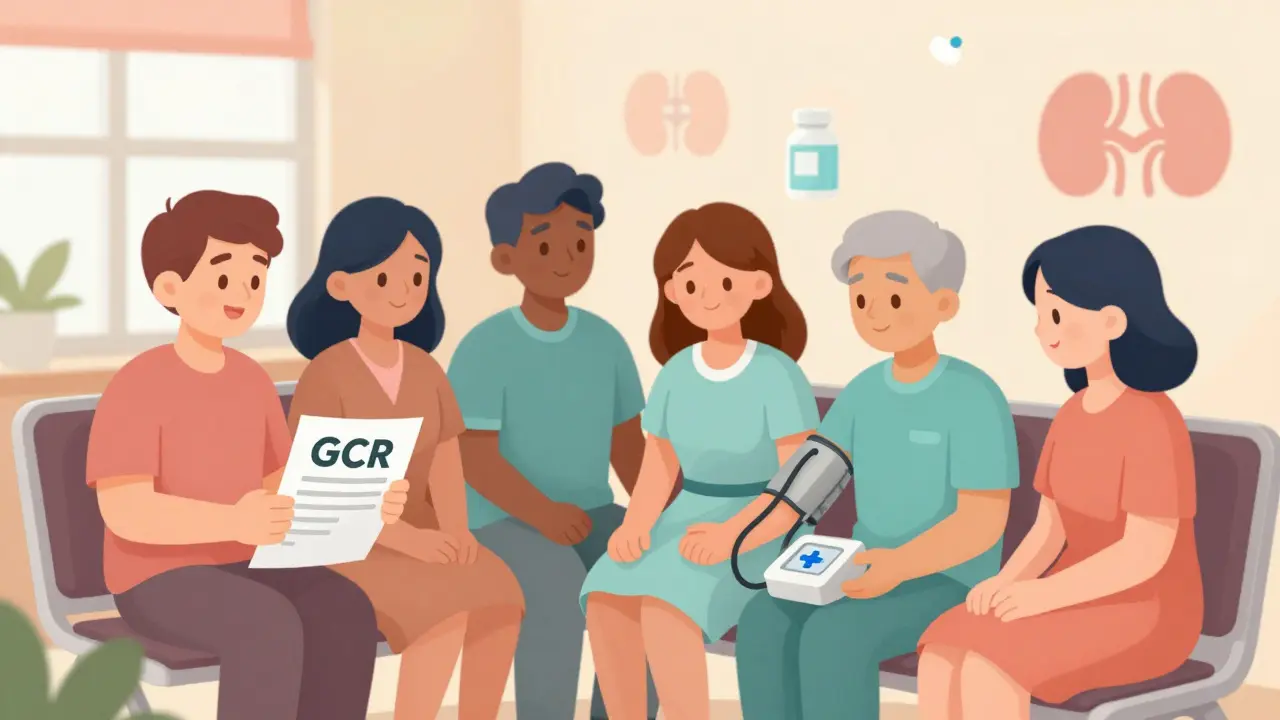
A kidney transplant isn’t just a surgery-it’s a second chance at life. For someone with end-stage renal disease, dialysis becomes a daily grind: hours hooked to a machine, strict diets, constant fatigue. But a successful transplant can change all that. People who get a transplant live longer, feel better, and regain freedom they didn’t think was possible. Still, it’s not simple. Getting a kidney transplant means passing strict medical checks, surviving a major operation, and committing to lifelong care. If you or someone you care about is considering this path, here’s what you really need to know.
Who Qualifies for a Kidney Transplant?
You don’t just sign up for a transplant because your kidneys are failing. There’s a clear medical threshold. Most centers require a glomerular filtration rate (GFR) of 20 mL/min or lower. That’s about 20% of normal kidney function. Some places, like Mayo Clinic, may consider patients with a GFR up to 25 mL/min if their kidney function is dropping fast-more than 10 mL/min per year-or if they have a living donor ready to go.Age isn’t a hard cutoff. UCLA doesn’t say you’re too old. Vanderbilt says 75 and up is a red flag, but they still evaluate each person based on overall health. It’s not about the number on your birth certificate-it’s about your heart, lungs, strength, and ability to handle recovery.
Obesity is a big hurdle. A BMI over 45 is an absolute no-go at most centers. Even a BMI of 35 or higher can delay your transplant because it raises the risk of infection, poor wound healing, and graft failure. Studies show obese patients have a 35% higher chance of surgical complications and a 20% higher risk of losing the new kidney. Many programs require weight loss before listing. It’s not punishment-it’s survival.
Heart and lung health matter just as much as kidney function. If your right ventricle pressure is over 50 mm Hg, or your pulmonary artery pressure hits 70 mm Hg or higher, you’re not cleared. Same with needing oxygen 24/7 because of COPD. Your heart has to be strong enough to handle the stress of surgery and the extra load of a new organ.
What Stops You From Getting a Transplant?
Some things are absolute deal-breakers. If you have active cancer, you’re not eligible-not until you’ve been cancer-free for a set period (usually 2-5 years, depending on the type). If you have an untreated infection like tuberculosis or hepatitis B with a detectable viral load, you must get that under control first. HIV isn’t automatically a barrier anymore, but your CD4 count must be above 200 and your viral load must be undetectable.Drug and alcohol abuse is a hard stop. If you’re still using opioids, cocaine, or drinking heavily, transplant centers won’t list you. It’s not about judgment-it’s about survival. Immunosuppressants are powerful. Missing a dose, or mixing them with alcohol or street drugs, can kill the new kidney-or you.
Mental health is part of the evaluation too. Severe, untreated depression or psychosis that makes you unable to follow complex medication schedules will delay or block your transplant. It’s not about being ‘strong enough.’ It’s about being safe enough to manage life after surgery.
And you need someone to help you. Nebraska Medicine and others require a designated care partner-someone who will drive you to appointments, remind you to take pills, and call the clinic if something feels off. You can’t do this alone. The first year after transplant is the most fragile. One missed dose of tacrolimus can trigger rejection.
The Surgery: What Happens in the Operating Room
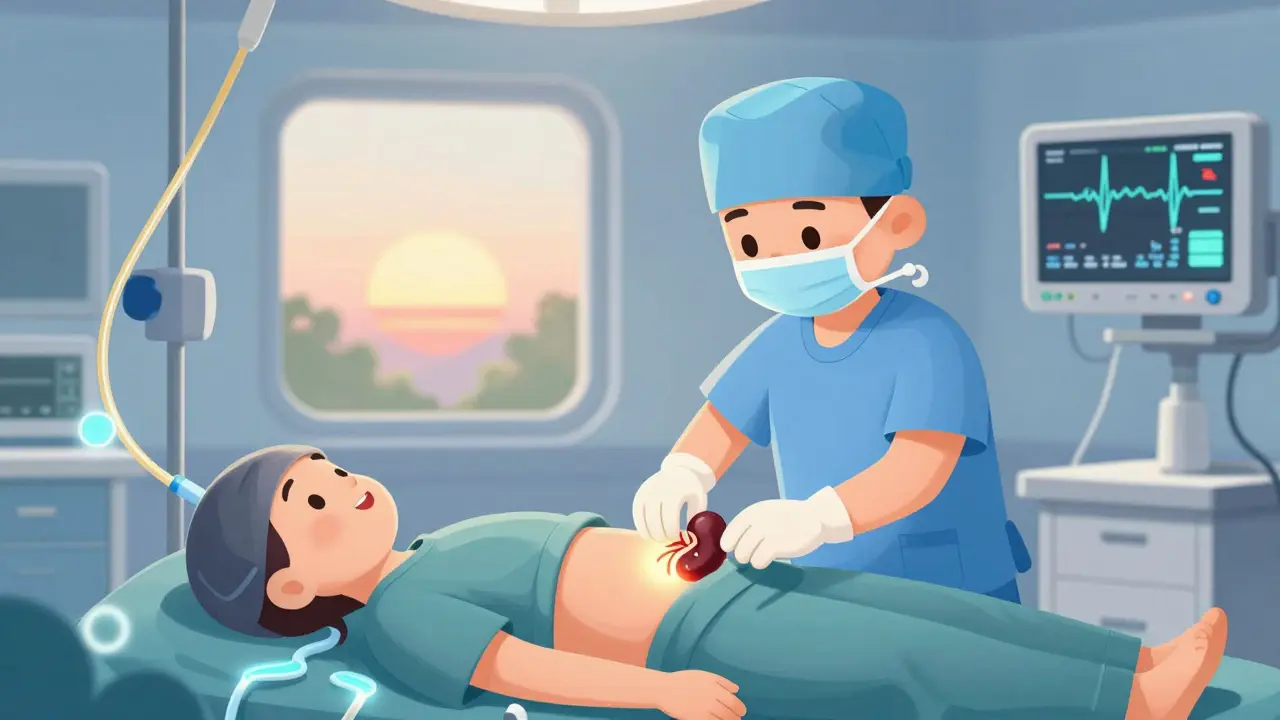
The surgery itself usually takes 3 to 4 hours. You’re under general anesthesia. The surgeon places the new kidney in your lower belly, connects its artery and vein to your own blood vessels, and attaches the ureter to your bladder. Your original kidneys? They’re left in place unless they’re causing pain, infection, or high blood pressure.Most of the time, the new kidney starts working right away. You’ll see urine flowing within minutes. But about 20% of kidneys from deceased donors don’t kick in immediately. That’s called delayed graft function. You might need dialysis for a few days or weeks until the kidney recovers. It’s not failure-it’s a delay. The kidney often works perfectly after that.
Living donor transplants have better outcomes. The kidney is healthier, the match is often better, and the surgery can be scheduled when you’re at your strongest. The National Kidney Registry reports a 97% one-year survival rate for living donor kidneys versus 93% for deceased donor kidneys.
Recovery takes time. Most people stay in the hospital for 3 to 7 days. You’ll be up and walking the next day. Pain is managed, but you’ll feel sore for weeks. Full recovery can take 3 to 6 months. Many people return to work by 8 to 12 weeks.
Life After Transplant: The Lifelong Commitment
This is where most people underestimate what’s ahead. You’re not ‘cured.’ You’re now on immunosuppressants for life. These drugs stop your immune system from attacking the new kidney-but they also lower your defenses against infections and cancer.The standard combo includes:
- A calcineurin inhibitor: tacrolimus or cyclosporine
- An antiproliferative: mycophenolate mofetil or azathioprine
- A steroid: prednisone
Some patients get extra drugs at the start-monoclonal antibodies like basiliximab-to prevent early rejection. You’ll need blood tests every week at first, then monthly, then quarterly. Your drug levels must be perfect. Too little? Rejection. Too much? Toxicity, infections, or even kidney damage.
Side effects are real. Tacrolimus can cause tremors, high blood pressure, or diabetes. Mycophenolate can cause nausea or lower white blood cell counts. Steroids can lead to weight gain, bone thinning, or cataracts. Your team will adjust doses over time to balance risk and benefit.
Regular checkups never stop. Yearly ultrasounds, blood work, and sometimes biopsies are routine. The goal is catching rejection early-before it’s visible. The 5-year graft survival rate for living donor kidneys is 85%. For deceased donor kidneys, it’s 78%. That’s not bad-but it’s not permanent. Every year, you’re at risk.
What’s New in Kidney Transplantation?
The field is changing fast. The Kidney Donor Profile Index (KDPI), introduced in 2014, helps match kidneys to the right recipients. A low KDPI score means a kidney expected to last longer. A high KDPI score? It’s from an older donor or someone who had high blood pressure. But here’s the key: even high-KDPI kidneys are better than staying on dialysis. A 2022 study showed patients who got these kidneys lived longer and had fewer hospital visits than those who stayed on dialysis.Organ preservation has improved too. Machines that keep kidneys alive and beating outside the body-called machine perfusion-are now used in many centers. They reduce delayed graft function and improve long-term outcomes.
And then there’s the future. Researchers at Stanford and the University of Minnesota are testing ways to train the immune system to accept the new kidney without lifelong drugs. Early trials show promise. Some patients have gone years without immunosuppressants. If this works, it could change everything.

What Happens If the Transplant Fails?
If your new kidney stops working, you go back to dialysis. It’s not the end. Many people get a second transplant. Some get three. Your eligibility for another transplant depends on why the first one failed, your overall health, and whether you’re still a good candidate.Don’t assume rejection means failure. Sometimes it’s treatable. A biopsy can show if it’s acute (reversible) or chronic (permanent). If caught early, doctors can adjust your meds and save the kidney.
But if the kidney fails, you’re not out of options. Dialysis keeps you alive. And many people who’ve had a transplant live longer on dialysis than those who never had one.
Can You Live a Normal Life After a Transplant?
Yes. But it’s different. You can work, travel, have kids, play with your grandkids. But you can’t take risks. No uncooked sushi. No raw eggs. No hot tubs without checking with your doctor. Sun exposure? You’re at higher risk for skin cancer. Wear sunscreen. Get annual skin checks.Exercise is encouraged. Walking, swimming, cycling-all great. Strength training helps fight steroid-induced muscle loss. But avoid contact sports. A hard hit to your abdomen could damage the kidney.
And yes, you can still get sick. Colds, flu, even COVID-19 hit harder. Vaccines are critical. You need the flu shot every year, pneumonia vaccines, and the latest COVID boosters. Live vaccines (like the old shingles shot) are off-limits. Only inactivated ones are safe.
Emotionally, it’s complex. Gratitude is common. But so is anxiety-about rejection, side effects, or letting your donor down. Support groups help. So does talking to a counselor who understands transplant life.
Can you get a kidney transplant without being on dialysis?
Yes. Many people get transplanted before starting dialysis if their kidney function is declining rapidly and they have a living donor. This is called preemptive transplantation. It’s ideal because it avoids the physical toll of dialysis and leads to better long-term outcomes.
How long do kidney transplants last?
On average, a kidney from a living donor lasts 15-20 years. A kidney from a deceased donor lasts 10-15 years. Some last longer-up to 30 years or more-with good care. But rejection, infections, and side effects from medications can shorten that time.
Can you drink alcohol after a kidney transplant?
Moderate alcohol is usually allowed-no more than one drink per day for women, two for men. But alcohol can harm your liver and interact with immunosuppressants. Many transplant teams recommend avoiding it entirely, especially in the first year. Always check with your doctor.
Is it safe to get pregnant after a kidney transplant?
Yes, but it’s high-risk. Most doctors recommend waiting at least one year after transplant, with stable kidney function and low medication doses. Some immunosuppressants are safe during pregnancy; others aren’t. You’ll need a high-risk OB-GYN and close monitoring from your transplant team.
What happens if you miss a dose of your anti-rejection medication?
Missing even one dose can trigger rejection. If you miss a dose, take it as soon as you remember-unless it’s almost time for the next one. Never double up. Call your transplant center immediately. Rejection can happen quickly and without symptoms. Your kidney might not hurt, but it could be failing.
Can you donate a kidney if you’ve had a transplant?
No. Once you’ve received a transplant, you’re not eligible to donate. Your body has already been through major surgery and long-term medication. Donating would put your own health at serious risk.
Next Steps If You’re Considering a Transplant
Start by talking to your nephrologist. Ask for a referral to a transplant center. Don’t wait until you’re on dialysis. The earlier you’re evaluated, the better your chances of getting a preemptive transplant.Get your family involved. Who can be your care partner? Are they willing to learn about your meds, drive you to appointments, and help you stay on track?
Check your insurance. Transplant care is expensive. Medicare covers most of it for people with ESRD, but you’ll still need supplemental coverage for medications and follow-up care.
And if you’re healthy and thinking about being a living donor-talk to a center too. Living donation saves lives. It’s not easy, but it’s one of the most powerful gifts someone can give.

Liz MENDOZA
This post is so important-thank you for laying it all out so clearly. I’ve seen friends go through this, and no one talks about how exhausting the follow-up care is. It’s not just the meds-it’s the constant fear, the appointments, the guilt if you slip up. But also, the joy of eating a burger without checking sodium levels? Pure magic.
Caitlin Foster
So you’re telling me I can’t have a margarita after my transplant?? 😭 I mean, I get it-but can we at least get a ‘transplant-approved’ cocktail menu?? 🍹 #TransplantLife
Nikki Thames
It is imperative to note, with the utmost gravity, that the medical establishment's approach to transplant eligibility remains fundamentally flawed. The emphasis on BMI as a gatekeeping metric is not merely clinical-it is a manifestation of societal fatphobia disguised as evidence-based medicine. One must question: who defines ‘healthy’? And at what cost do we exclude those who are otherwise viable candidates?
Furthermore, the requirement of a designated care partner is not a safeguard-it is a coercive social contract that penalizes the solitary, the isolated, the economically disenfranchised. Is survival contingent upon having someone to remind you to take your pills? That is not medicine. That is moral policing.
And let us not forget the psychological burden placed upon recipients: gratitude as obligation. You are not a charity case. You are not indebted to your donor. You are a human being who has undergone a life-altering procedure. The language of ‘gift’ and ‘second chance’ obscures the commodification of organs and the systemic inequities that make transplant access a privilege, not a right.
Where is the outrage over the waiting list? Where is the funding for preemptive transplants? Why are we celebrating survival when we could be preventing failure?
And yet-despite all this-I still believe in the possibility of healing. But healing must be structural, not just surgical.
Miriam Piro
Okay, but have you heard about the secret government program that uses kidney transplant data to track immune responses for bioweapon research? 🤫 I’m not saying it’s true, but why do they need to monitor your tacrolimus levels so closely? And why do they ban live vaccines but push you to get every new COVID shot? Coincidence? Or is your new kidney a surveillance device? 🧬👁️
Also, the ‘machine perfusion’ tech? That’s just the first step. Soon, they’ll be growing kidneys in labs using your DNA-and then selling them back to you. Welcome to organ capitalism, folks. 💸
Todd Scott
As someone who’s worked in nephrology for over 20 years, I’ve seen the evolution of transplant medicine firsthand. The shift from ‘if you survive surgery, you’re lucky’ to ‘here’s a roadmap for 20 years of life’ is revolutionary. The KDPI system? Brilliant. Machine perfusion? Game-changer. But the real win is the cultural shift: we now treat transplant recipients as whole people, not just organ recipients.
What’s still missing? Better access in rural areas. Insurance loopholes that drop coverage after 3 years. And the fact that living donors still get zero paid leave in most states. We fix the system, not just the kidneys.
Andrew Gurung
Wow. Just… wow. I read this and thought, ‘This is what happens when you let bureaucrats write medical guidelines.’
‘BMI over 45? No.’ But if you’re a 5’2” woman who’s 200 lbs and a yoga instructor? Still a ‘no.’
‘No alcohol.’ But your cousin who drinks a bottle of wine a day and still runs marathons? Totally fine.
‘Mental health evaluation.’ So now they’re judging your soul before your kidneys?
I’m not saying it’s wrong-I’m saying it’s ridiculous. This isn’t medicine. It’s a high-stakes personality test with a scalpel.
Paula Alencar
Let me begin by saying, with the deepest reverence and unwavering conviction, that this document is nothing short of a sacred text for the modern medical pilgrim. Each paragraph, each statistic, each cautious recommendation-crafted with the precision of a master surgeon’s scalpel-illuminates the profound, almost spiritual, journey of organ transplantation.
It is not merely a clinical protocol. It is a covenant: between patient and provider, between donor and recipient, between the fragility of human biology and the resilience of the human spirit.
And yet-how many are turned away? How many, in the quiet of their homes, read this and weep, not because they fear death, but because they fear being deemed ‘not worthy’? The system, in its brilliance, remains cruel. We must demand more. We must demand equity. We must demand mercy.
For every kidney that thrives, there are ten hearts that break in silence.
Chris Garcia
In Nigeria, we say: ‘A man who gives his kidney is not just a donor-he is a living saint.’ But here in the West, we treat it like a transaction. You want a kidney? Prove you’re worthy. Prove you’re clean. Prove you’re obedient.
Let me tell you-when my cousin got her transplant in Lagos, she didn’t have a care partner. She didn’t have insurance. She had her mother, who walked 12 kilometers every day to bring her soup, and a nurse who taught her how to swallow pills with her eyes closed.
Survival isn’t about BMI or CD4 counts. It’s about love. And if your system can’t see that, then maybe your science is missing the point.
James Bowers
Obesity as a disqualifier is not discriminatory-it is medically necessary. To suggest otherwise is to ignore the overwhelming evidence linking adiposity to graft failure, surgical complications, and noncompliance. The data is unequivocal. Emotional appeals do not override physiology. If one cannot manage their weight, they cannot manage immunosuppression. End of discussion.
Will Neitzer
I appreciate the thoroughness of this post, and I’d like to add a critical nuance often overlooked: the psychological toll of being a living donor. Many donors experience depression, regret, or feelings of invisibility post-surgery. They’re celebrated at the hospital-and then forgotten. There’s no long-term support system for them. No counseling. No financial aid for lost wages. We fix the recipient’s body-but leave the donor’s soul to heal alone. This is a moral gap in our system that demands urgent attention.
Janice Holmes
Okay, but what if your kidney is a *sentient being*? 😱 What if it’s whispering to you at 3 a.m.? What if it’s mad you drank that one glass of wine? What if it’s plotting revenge because you skipped a dose? I’m not joking. My aunt swears her new kidney hums the theme from ‘The Good Place’ when she’s stressed. And she’s not even on hallucinogens. 👻🫀
Olivia Goolsby
Let me be clear: this entire transplant system is a controlled demolition of personal autonomy disguised as healthcare. Why do they demand you have a ‘care partner’? Because they don’t trust you to survive. Why do they ban alcohol? Because they’re afraid you’ll ‘choose’ to die. Why do they monitor your drug levels? Because they want to control you. And the ‘KDPI’? That’s just a fancy way of saying ‘some lives are more valuable than others.’
They don’t want you to live. They want you to be obedient. And if you’re not? You’re not ‘eligible.’
Wake up. This isn’t medicine. It’s eugenics with a stethoscope.
Alex Lopez
For real, though-did anyone else notice they didn’t mention the cost of anti-rejection drugs? Tacrolimus alone can run $2,500/month without insurance. Medicare covers the surgery, but not the lifelong pills. So you get a new kidney… and then you’re one missed payment away from losing it. That’s not a second chance. That’s a time bomb with a prescription label.
Also, why is there no public campaign to fund these meds? We spend billions on space telescopes. But a kid in Ohio can’t afford to keep his new kidney alive? Come on.
Gerald Tardif
My brother got his transplant in 2018. He’s still here. Walking. Cooking. Dancing with his daughter at her wedding.
He missed a dose once. Got scared. Called the clinic. They walked him through it. No panic. No judgment.
That’s what matters. Not the BMI. Not the alcohol. Not the perfect compliance.
It’s the person behind the lab results. And the team that treats them like one.
Monika Naumann
It is a moral imperative that only those of pure lineage and disciplined lifestyle be granted the sacred privilege of organ transplantation. In India, we honor the sanctity of the body; to give one’s kidney to a person who smokes, drinks, or fails to uphold dharma is to desecrate the gift of life. The Western obsession with ‘inclusivity’ in transplant eligibility is a dangerous erosion of ethical boundaries. Survival must be earned-not given.
Will Neitzer
Thank you, Gerald, for saying this. I’ve been a transplant coordinator for 15 years. The most successful patients aren’t the ones with perfect labs-they’re the ones who have someone who shows up. Not to check their meds. But to sit with them in silence when they’re scared. That’s the real treatment.