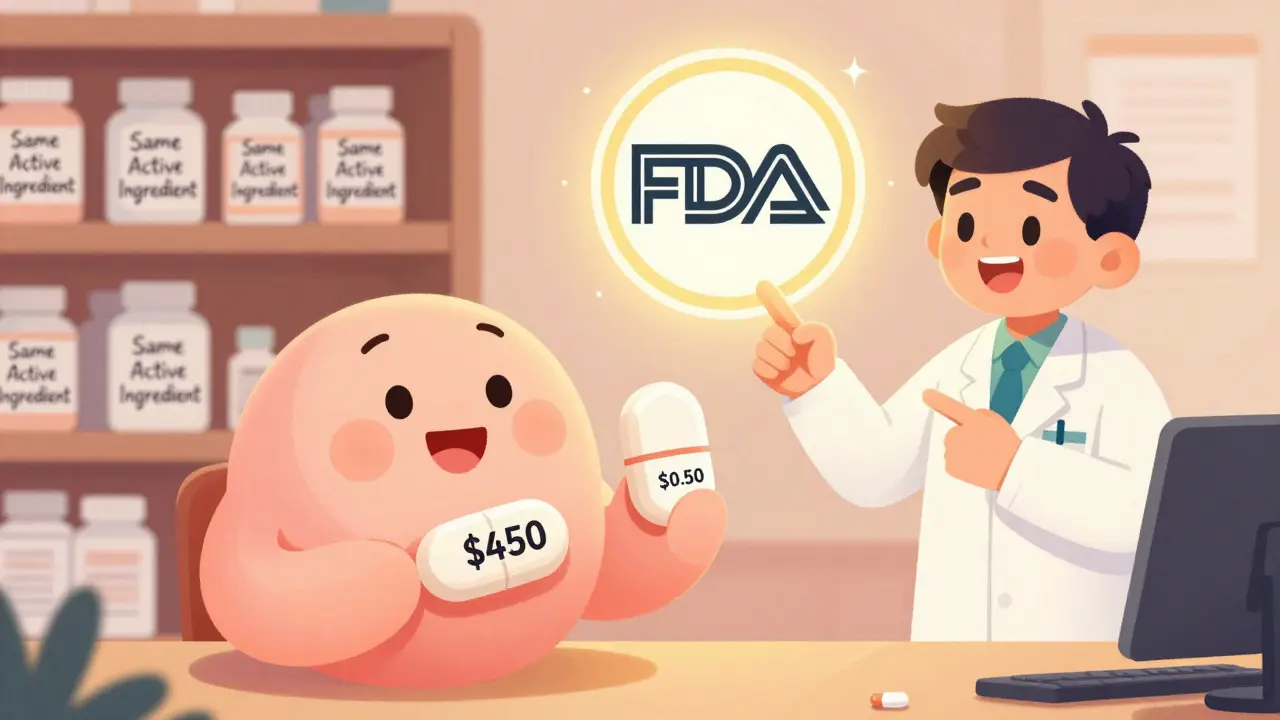
Switching to generic medications can cut your prescription costs by 90%-sometimes from hundreds of dollars down to under a dollar per pill. But a lot of people worry: Is it really the same? Can you trust a pill that costs less to work just as well? The short answer is yes-for most people, most of the time. The science, the regulations, and the real-world data all point to one thing: generics are not cheaper because they’re worse. They’re cheaper because they don’t need to repeat expensive marketing, patents, or clinical trials.
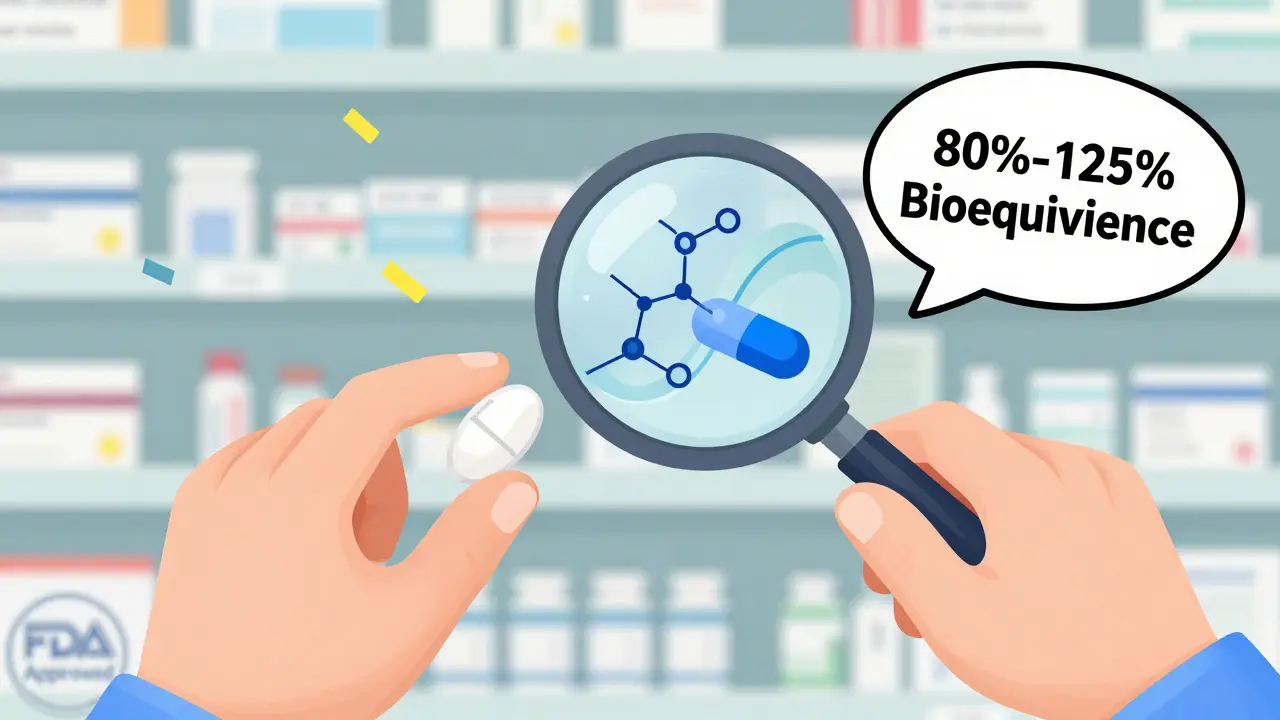
The U.S. Food and Drug Administration (FDA) doesn’t approve a generic drug unless it matches the brand-name version in every way that matters: same active ingredient, same strength, same dosage form, same route of administration, and same therapeutic effect. That means if your brand-name drug is 10 mg of lisinopril taken once daily by mouth, the generic has to be exactly that. No more, no less. The FDA requires bioequivalence testing in healthy volunteers, proving the generic absorbs into your bloodstream at the same rate and to the same extent as the brand. The acceptable range? Between 80% and 125% of the brand’s levels. For most drugs, that’s a tight enough margin to guarantee identical results.
Why Generics Cost So Much Less
Brand-name drugs aren’t expensive because they’re better. They’re expensive because the company that invented them spent years and millions developing the drug, running clinical trials, and getting FDA approval. Once the patent expires (usually after 14-17 years), other companies can make the same drug. They don’t need to repeat the expensive trials. All they have to prove is that their version works the same way in your body. That’s why a 30-day supply of brand-name Lipitor (atorvastatin) might cost $450, while the generic costs less than $0.50 at major U.S. pharmacies. That’s not a scam. That’s how competition works.
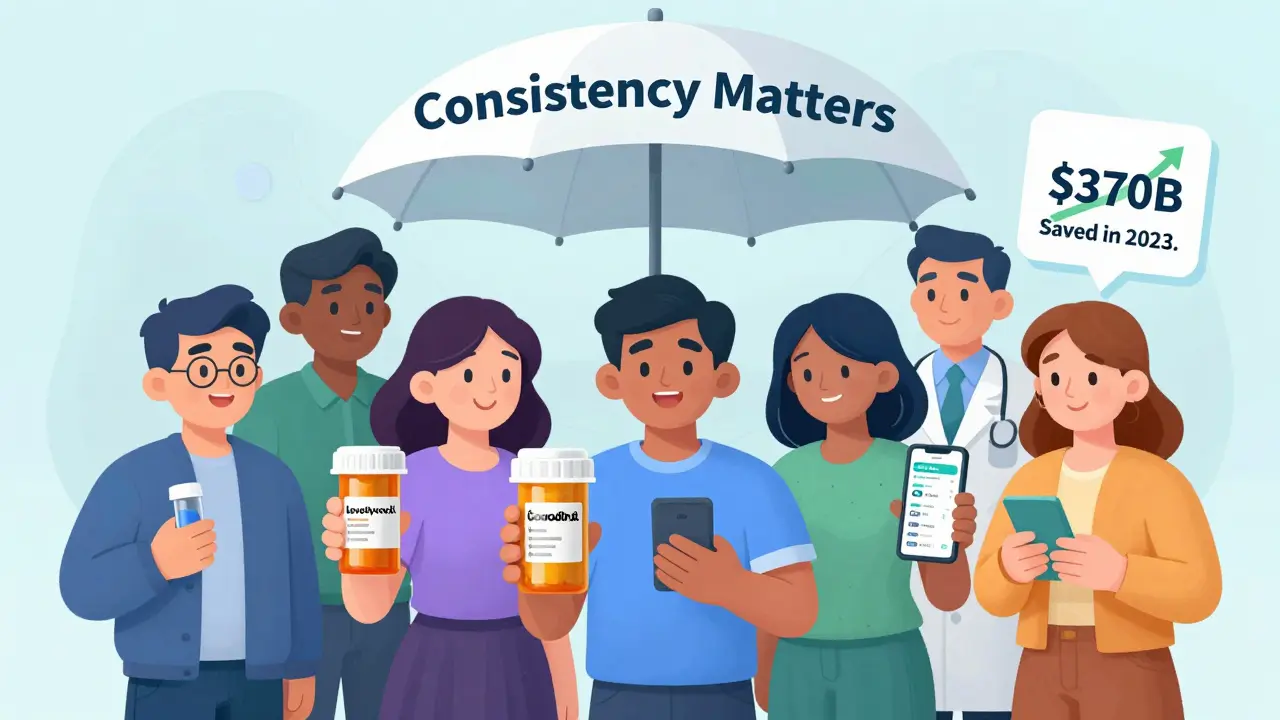
The savings add up fast. A 2023 report from the Association for Accessible Medicines found that generics saved the U.S. healthcare system $370 billion in a single year. That’s not theoretical. That’s money taken out of your pocket, your insurance bill, and your out-of-pocket costs. In Australia, where you pay a co-payment for PBS-listed medications, generics are automatically dispensed unless your doctor specifically writes "Do Not Substitute."
Are Generics Always Safe? The Exceptions
Most of the time, yes. But there are a few drugs where small differences matter more. These are called narrow therapeutic index (NTI) drugs. That means the difference between a dose that works and a dose that’s dangerous is very small. Examples include:
- Warfarin (blood thinner)
- Levothyroxine (thyroid hormone)
- Phenytoin (anti-seizure)
- Cyclosporine (immunosuppressant)
For these, the FDA requires even tighter bioequivalence-between 90% and 111%-to ensure stability. Even then, studies show that switching between different generic manufacturers of levothyroxine can cause small fluctuations in thyroid hormone levels. A 2023 Drugs.com review of over 1,800 patient reports found 23% of users on generic levothyroxine reported inconsistent symptoms, compared to only 8% on Synthroid. That doesn’t mean generics are unsafe. It means consistency matters. If you’re stable on one brand, stick with it.
Some studies have looked at statins (cholesterol drugs) and found slightly higher risks of heart events with generics-but newer data from a 2024 University of California study tracking 2.3 million patients shows that when patients stay on the same generic manufacturer, the risk disappears. The problem isn’t the generic. It’s switching manufacturers repeatedly.
What You Can Do to Stay Safe
Here’s how to use generics safely and save money without guesswork:
- Ask your pharmacist: When you pick up your prescription, ask: "Is this the same manufacturer as last time?" If it changed, ask why. A simple switch in manufacturer can cause side effects in sensitive patients.
- Check the pill: Generics often look different-different color, shape, or imprint. Use the FDA’s Drugs@FDA database to look up your drug and see what each manufacturer’s pill should look like. If your pill suddenly changes shape and you feel off, call your pharmacist.
- Don’t switch manufacturers unless necessary: For NTI drugs, stick with one generic brand. If your pharmacy switches you without warning, ask them to keep you on the same one. Most pharmacies will honor that request.
- Monitor how you feel: If you start feeling dizzy, tired, or your symptoms return after switching to a generic, don’t ignore it. Talk to your doctor. It might not be the drug-it might be the filler. But it’s worth checking.
- Use price comparison tools: Apps like GoodRx or SingleCare show you the lowest cash price for your generic across nearby pharmacies. Sometimes the cheapest option isn’t even the one your insurance prefers.
What Experts Say
Dr. Niteesh Choudhry, director of the Center for Population Health at Brigham and Women’s Hospital, says: "There is really no hard proof that generic medications are any less effective or safe than the originals." The FDA’s own director of generic drugs, Sally Seifert, confirmed in 2023 that after reviewing over 12,000 generic applications, "generic drugs have the same risks and benefits as their brand-name versions." But experts also agree: consistency is key. A 2012 study in the Journal of Clinical Pharmacology found that when patients switched between brand and generic versions, 30% had no change, 30% felt better, 10% had side effects, and 30% stopped taking the drug entirely. That last group didn’t quit because the drug didn’t work. They quit because the pill looked different, they got confused, or they heard rumors.
The Bigger Picture
Generics aren’t just about saving money. They’re about access. In 2023, 90% of all prescriptions filled in the U.S. were for generics. That’s because they make treatment possible for people who otherwise couldn’t afford it. A 2024 survey found that 89% of people who switched to generics stayed on their medication, compared to only 67% who stayed on brand-name drugs because they were too expensive.
And it’s not just pills. Biosimilars-complex generic versions of biologic drugs like Humira or Enbrel-are now entering the market. These are used for cancer, arthritis, and autoimmune diseases. They’re not cheap yet, but they’re already saving billions. By 2030, they’re expected to save $300 billion.
The bottom line: if your doctor says it’s okay, and your pharmacist confirms it’s FDA-approved, a generic is almost certainly safe. The biggest risk isn’t the drug-it’s switching back and forth between brands. If you’re stable, stay put. If you’re cost-sensitive, ask for the generic. And if you notice a change in how you feel, speak up.
Are generic drugs really as effective as brand-name drugs?
Yes, for the vast majority of medications. The FDA requires generics to contain the exact same active ingredient, in the same strength and dosage form, and to be absorbed into the bloodstream at the same rate and extent as the brand-name drug. Studies involving millions of patients show no meaningful difference in effectiveness for drugs like blood pressure medications, antibiotics, or antidepressants. The main exceptions are narrow therapeutic index drugs like levothyroxine or warfarin, where small variations matter more-so consistency in manufacturer is key.
Why do generic pills look different?
Generic drugs are allowed to have different colors, shapes, and inactive ingredients (like fillers or dyes) because those don’t affect how the drug works. The law only requires the active ingredient to match. That’s why your generic lisinopril might be a white oval pill instead of a blue capsule. If the appearance changes suddenly, check the imprint code on the pill and verify it against the FDA’s Drugs@FDA database. A change in manufacturer is normal-but if you feel different after the switch, talk to your pharmacist.
Can I switch between different generic manufacturers?
For most drugs, yes. But for narrow therapeutic index drugs like levothyroxine, warfarin, or phenytoin, frequent switching between manufacturers can cause small changes in blood levels that may lead to side effects or loss of effectiveness. The best practice is to stick with one generic manufacturer once you find one that works. If your pharmacy switches your prescription without telling you, ask them to keep you on the same one. You have the right to request consistency.
Why are some generics more expensive than others?
Price differences come down to supply, demand, and manufacturing costs. If only one company makes a generic, it can charge more. When multiple manufacturers enter the market, prices drop sharply. Sometimes, a generic made overseas costs less than one made in the U.S. But both are FDA-approved and equally safe. Use price comparison tools like GoodRx to find the lowest cash price, regardless of brand. Insurance formularies don’t always pick the cheapest option-so check outside your plan.
Is it safe to use generics if I’m on multiple medications?
Yes, as long as your pharmacist and doctor are aware of all your medications. The biggest risk isn’t the generic itself-it’s interactions between drugs. If you’re taking five or more medications, ask for a medication review. Some drug combinations can be sensitive to small changes in absorption. If you notice new side effects after switching to a generic, don’t assume it’s unrelated. Bring it up with your provider. Many pharmacies now offer free medication therapy management services to help with this.

lela izzani
Generics saved me over $2,000 last year on my blood pressure meds. I was skeptical at first, but my doctor explained the FDA rules and I checked the pill imprint myself. Same active ingredient, same results. No dizziness, no weird side effects. Just cheaper and just as effective. I wish more people knew this.
John Smith
So you're telling me I'm paying $400 for a pill that's literally the same as the $0.30 version? Wow. My insurance company is literally robbing me. I'm switching tomorrow. No more brand-name nonsense. This is why America is broke.
Brandice Valentino
I switched to generic levothyroxine and felt like a zombie for 3 weeks. My doc said it was 'just adjustment' but I know better. Now I only take Synthroid. Don't let them fool you. The fillers are sketchy. I read it on the internet so it must be true lol
David McKie
Oh for god's sake. Another one of these 'generics are fine' propaganda pieces. You know what happens when you switch manufacturers on warfarin? You end up in the ER with a hemorrhage. Or worse-on the floor. I’ve seen it. I’ve seen families cry. And now you want me to believe that 80-125% bioequivalence is somehow 'safe'? That’s not science. That’s gambling with people’s lives. The FDA doesn’t regulate the fillers. The fillers can be toxic. I’ve seen generics with talc that should’ve been banned in 1987. Stop pretending this is a win for the public. It’s a win for Big Pharma’s bottom line.
Shalini Gautam
In India we use generics every day and they work great! My mom takes her BP med and it's half the price. We don't have fancy apps like GoodRx but we know what works. If your body feels okay, then it's okay. Don't overthink it. Also, Indian-made generics are FDA-approved too! 🇮🇳💪
Christina VanOsdol
OMG I switched to generic Zoloft last year and I swear I felt like a different person 😭😭😭 I went from 'functioning adult' to 'crying in the shower because my cat looked at me wrong'... I went back to brand and now I'm back to normal. I'm not crazy. I'm just sensitive. And apparently so are 23% of levothyroxine users. So yeah. Don't play Russian roulette with your mental health. 🤯💊 #genericstruggles
Michael FItzpatrick
Let’s not turn this into a fearfest. Generics are one of the greatest public health wins of the last 50 years. They’re not magic. They’re not perfect. But they’re science-backed, FDA-vetted, and life-changing for millions who otherwise couldn’t afford treatment. I’ve worked in rural clinics where people chose between insulin and groceries. Generics didn’t just save money-they saved lives. The occasional weird reaction? Yeah, it happens. But the solution isn’t to panic-it’s to track your pills, ask your pharmacist, and stick with one manufacturer. That’s not hard. That’s responsibility. And if you’re scared? Talk to your doctor. Not Reddit. Not TikTok. A real human with a medical degree.
Brooke Exley
You got this!! 💪 Switching to generics is one of the smartest financial moves you can make-and it doesn’t mean sacrificing your health. I’ve helped dozens of clients make the switch safely. Here’s the secret: consistency is king. Find one manufacturer you trust, stick with it, and if the pill looks different? Call your pharmacy. Ask for the batch number. Know your stuff. You’re not being paranoid-you’re being empowered. And hey, if you feel off? That’s your body talking. Listen. Speak up. You’re not just saving money-you’re taking control of your health. Go you!! 🎉🩺
Valerie Letourneau
While I appreciate the general sentiment of cost containment through generic substitution, I must emphasize that the regulatory frameworks governing bioequivalence, while rigorous, are not universally harmonized across jurisdictions. In Canada, for instance, Health Canada employs a slightly different statistical threshold for bioequivalence, and the interchangeability of generics is subject to provincial formulary policies. Furthermore, the presence of excipients-while inert in most cases-can elicit idiosyncratic reactions in pharmacogenetically sensitive populations. A blanket assertion of equivalence, while statistically valid, may overlook individual physiological variability. Therefore, while generics are generally appropriate, personalized clinical judgment remains paramount.
Southern Indiana Paleontology Institute
Yall act like generics are some kind of scam. We got the same damn pill. Just cheaper. My cousin in Texas takes his generic statin and he’s fine. I took mine for 5 years. No problems. Stop being drama queens. America is broke because you think everything has to be branded. Get a grip.
Khaya Street
I have been taking generic metformin for six years. No issues. I also work in a clinic in Johannesburg. We use generics for HIV, diabetes, hypertension. People live longer. They work. They raise children. The fear is manufactured. The savings are real. The science is clear. Do not let fear drive your health decisions.
Natanya Green
I just switched to generic omeprazole and now I’m having weird heartburn?? 😭 I thought it was supposed to be the SAME!! Why does it feel like my stomach is doing yoga?? I called my pharmacy and they said ‘it’s just a different filler’… but I’m not a lab rat!! I want my old blue pill back!! 😩💕 #genericproblems #heartburnhellscape