Every year, hundreds of thousands of patients in U.S. hospitals suffer harm because of medication errors - mistakes that shouldn’t happen. These aren’t rare accidents. They’re systemic failures that happen because of unclear labels, rushed workflows, or outdated systems. And the worst part? Most of them are preventable.
What Counts as a Medication Error?
A medication error isn’t just giving the wrong pill. It’s any mistake that happens while a drug is under the control of a healthcare provider, pharmacist, or even the patient. That includes wrong dose, wrong patient, wrong route, wrong timing, or even giving a drug that interacts badly with another. The American Society of Health-System Pharmacists defines it simply: any preventable event that could cause harm.One of the most shocking facts? Studies from the 1990s still hold true today: on average, each hospital patient experiences at least one medication error per day. That’s not one error per month. Not one per week. Per day. And about 7,000 people die each year in U.S. hospitals because of these mistakes. Many of those deaths are tied to just a few high-risk drugs - insulin, opioids, anticoagulants, and chemotherapy agents like methotrexate.
The Big Three: High-Alert Medications
Some drugs are so dangerous that even a tiny mistake can kill. These are called high-alert medications. The Institute for Safe Medication Practices (ISMP) keeps a public list, and hospitals are required to identify them locally based on their own error reports.Three of the most dangerous:
- Insulin - Too much causes dangerous low blood sugar. Too little leads to diabetic ketoacidosis. Even a decimal point error - 10 units instead of 1.0 - can be fatal.
- Opioids - Used for pain, but they suppress breathing. Giving the wrong dose to an elderly patient or someone with sleep apnea can stop their lungs.
- Methotrexate - A chemotherapy drug. If given daily instead of weekly, it causes bone marrow failure. One patient died after a nurse accidentally gave it every day for weeks because the electronic system didn’t block it.
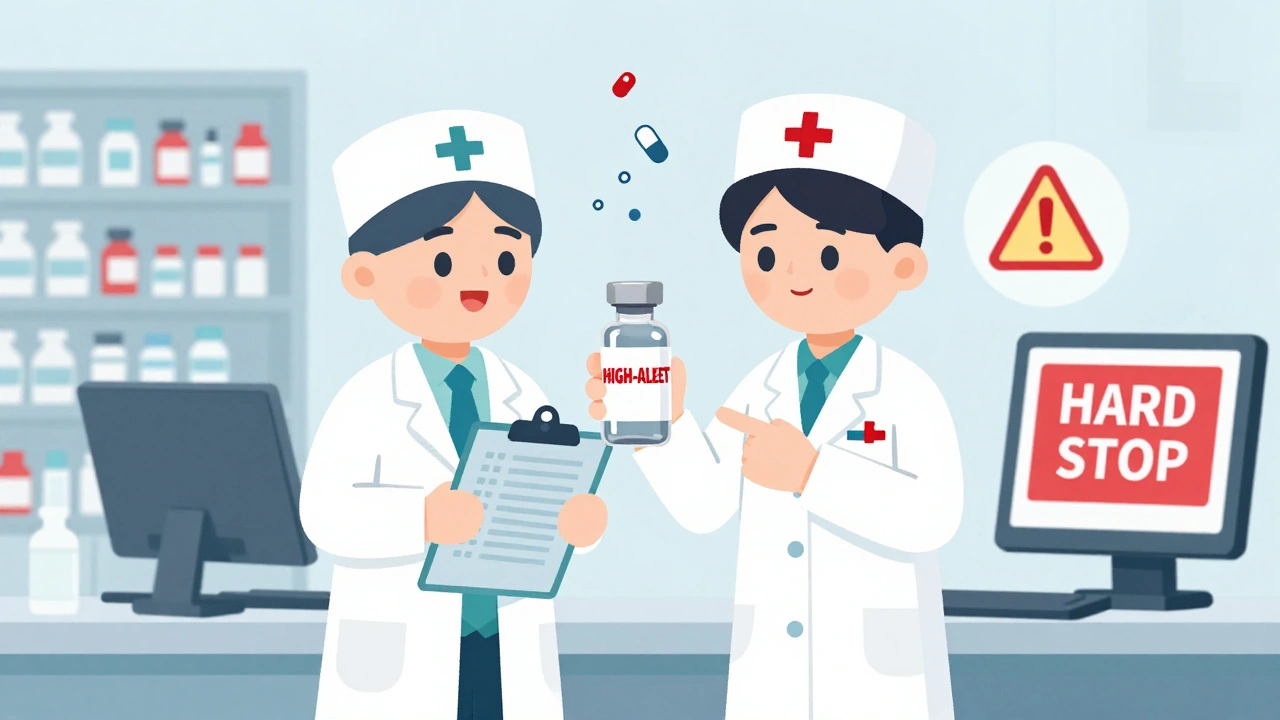
Hospitals that use hard stops in their electronic systems - where the computer refuses to allow a daily methotrexate order unless a doctor confirms it’s for cancer - have cut those errors by over 80%. Dr. Robert Wachter from UCSF says this single fix has prevented about 1,200 serious errors every year.
How Systems Fail - And How to Fix Them
Medication errors don’t happen because nurses are careless. They happen because systems are broken.Consider this: a nurse walks into a room to give a patient their morning meds. The patient’s wristband says “John Smith.” The chart says “John Smith.” The barcode on the pill bottle matches. But the patient is actually “Jon Smith” - spelled with one ‘h’. The system didn’t catch it. The nurse didn’t notice. The error slipped through.
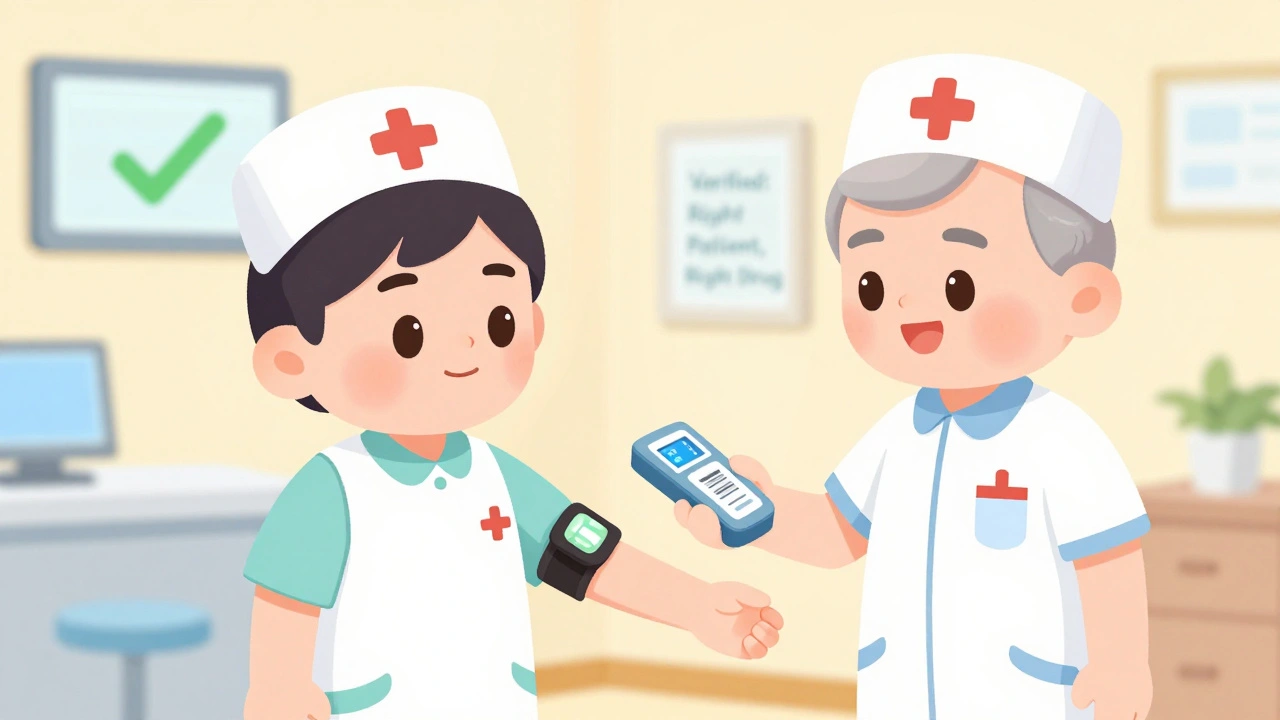
That’s why the Right Patient Check is non-negotiable. It’s not enough to check the name. You must verify two identifiers - name and date of birth - and match them to the wristband. A 2022 survey by the National Council on Aging found that 68% of older patients felt safer when this double-check was done consistently.
Another fix? Barcode medication administration (BCMA). This system requires nurses to scan the patient’s wristband and the drug’s barcode before giving any medication. Hospitals with full BCMA use see 55% fewer serious errors than those without it, according to the Agency for Healthcare Research and Quality.
But here’s the catch: 54% of small hospitals (under 100 beds) still don’t use BCMA. Why? Cost. Training. Outdated electronic health records. One pharmacy director in a rural hospital told me their system couldn’t create hard stops for high-alert drugs because the vendor wouldn’t update the software. So they started having pharmacists manually review every insulin order. It added time, but it saved lives.
What Hospitals Are Doing Right - And What They’re Not
The ISMP Targeted Medication Safety Best Practices for Hospitals (2020-2021) is the gold standard. It’s not a vague guideline. It’s 19 specific, actionable rules. For example:- Never allow glacial acetic acid in hospital areas - it looks like water but can burn tissue on contact.
- Use only pre-mixed IV bags of oxytocin in labor and delivery - no one should be mixing it by hand.
- Require dual verification for high-alert drugs like heparin and morphine - two trained staff must check the dose before giving it.
Hospitals that follow all 19 practices reduce preventable harm by 37% compared to those following only general safety goals from the Joint Commission. But here’s the problem: only 42% of community hospitals fully implement all ISMP practices. Academic medical centers? 78%. The gap isn’t about skill - it’s about resources.
Implementation costs an average of $285,000 per hospital. That’s a lot for a small clinic. But the cost of not fixing it? The Institute of Medicine estimates medication errors cost the U.S. healthcare system $21 billion a year. That’s more than the annual budget of many small states.
The Human Factor: Staff Burnout and Workarounds
No system works if the people using it are exhausted.A nurse manager in a rural hospital posted on the American Nurses Association forum: “The requirement for written and verbal discharge instructions for methotrexate created huge delays. We had one pharmacist trying to educate 20 patients a day. We were behind. Patients got frustrated. We started cutting corners.”
That’s the hidden cost of safety rules. When they’re poorly designed, they create workarounds - and workarounds are where errors hide. A nurse might skip scanning a barcode because the scanner keeps failing. A pharmacist might skip a double-check because they’re short-staffed. These aren’t rebellions. They’re adaptations to broken systems.
The fix? Involve frontline staff in designing safety protocols. Don’t just hand them a policy. Ask: “What’s making this hard?” Then build the solution around their reality.
What’s Changing in 2025?
Medication safety isn’t standing still.In 2023, the FDA updated labeling rules for high-concentration electrolytes - things like potassium chloride. Now, the packaging must show the concentration in bold, clear text. Full compliance is required by December 31, 2024.
The ISMP is also expanding its Best Practices to include outpatient clinics. Why? Because medication errors are rising outside hospitals. Between 2018 and 2022, reported errors in ambulatory settings jumped 47%. Patients are getting prescriptions filled at pharmacies, taking multiple drugs at home, and not understanding instructions.
And then there’s AI. Gartner predicts that by 2025, 75% of U.S. hospitals will use artificial intelligence to catch medication errors in real time. Right now, only 22% do. These systems can flag a potential drug interaction, spot a dose that’s too high for a patient’s weight, or even notice if a patient has been given the same drug twice in 24 hours.
At Mayo Clinic and Johns Hopkins, pilot programs are now asking patients to review their own medication lists before discharge. Patients caught 32% more errors than staff did - things like wrong doses, missing refills, or drugs they were allergic to. The future of safety isn’t just about technology. It’s about trusting the patient.
What You Can Do - Whether You’re a Patient or Provider
If you’re a healthcare worker:- Always use two patient identifiers - never just the name.
- Ask: “Is this a high-alert drug?” If yes, double-check.
- Speak up if a system feels unsafe. Don’t assume someone else will fix it.
- Push for barcode scanning and hard stops. If your EHR can’t do it, demand it.
If you’re a patient or family member:
- Bring a list of all your medications - including vitamins and supplements - to every appointment.
- Ask: “What is this drug for? What side effects should I watch for?”
- Check your wristband before any medication is given. Make sure your name and birth date are correct.
- Don’t be afraid to say: “I think there’s a mistake.”
Medication safety isn’t about blame. It’s about building systems so that even when people make mistakes, the system catches them. That’s the goal. And it’s possible - if we stop treating safety as an add-on and start treating it as the foundation.
What is the most common cause of medication errors in hospitals?
The most common cause isn’t human error alone - it’s system failure. Poorly designed electronic health records, lack of barcode scanning, unclear drug labels, and absence of hard stops for high-alert medications create opportunities for mistakes. Even trained staff can misread similar-looking drug names (like hydralazine and hydroxyzine) if the system doesn’t help them catch it.
How do I know if my hospital follows proper medication safety practices?
Look for three things: 1) Nurses scan your wristband and the medication barcode before giving you a drug. 2) High-alert drugs like insulin or morphine require two staff members to verify the dose. 3) You’re asked to review your medication list before discharge and given clear written instructions. If you don’t see these, ask why. Hospitals that follow ISMP Best Practices make this visible to patients.
Why is methotrexate so dangerous if given daily instead of weekly?
Methotrexate is a chemotherapy drug meant to be taken once a week. When taken daily, it builds up in the body and shuts down bone marrow function - leading to severe drops in white blood cells, platelets, and red blood cells. This causes life-threatening infections, bleeding, and anemia. One patient died after receiving daily doses for three weeks because the electronic system didn’t block the order. Now, hard stops require a doctor to confirm cancer diagnosis before daily dosing is allowed.
Are medication errors more common in clinics or hospitals?
Historically, hospitals had more errors because of complex drug regimens. But since 2019, outpatient clinics have seen a 40% rise in medication errors - mostly from incorrect prescriptions, poor communication between providers, and patients taking multiple drugs without proper education. The ISMP is now updating its safety guidelines to include outpatient settings because the problem is growing fast.
What role do patients play in preventing medication errors?
Patients are the last line of defense. Studies show that when patients review their own medication lists before discharge, they catch 32% more errors than staff do. This includes noticing wrong doses, missing drugs, or drugs they’re allergic to. Don’t assume the system got it right. Ask questions. Bring a list. Speak up.

Carole Nkosi
Let’s be real - this whole ‘system failure’ narrative is just corporate gaslighting. Nurses aren’t saints, and hospitals aren’t victims. They’re profit centers that cut corners to maximize shareholder returns. You think they don’t know about barcode scanning? They know. They just don’t care until someone dies. And then they slap on a ‘best practice’ sticker and call it progress. Wake up. This isn’t about tech - it’s about power.
Jennifer Patrician
So you’re telling me the FDA just changed potassium chloride labels in 2023… but nobody’s talking about how the same companies that make these drugs also lobby Congress to block mandatory AI audits? And that the same EHR vendors who refuse to update hard stops are the ones donating to every hospital board member’s reelection campaign? This isn’t incompetence - it’s a cartel. The ‘patient as last line of defense’? That’s not safety. That’s exploitation dressed up as empowerment.
Deborah Jacobs
I’ve worked ER nights for 17 years. I’ve seen the barcode scanner die mid-shift because the hospital refused to replace the $200 device. I’ve watched a nurse cry because she had to choose between scanning meds or getting a patient to the bathroom before they soiled themselves. The system isn’t broken - it’s starved. And the people fixing it? They’re the ones getting yelled at for ‘not following protocol’ while the admin office buys a new yacht. This isn’t about methotrexate or insulin - it’s about dignity. Stop treating nurses like disposable cogs and start treating them like the humans who keep you alive.
Krishan Patel
It is not acceptable that patients are expected to act as medical auditors. This is a fundamental abdication of professional responsibility. The Hippocratic Oath mandates competence, not crowd-sourced verification. If a hospital cannot guarantee accurate medication administration through trained personnel and properly engineered systems, then it has no business operating. The fact that patients must now double-check their own prescriptions is not innovation - it is institutional failure on a moral level. Furthermore, the assertion that AI will solve this by 2025 is statistically naive. AI cannot replace human judgment in complex polypharmacy scenarios without extensive validation - which no vendor is providing.
Stephanie Bodde
Y’all are so right. 😔 I just had a patient yesterday who said, ‘I didn’t know this pill was supposed to be weekly’ - and she’d been taking it daily for 3 weeks. We caught it because she asked. But why did she have to? I’m so proud of her for speaking up. 🙌 You’re not being ‘difficult’ - you’re saving your own life. Keep asking. Keep checking. We’re here for you. 💙
Philip Kristy Wijaya
The real issue here is that we’ve allowed bureaucracy to replace clinical judgment and now we’re blaming the system when people die but nobody wants to admit that the system was designed by people who never set foot in a hospital and the only thing they care about is reducing liability not saving lives and yes I know this sounds dramatic but when your grandmother gets the wrong dose of morphine because the software glitched and no one had time to fix it because they were too busy filling out compliance forms then you realize this isn’t about tech it’s about a culture that values paperwork over people
luke newton
You think this is about medication errors? No. This is about the slow death of American healthcare. Every time you say ‘double-check’ or ‘barcode scan’ you’re just patching a sinking ship. The real problem? We let insurance companies dictate care. They don’t pay for pharmacists to review every order. They don’t pay for extra nurses. They don’t pay for training. They pay for profit margins. And now we’re surprised when people die? Wake up. This isn’t a medical crisis. It’s a capitalist one.
Ali Bradshaw
My cousin’s dad was in a rural hospital last year. They didn’t have BCMA. The pharmacist walked over every morning with a clipboard and read out each med to the nurse. Took 45 minutes. But no one died. No one got the wrong drug. Why? Because someone took the time. Not because of tech. Because of care. Maybe the answer isn’t more AI or more scanners - maybe it’s more people. More respect. More hours. More humanity. We’re not machines. And neither are they.
an mo
Let’s cut the fluff. The U.S. spends 18% of GDP on healthcare and still can’t prevent basic medication errors? That’s not a failure of systems - it’s a failure of national competence. Compare this to Germany’s centralized EHR with mandatory AI-driven dose validation or Japan’s pharmacist-led ward rounds. We’re not just behind - we’re embarrassingly archaic. This isn’t about ‘workarounds’ - it’s about a culture that treats healthcare as a commodity instead of a right. If you want safety, stop outsourcing it to private equity and start investing in public infrastructure. Or keep burying your grandparents.