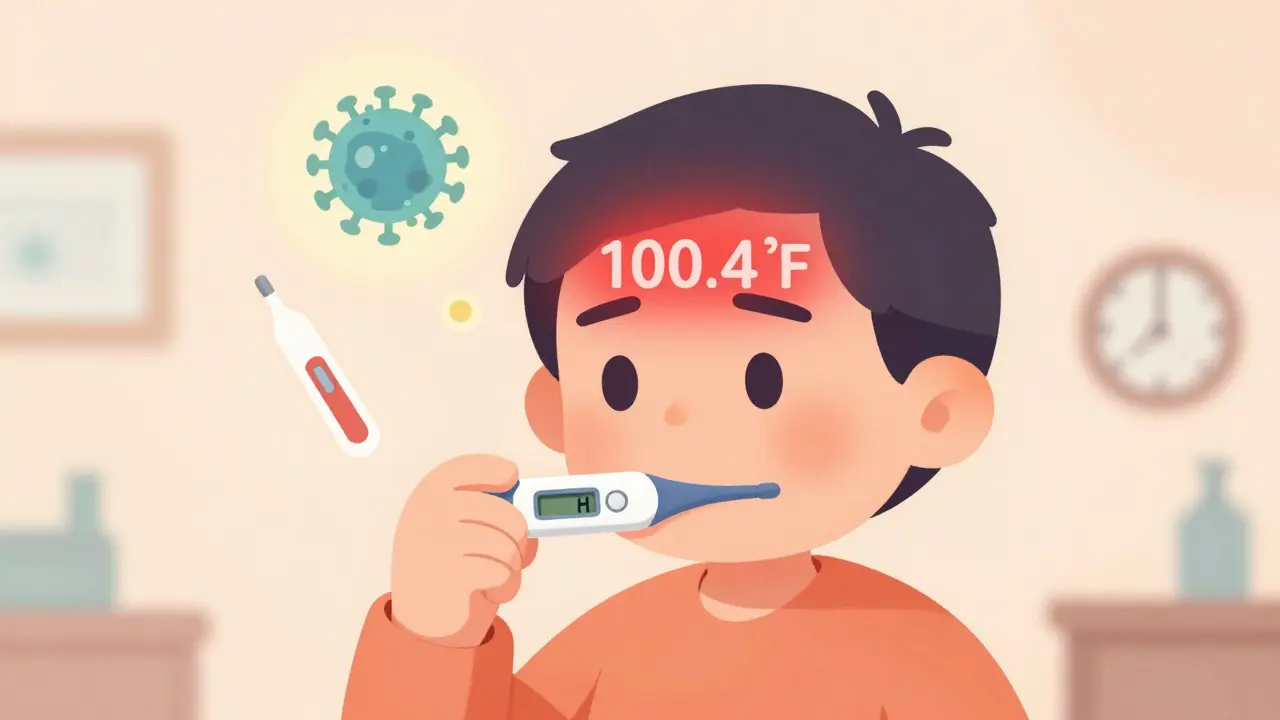
Most people think a fever is just a sign you’re sick - and that’s true. But not every fever needs a doctor. The real question isn’t if you have a fever, it’s when you should act. A temperature of 100.4°F (38°C) or higher is the medical cutoff for fever, but your body’s normal baseline can vary. Some people run naturally cooler at 97°F, others run warmer at 99°F. What matters isn’t just the number - it’s the context.
What causes fever in adults?
Fever isn’t the illness - it’s your body’s defense system kicking in. When your immune system detects invaders like viruses, bacteria, or even abnormal cells, it signals the hypothalamus (your body’s thermostat) to raise your temperature. That heat makes it harder for pathogens to survive. Most fevers come from common infections: colds, flu, strep throat, or even a urinary tract infection. But fever can also signal something deeper - like an autoimmune flare-up (such as rheumatoid arthritis), a reaction to medication, or rarely, certain cancers. That’s why it’s not always just a cold.
How high is too high?
Not all fevers are created equal. Doctors break them into tiers:
- Low-grade: 99.1°F to 100.4°F (37.3°C to 38°C) - usually mild, often viral
- Moderate: 100.6°F to 102.2°F (38.1°C to 39°C) - more concerning if it lasts more than a day or two
- High-grade: 102.4°F to 105.8°F (39.1°C to 41°C) - needs attention
Here’s the hard line: if your temperature hits 103°F (39.4°C) or higher, it’s time to call your doctor - especially if it doesn’t come down with rest, fluids, or over-the-counter meds like acetaminophen or ibuprofen. If you hit 105°F (40.6°C), treat it like an emergency. At that point, your body is at risk of protein damage, and neurological effects become possible. You don’t wait. You go to urgent care or the ER.
Duration matters more than the number
Many people panic when they hit 101°F on day one. But most viral fevers last 48 to 72 hours. If yours is still going after three full days - even if it’s only 100.5°F - that’s a red flag. Studies show that 90% of viral infections resolve within this window. If it doesn’t, something else might be going on: a bacterial infection like pneumonia, a sinus infection that turned serious, or even a hidden abscess. The longer it lasts, the higher the chance you’ll need antibiotics or further testing.
Some people get fevers that come and go for a week. That’s not normal. Recurring fever - even if it’s mild - means your body is fighting something persistent. Don’t ignore it. A 2022 study from the American College of Physicians found that recurrent fevers lasting over seven days were strongly linked to bacterial causes that needed targeted treatment.
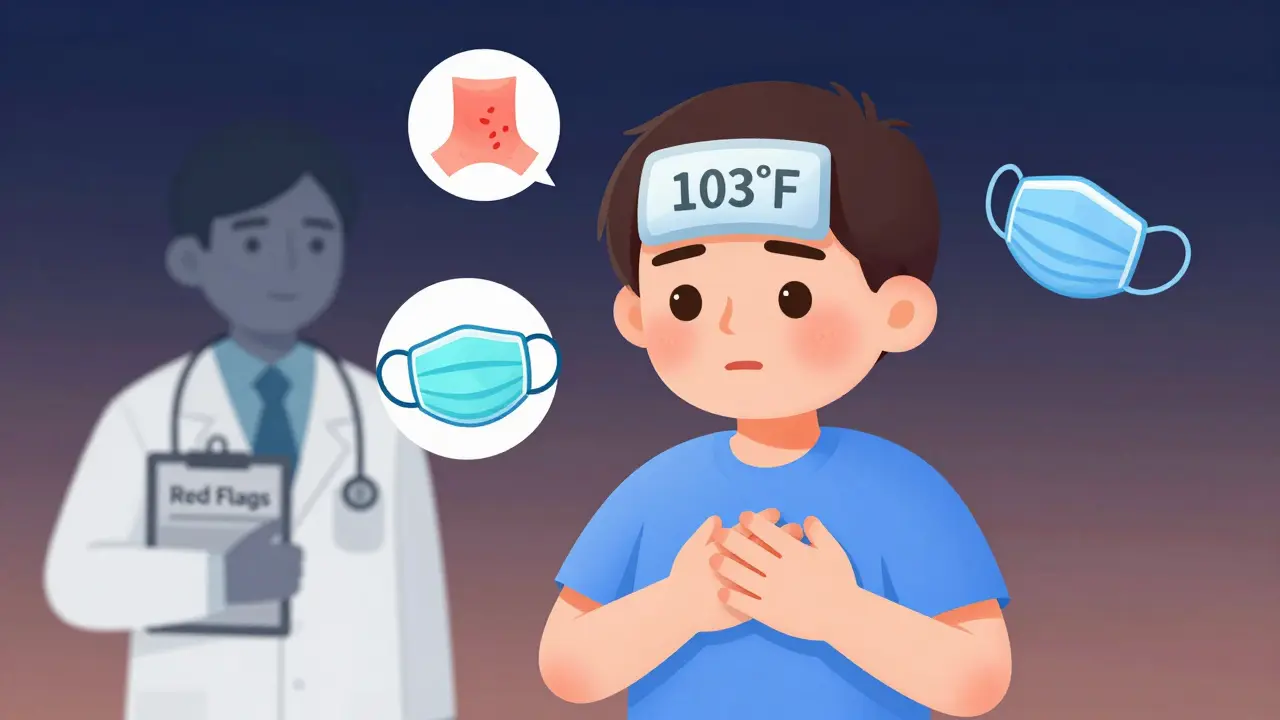
Red flags: When fever becomes an emergency
Temperature alone doesn’t tell the whole story. Some symptoms paired with fever mean you need help now. These aren’t "maybe" situations - they’re urgent:
- Confusion or trouble waking up - This could mean infection has reached your brain (meningitis or encephalitis).
- Stiff neck - Especially with headache or light sensitivity. Classic sign of meningitis.
- Difficulty breathing or blue lips/tongue - Your body isn’t getting enough oxygen.
- Seizures - Even if it’s just one twitch or brief loss of awareness.
- Severe pain - Especially in the abdomen, lower back, or chest. Could be appendicitis, kidney infection, or heart issues.
- Rash that doesn’t fade - Press a glass against it. If it doesn’t blanch (turn white), it could be meningococcal disease or toxic shock.
- Cannot urinate or pain when urinating - Could signal a kidney infection that’s spreading.
- Loss of consciousness - No matter how brief.
If you have any of these, don’t wait. Call 911 or go to the ER. These symptoms mean your body is in crisis mode.
Who’s at higher risk?
Not everyone gets the same pass with fever. Certain people need to act at much lower thresholds:
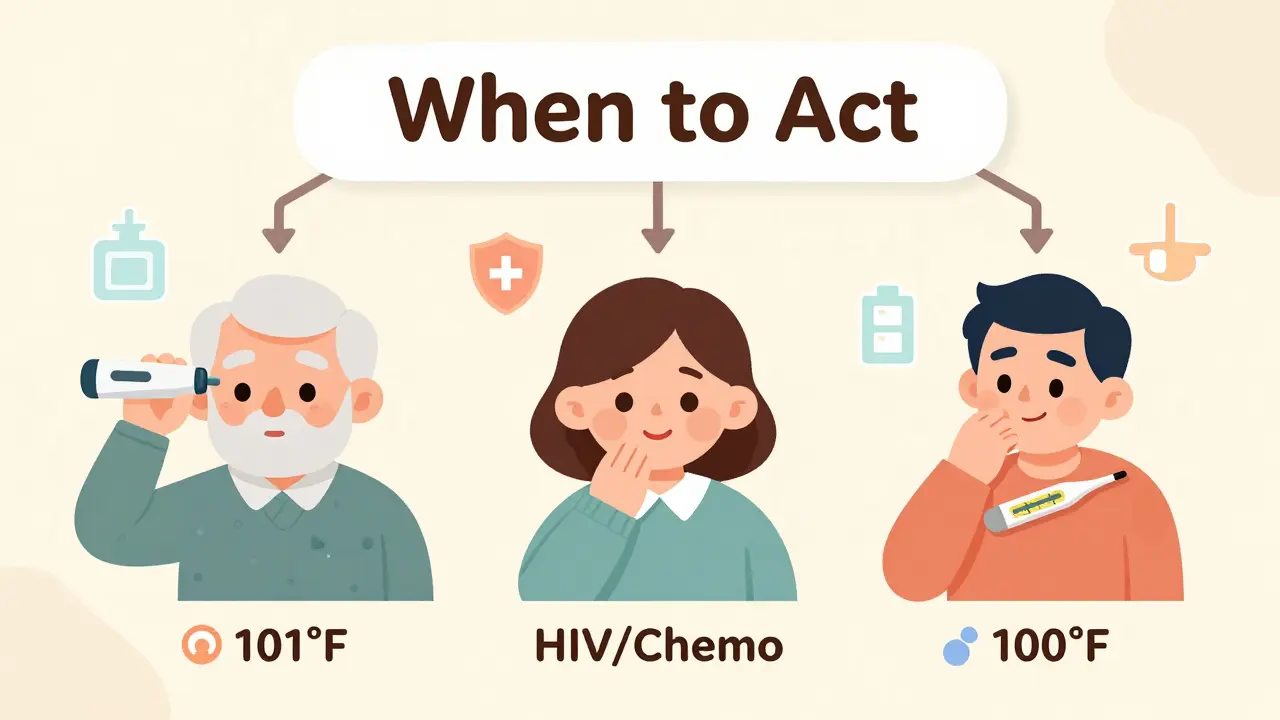
- Adults 65 and older - Immune systems weaken with age. A fever of 101°F (38.3°C) or higher should prompt a call to a doctor.
- Immunocompromised people - This includes anyone on chemotherapy, taking long-term steroids, living with HIV, or who’s had an organ transplant. Even a low-grade fever can signal a life-threatening infection.
- People with chronic illnesses - Diabetes, COPD, heart disease, sickle cell anemia, or cystic fibrosis make you more vulnerable to complications. A fever that a healthy person might shrug off could spiral fast for you.
A 2023 CDC report found that 18% of preventable hospitalizations during recent outbreaks involved vulnerable adults who waited too long to seek care. That’s avoidable.
How to measure fever correctly
Don’t trust a forehead scan if you just came in from the gym or took a hot shower. Environmental factors can throw off readings by 1-2°F. For the most accurate number in adults:
- Use a digital oral thermometer. Place it under the tongue, close your mouth, and wait until it beeps.
- Wait 30 minutes after exercise, eating, drinking hot liquids, or taking a hot shower.
- Temporal (forehead) thermometers are okay if used properly - but they’re less precise. If the reading seems off, double-check orally.
- Never use a rectal thermometer on an adult. It’s unnecessary and uncomfortable.
And remember: if you feel awful but your thermometer says 99.8°F, trust your body. Symptoms matter more than the number.
What not to do
Common mistakes delay care:
- Waiting until you hit 104°F - By then, you’re already in danger territory.
- Assuming "it’s just a virus" - Viruses don’t last five days. If it does, it’s probably not a virus.
- Using cold baths or alcohol rubs - These can cause shivering, which raises your core temperature further.
- Ignoring other symptoms - A fever with no other signs? Fine. A fever with a rash, neck pain, or confusion? Not fine.
A 2023 Kaiser Permanente survey found that 42% of adults waited until their fever hit 104°F before calling a doctor. That’s too late. The guidelines say 103°F - and for some people, even lower.
What to do next
If you’re unsure:
- Take your temperature with a digital oral thermometer.
- Check for red flag symptoms.
- Track how long it’s lasted.
- Ask yourself: "Am I in a high-risk group?"
If you’re over 65, immunocompromised, or have a chronic illness - call your doctor at 101°F or higher.
If you’re healthy and your fever is under 103°F, with no other symptoms - rest, hydrate, take acetaminophen or ibuprofen, and wait 48 hours. If it doesn’t break, call your doctor.
If your fever is 103°F or higher - call your doctor today. If it’s 105°F or you have any emergency symptoms - go to the ER.
Fevers are your body’s alarm. Listen to it. Don’t wait until it screams.
Is a fever of 100.4°F dangerous in adults?
A fever of 100.4°F (38°C) is the medical definition of fever, but it’s not dangerous by itself. Most healthy adults can have a fever this high for a day or two without issue - especially if it’s from a cold or flu. The key is watching for changes: if it climbs above 102°F, lasts longer than 72 hours, or comes with other symptoms like rash or confusion, then it’s time to get checked.
Can a fever go away on its own without medicine?
Yes. Fever is your body’s natural response, and many fevers resolve without medication. Rest, fluids, and cool environments often help. Medicines like acetaminophen or ibuprofen reduce discomfort and lower temperature slightly, but they don’t cure the underlying cause. If your fever lasts more than three days, though, you need medical evaluation - even if you feel fine otherwise.
Should I go to the ER for a fever of 103°F?
Not always - but you should call your doctor. A fever of 103°F (39.4°C) is high enough to require medical advice. If you’re young and healthy with no other symptoms, you may be able to manage it at home with guidance. But if you’re over 65, immunocompromised, or have other symptoms like confusion, trouble breathing, or a rash, go to the ER immediately. The temperature alone isn’t the only factor - context matters.
Why do some people get fevers without any other symptoms?
Sometimes, especially early in an infection, fever is the only sign. Your body raises its temperature before other symptoms like cough, sore throat, or fatigue appear. But if the fever lasts more than 48 hours without any other signs, it could mean a hidden infection - like a urinary tract infection, abscess, or even a slow-growing tumor. That’s why doctors recommend evaluation after three days, even if you feel "fine."
Can stress or overwork cause a fever?
Stress alone doesn’t cause true fever. But chronic stress can weaken your immune system, making you more likely to catch an infection that then causes fever. Some people report feeling "hot" or having a low-grade temperature during high stress - but this is usually a perception, not a measured fever. If your temperature is above 100.4°F, it’s likely due to an infection or inflammation, not just burnout.
Is it safe to take ibuprofen and acetaminophen together for fever?
Yes, if done correctly. Many doctors recommend alternating ibuprofen and acetaminophen every 4-6 hours for stubborn fevers - but never exceed the maximum daily dose of either. For example: take acetaminophen at 8 a.m., ibuprofen at noon, acetaminophen at 4 p.m., ibuprofen at 8 p.m. Always check labels and consult your pharmacist if you’re on other medications or have liver or kidney issues.
Do I need antibiotics for a fever?
Not necessarily. Most fevers in adults are caused by viruses - and antibiotics don’t work on viruses. Taking them unnecessarily can lead to resistance and side effects. Doctors only prescribe antibiotics if there’s strong evidence of a bacterial infection - like a positive strep test, pneumonia on an X-ray, or a urinary tract infection confirmed by urine culture. Never demand antibiotics for a fever. Let your doctor decide based on symptoms and tests.

Martin Halpin
Look, I get the whole 'fever is a defense mechanism' spiel, but let’s be real - if I’m at 103°F and I can’t remember my own damn phone number, I’m not waiting for some '48-hour rule.' My body’s not a lab experiment. I’ve had fevers that 'resolved' and then turned into pneumonia. Don’t play games with your temperature. If it’s high, go. No debate.
Justin Ransburg
Thank you for this comprehensive guide. It’s refreshing to see clear, evidence-based information presented without alarmism. Many people underestimate the importance of context when it comes to fever - duration, symptoms, and individual risk factors matter far more than a single number. This is exactly the kind of public health messaging we need more of.
Brandon Vasquez
Good breakdown. I’ve been a nurse for 12 years and I still see people wait too long. The 'just rest it off' mindset kills people. Especially older folks or those with diabetes. If you’re unsure, call. It’s not a burden. It’s what we’re here for.
Vikas Meshram
Actually the CDC says 100.4 is the cutoff but many doctors use 99.5 as baseline for elderly. You're using outdated guidelines. Also rectal thermometers are still used in hospitals for accuracy - don't spread misinformation. And ibuprofen can be dangerous for people with kidney disease - you didn't mention that. This post is incomplete.
Ben Estella
USA has the best healthcare system in the world. If you're too lazy to drive to urgent care because your fever is 102, you're part of the problem. Stop being a baby. Get up. Go. You don't need a PhD to know when to call a doctor. This article is too soft. Tough love needed.
Jimmy Quilty
So let me get this straight - fever is your body’s defense system? Hah. That’s what they told us about 5G and vaccines too. Who’s really controlling the hypothalamus? Big Pharma? The CDC? The fact they say 'don’t use cold baths' but don’t mention how many people have died from overmedicating with Tylenol? Suspicious. I’ve had fevers for 10 days and never seen a doctor - still alive. Coincidence? I think not.
Miranda Anderson
I love how this post acknowledges that everyone’s baseline is different. I run at 97.6°F normally, so 99.8°F feels like a full-on meltdown to me. I’ve learned to trust how I feel more than the thermometer - if I’m shaking, sweating, and can’t stand up, it doesn’t matter if it’s 100.1. I’m calling my doctor. Also, I’ve never used a rectal thermometer on an adult - and I’ve been taking care of my elderly aunt for 5 years. This article got it right.
Gigi Valdez
Accurate and well-referenced. The emphasis on duration over temperature is critical. Many patients fixate on the number and ignore the bigger picture. I’ve seen patients with 101°F fevers for five days with no other symptoms - turns out it was a silent abscess. Early detection saves lives. This should be required reading.
bill cook
I had a fever for 11 days last year. No other symptoms. Just… hot. I didn’t go to the doctor because I didn’t want to be 'that guy.' Turns out it was lymphoma. I’m alive now, but I wish I’d listened to this article six months earlier. Please, if you feel off - even a little - get checked. Don’t wait for it to scream.
Byron Duvall
103°F? Nah. I’ve had 104°F and went to work. My boss said 'go home' - I said 'I’m not a child.' This whole thing is just fearmongering. People are dying from anxiety about fevers, not fevers themselves. Just let your body do its thing. Stop medicating everything. Nature knows better.
Katherine Farmer
How quaint. You assume everyone has access to digital thermometers. In rural America, in parts of India, in refugee camps - people use mercury thermometers or guess by touch. You’re writing for the privileged. Also, 'call your doctor' - ha. My insurance deductible is $7,000. Who exactly is supposed to 'call'? This article is tone-deaf.
Full Scale Webmaster
Okay, let me break this down because clearly nobody else understands the real science here. Fever isn’t a defense - it’s a symptom of immune dysregulation caused by chronic low-grade inflammation from environmental toxins, EMF exposure, and glyphosate in our food supply. The 'viral fever' narrative is a corporate lie. The hypothalamus isn’t 'thermostatically' regulated - it’s hijacked by cytokine storms triggered by vaccine adjuvants. I’ve studied this for 17 years. I’ve had 12 fevers over 104°F and never taken ibuprofen. I drank lemon water and did cold plunges. I’m 52. Still alive. Still lucid. Still fighting the narrative. You’re being manipulated. Wake up.
Brandie Bradshaw
Thank you for emphasizing that symptoms > numbers. I’ve been on the receiving end of medical gaslighting - 'It’s just a virus' - while I was in septic shock. I had a 101.3°F fever for 72 hours with zero other symptoms. No rash. No pain. Just… exhaustion. My primary care doctor dismissed me. My ER doctor saved me because he listened to how I felt. The body doesn’t lie. The algorithm does. This article is the antidote to the 'just take a pill and wait' culture. We need more of this. Not less.