Bipolar Disorder Antidepressant Risk Calculator
Your Risk Factors
How This Works
This calculator estimates your risk of mood switching (from depression to mania or hypomania) when taking an antidepressant for bipolar disorder, based on clinical data from studies like STEP-BD.
The risk is calculated using:
- Base risk of the specific antidepressant class
- Adjustments for bipolar type
- Impact of rapid cycling history
- Presence of mixed features
- History of antidepressant-induced mania
When someone with bipolar disorder feels crushed by depression, it’s tempting to reach for an antidepressant. After all, these drugs work for unipolar depression. But in bipolar disorder, antidepressants don’t just treat sadness-they can trigger mania, rapid cycling, or even suicidal crises. This isn’t a rare side effect. It’s a well-documented, clinically significant risk that many doctors still ignore.
Antidepressants Can Trigger Mania-And It’s Not Just a Theory
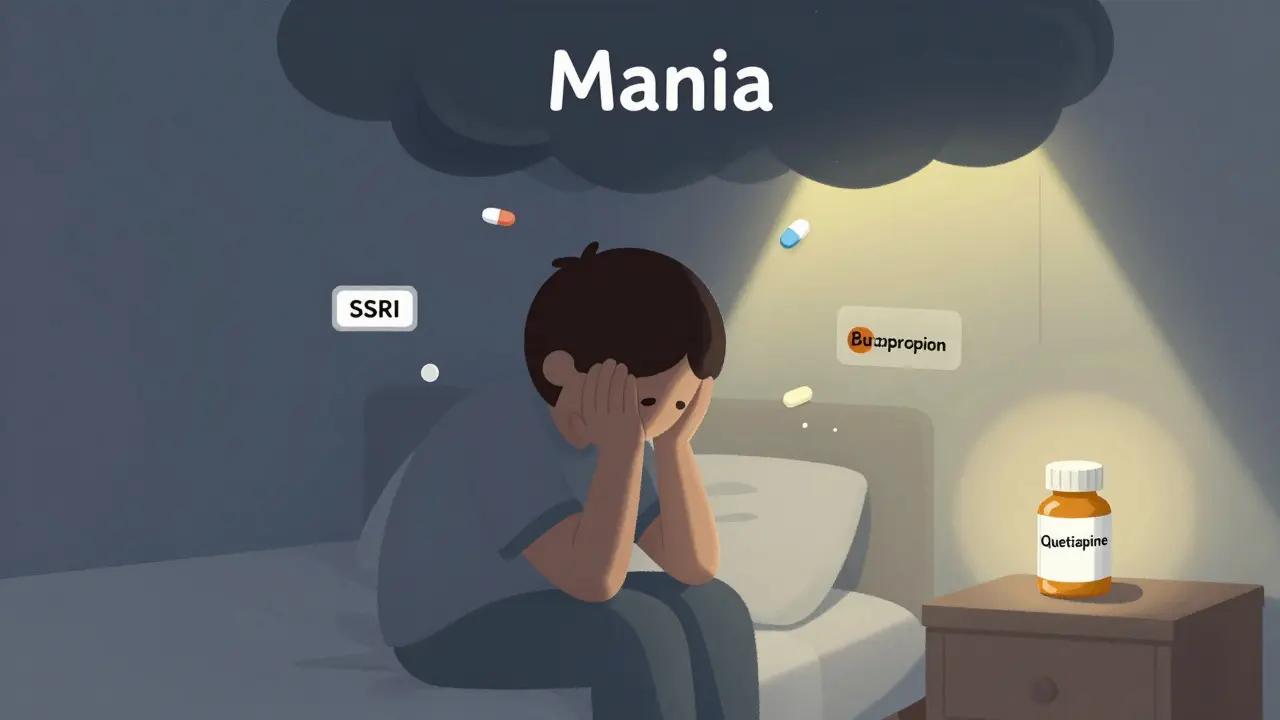
Here’s the hard truth: if you have bipolar disorder, taking an antidepressant without a mood stabilizer can flip your mood from deep depression into full-blown mania. This isn’t a one-in-a-thousand fluke. Studies tracking over 10,000 patients show that about 12% of people with bipolar depression who take antidepressants experience a switch into mania or hypomania. In real-world settings, that number jumps to 31%. That’s more than one in three people.
This isn’t about being "weak" or "unstable." It’s about brain chemistry. Antidepressants, especially SSRIs like sertraline or fluoxetine, flood the brain with serotonin. In someone with bipolar disorder, that can overstimulate reward pathways, push sleep cycles off track, and ignite manic energy. The result? Racing thoughts, reckless spending, sleeplessness, or even psychosis. One patient in the STEP-BD study described going from crying in bed to calling strangers at 3 a.m. after just one week on an SSRI. Hospitalization followed.
Not All Antidepressants Are Equal-But None Are Safe Alone
Some doctors think switching from an SSRI to bupropion (Wellbutrin) reduces risk. It’s true: SSRIs carry about an 8-10% risk of mood switching, while tricyclics like amitriptyline jump to 15-25%. SNRIs like venlafaxine? Even higher. But here’s the catch: no antidepressant is safe without a mood stabilizer. Even bupropion, often called "the safest," still carries a 7-9% switch risk when used alone. And if you’ve ever had a prior antidepressant-induced manic episode? Your risk skyrockets to over 30%.
Why does this happen? It’s not just about the drug class. It’s about your biology. People with Bipolar I are far more likely to switch than those with Bipolar II. If you’ve had rapid cycling (four or more mood episodes in a year), your risk doubles. And if your depression comes with mixed features-like irritability, agitation, or racing thoughts alongside sadness-you’re in the danger zone. About 20% of bipolar depressions have these mixed symptoms, and antidepressants make them worse.
The FDA-Approved Alternatives That Actually Work
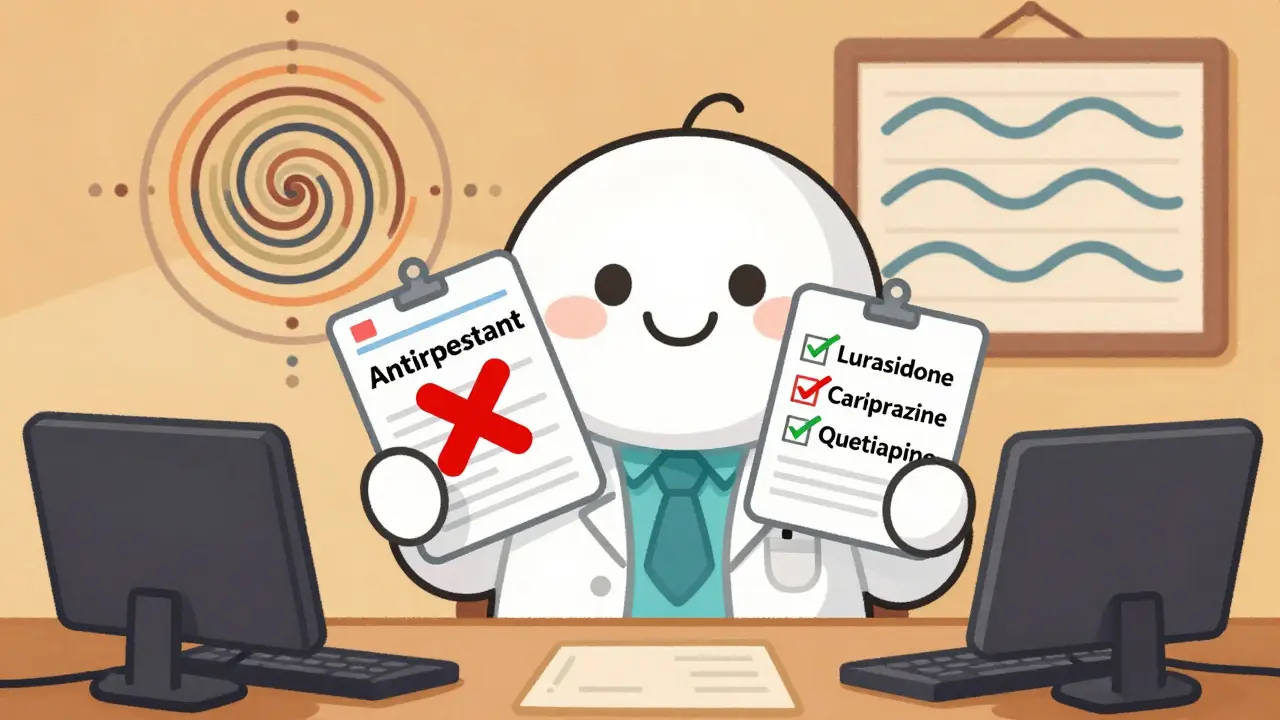
Since 2003, the FDA has approved four treatments specifically for bipolar depression. None are traditional antidepressants.
- Quetiapine (Seroquel): Works for 50-60% of patients. Switch risk? Under 5%.
- Lurasidone (Latuda): 50% response rate. Only 2.5% switch risk.
- Cariprazine (Vraylar): 48% response rate. 4.5% switch risk.
- Olanzapine-fluoxetine combo (Symbyax): Approved in 2003. Still used, but with caution due to weight gain.
These aren’t "second choices." They’re first-line. They stabilize mood while lifting depression. Unlike antidepressants, they don’t just mask symptoms-they prevent cycling. And they do it without the ticking time bomb of mania.
Why Do So Many Still Prescribe Antidepressants?
Here’s the uncomfortable reality: 50-80% of bipolar patients are still prescribed antidepressants. In community clinics, it’s as high as 80%. In academic centers? Closer to 50%. Why the gap?
Many doctors don’t have time to learn the nuances. Others believe antidepressants work better than the alternatives. Some patients beg for them-"I just want to feel normal again." And there’s another factor: antidepressants are cheaper. A 30-day supply of sertraline costs $10-$20. Quetiapine? $150. Insurance often doesn’t cover the better options unless you’ve tried and failed antidepressants first.
There’s also a deep-rooted bias. For decades, bipolar depression was treated like unipolar depression. Even today, many patients are misdiagnosed. Studies show 40% of people with bipolar disorder are initially labeled with unipolar depression. That means they get antidepressants for years before anyone even considers mood stabilizers.
When Antidepressants Might Be Used-And How
The International Society for Bipolar Disorders (ISBD) updated its guidelines in 2022. Their stance is clear: antidepressants should be avoided as monotherapy. But they do allow limited use under strict conditions:
- Only after two FDA-approved treatments (like quetiapine or lurasidone) have failed.
- Only as a short-term add-on to a mood stabilizer (lithium, valproate) or atypical antipsychotic.
- Only for severe, disabling depression with no mixed features.
- Only with weekly check-ins for the first month.
- Only for 8-12 weeks max-even if it "works."
Even then, experts like Dr. Nassir Ghaemi at Tufts Medical Center use them in fewer than 20% of their bipolar patients. And they avoid tricyclics and SNRIs entirely. Bupropion and SSRIs are the only ones they’ll consider-and only with extreme caution.
The Hidden Long-Term Damage
Most people think the danger ends when the manic episode passes. It doesn’t.
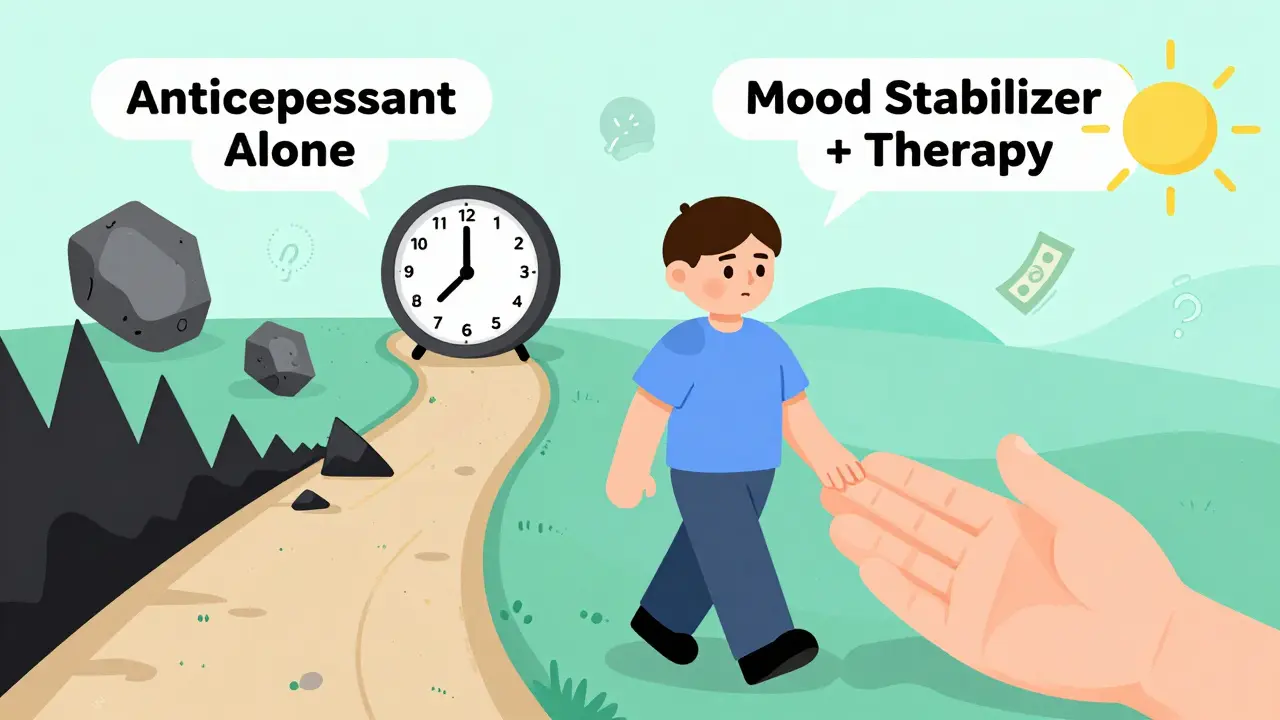
Long-term antidepressant use in bipolar disorder is linked to:
- Rapid cycling: A 2.1x higher chance of having four or more mood episodes a year.
- More frequent depressions: One study found patients on antidepressants had 1.7x more depressive episodes over time.
- Reduced effectiveness of mood stabilizers: Antidepressants can interfere with lithium’s ability to prevent mania.
- Increased suicide risk during mixed states: When depression and mania overlap, antidepressants can worsen agitation and impulsivity.
The STEP-BD study tracked patients for over 10 years. Those who stayed on antidepressants longer than 24 weeks had a 37% higher chance of recurrence. Not more mania-more episodes, period.
What You Should Do If You’re on Antidepressants for Bipolar Disorder
If you’re taking an antidepressant for bipolar depression, here’s what to ask your doctor:
- "Have I been properly diagnosed with bipolar disorder?" (Many aren’t.)
- "Am I on a mood stabilizer or antipsychotic too?" (If not, you’re at risk.)
- "How long have I been on this?" (If more than 12 weeks, it’s time to reassess.)
- "Have I ever had a manic episode while on this drug?" (If yes, stop immediately.)
- "Are there FDA-approved alternatives I haven’t tried?"
Don’t stop abruptly. That can cause rebound depression. Work with your provider to taper slowly while introducing a mood-stabilizing medication.
The Future of Treatment
The field is moving fast. Ketamine nasal spray (esketamine) showed a 52% response rate in bipolar depression with only 3.1% switch risk in a 2023 trial. New drugs are being designed to target both depression and mood stability at once. Genetic tests are emerging that can predict who’s most likely to switch-like the 5-HTTLPR gene variant, which triples risk.
But until these become mainstream, the safest path is clear: avoid antidepressants unless absolutely necessary, and never without a mood stabilizer. The risks aren’t theoretical. They’re real, measurable, and life-altering.
Can antidepressants make bipolar depression worse?
Yes. In bipolar disorder, antidepressants can trigger mania, hypomania, or mixed states-where depression and mania happen at the same time. This can worsen mood instability, increase episode frequency, and raise suicide risk. Studies show antidepressants don’t work better than mood stabilizers for bipolar depression, but they carry much higher risks.
Which antidepressants are safest for bipolar disorder?
No antidepressant is truly "safe" for bipolar disorder without a mood stabilizer. If used at all, SSRIs (like sertraline) and bupropion carry the lowest switch risk-around 8-10%. Tricyclics and SNRIs are far riskier, with switch rates over 20%. But even the safest options should only be used short-term and never alone.
Why aren’t antidepressants FDA-approved for bipolar depression?
They’re not approved because clinical trials showed they don’t offer enough benefit to justify the risks. While they may help some people feel better in the short term, they significantly increase the chance of mania, rapid cycling, and long-term mood instability. The FDA has approved four non-antidepressant drugs specifically for bipolar depression because they work better and are safer.
What should I do if I think an antidepressant triggered my mania?
Contact your psychiatrist immediately. Do not stop the medication on your own. Manic episodes can escalate quickly. Your provider will likely taper the antidepressant slowly while adding or adjusting a mood stabilizer like lithium or quetiapine. Document your symptoms-sleep changes, energy levels, spending habits, irritability-as these help guide treatment.
Are there non-drug treatments for bipolar depression?
Yes. Psychotherapy like cognitive behavioral therapy (CBT) and interpersonal and social rhythm therapy (IPSRT) are proven to help stabilize mood. Regular sleep, exercise, and avoiding alcohol or drugs are critical. Some people also benefit from transcranial magnetic stimulation (TMS), though it’s less studied in bipolar disorder than in unipolar depression. These should be used alongside medication-not as replacements.

Paul Ratliff
bro i was on sertraline for 8 months and one day i was buying 3 laptops and calling my ex at 4am lmao woke up in the psych ward with a nurse asking if i knew what day it was
SNEHA GUPTA
The biological reality here is that bipolar disorder isn't depression with extra features. It's a different disease entirely. Treating it like unipolar depression is like using a hammer to fix a watch. The tools are wrong, and the damage is predictable. We need to stop pathologizing mood variation and start honoring neurodiversity in treatment design.
Andrew Muchmore
I've seen too many people get prescribed antidepressants like they're candy. No mood stabilizer? You're playing Russian roulette with your brain. The data doesn't lie. 31% switch rate in real life? That's not a side effect. That's a hazard warning.
Jeremy Van Veelen
Let me be blunt: the psychiatric establishment is still stuck in the 1990s. We have FDA-approved, evidence-based, mood-stabilizing alternatives with lower switch rates than a lukewarm SSRI... and yet clinicians still reach for the cheapest, most profitable option. This isn't medical negligence. It's institutional greed wrapped in white coats.
jerome Reverdy
I work in a community clinic and I can tell you-patients don’t ask for antidepressants. They’re told they have ‘major depression’ and handed a script. No one explains the bipolar distinction. No one mentions quetiapine. By the time someone gets referred to a specialist, they’ve been on an SSRI for 3 years. The system is broken, not the people.
gemeika hernandez
I used to think bipolar was just mood swings. Then I saw my cousin go from crying in church to maxing out 5 credit cards in 48 hours after her doctor put her on Wellbutrin. Now I tell everyone: if you’re bipolar, don’t touch antidepressants unless you’re ready to lose your life savings and your kids.
Nicole Blain
i just want to say thank you for writing this 💔 i was misdiagnosed for 7 years. got 3 different antidepressants. had 2 hospitalizations. finally got lurasidone last year and i can breathe again. 🌿
Kathy Underhill
The real tragedy isn't just the manic switches. It's how many people never recover full stability because they were kept on antidepressants too long. The long-term data is clear: more episodes, faster cycling, diminished response to lithium. This isn't about one bad reaction. It's about a slow erosion of brain resilience.
lawanna major
I’m so glad someone finally laid this out without sugarcoating. The myth that antidepressants help bipolar depression is one of the most dangerous lies in psychiatry. We owe it to patients to prioritize safety over convenience. Quetiapine, lurasidone, cariprazine-they’re not alternatives. They’re the standard.
Ryan Voeltner
It is imperative to recognize that the current clinical paradigm, while rooted in historical precedent, is demonstrably inadequate for the management of bipolar depression. The empirical evidence presented herein necessitates a paradigmatic shift toward pharmacotherapeutic modalities that prioritize affective stabilization over symptomatic relief alone.
Linda Olsson
They don't want you to know this. Big Pharma spends billions marketing SSRIs. The FDA-approved meds? Too expensive. Too new. Too hard to prescribe. They'll keep pushing antidepressants until the system collapses. Don't trust your doctor. Trust the data. And if they push back? Get a second opinion. Or ten.
Ayan Khan
In many cultures, mental health is still seen as a personal failing. But this article shows it’s a biological mismatch. We need global education-not just in the US. In India, people are still told to pray harder when they’re depressed. What they need is lurasidone. And a doctor who knows the difference.