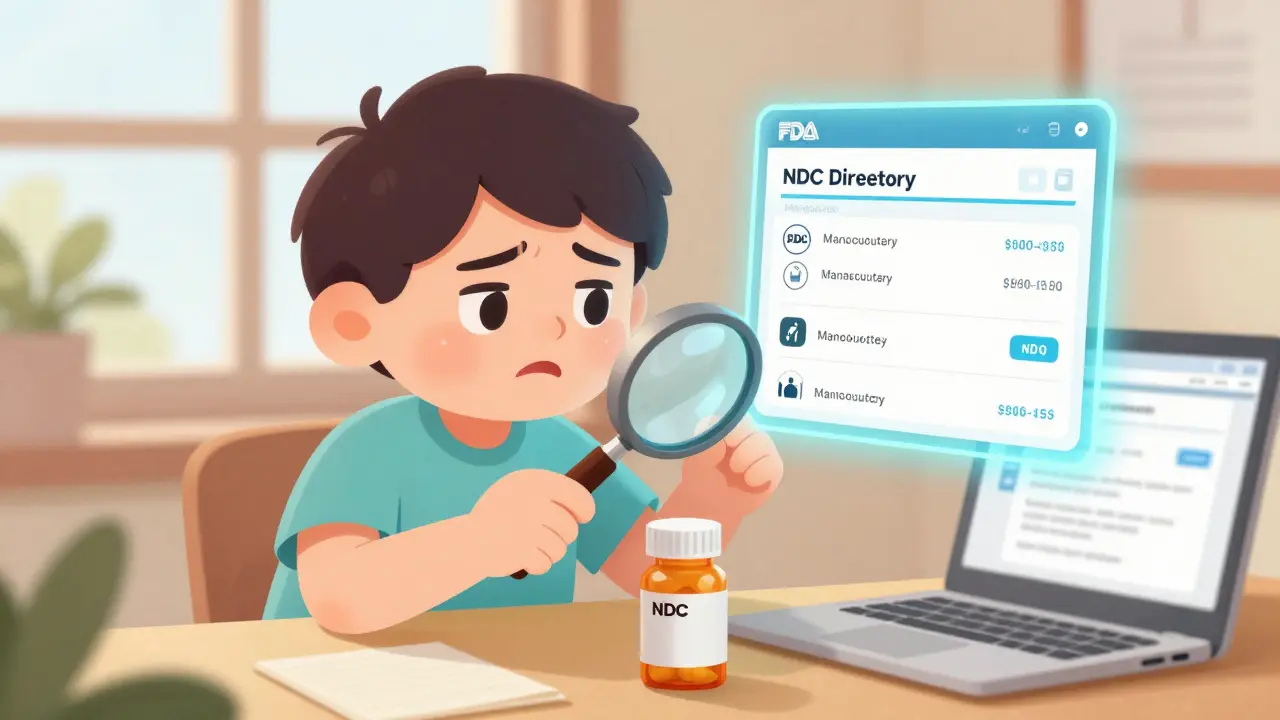
Every year, millions of people around the world take medications they think are safe-only to find out later they were fake. Counterfeit drugs don’t just fail to work; they can poison you. In 2022, the FDA reported an 18% jump in counterfeit drug incidents compared to the year before. The good news? The U.S. Food and Drug Administration has built a set of public databases that let you check if a medication is real. You don’t need to be a pharmacist to use them. You just need to know where to look.
What the FDA Databases Actually Do
The FDA doesn’t just approve drugs. It tracks every single prescription medication sold in the U.S. through three main systems: the NDC Directory, the Drug Establishments Current Registration Site, and the Orange Book. These aren’t hidden government tools-they’re free, public, and updated every business day.The National Drug Code (NDC) Directory is the heart of it all. Every FDA-approved drug has a unique 10- or 11-digit number. This isn’t a barcode you scan at the pharmacy-it’s a digital fingerprint. The number breaks down into three parts: the labeler code (who made it), the product code (what the drug is), and the package code (how it’s packaged). If a drug doesn’t show up here, it’s not legally approved for sale in the U.S.
The Drug Establishments Current Registration Site tells you who’s allowed to make or distribute that drug. If a company isn’t registered, they’re operating illegally. In 2022, the FDA issued 68 warning letters to companies with outdated or missing registrations. That’s not a glitch-it’s enforcement.
The Orange Book lists approved generic drugs and tells you which ones are therapeutically equivalent to brand-name versions. This matters if you’re switching from, say, Lipitor to a generic atorvastatin. You need to know if the generic is truly interchangeable.
How to Check a Drug’s Legitimacy
Let’s say you buy a bottle of metformin online and the packaging looks off. Here’s how to verify it:- Find the NDC number on the box. It’s usually printed near the barcode, sometimes labeled “NDC.”
- Go to the FDA’s NDC Directory at accessdata.fda.gov/scripts/cder/ndc/.
- Type the full NDC number into the search bar. Don’t guess. If it’s 10 digits, use all 10. If it’s 11, use all 11.
- Check the results. If the drug appears, you’ll see the manufacturer, the approved strength, and the dosage form.
- Now cross-check the manufacturer’s name with the Drug Establishments Current Registration Site. If the company isn’t listed there, it’s a red flag.
Real-world example: A man in Ohio bought “Lisinopril” from a website offering 80% off. The bottle had an NDC of 0045-6001-12. When he searched it, the FDA showed that NDC belonged to a different company-Zydus Pharmaceuticals-and the strength listed was 20 mg, not the 10 mg he received. The bottle was counterfeit. He reported it. The FDA pulled 12,000 similar bottles from U.S. warehouses.
Why the NDC System Isn’t Perfect
The system works well-but it has gaps. The NDC identifies the type of drug, not the individual bottle. That means two identical bottles of the same drug from the same batch have the same NDC. A counterfeiter can copy the label, the NDC, and the packaging-and it’ll still show up as “valid” in the FDA database.That’s why the Drug Supply Chain Security Act (DSCSA), fully active since November 2023, added a new layer: product identifiers with serial numbers. Each package now has a unique 2D barcode that links to a digital record. But here’s the catch: most consumers won’t see this. It’s for pharmacies, distributors, and hospitals to scan and verify at each handoff. You won’t have a scanner at home.
So what can you do? Stick to the basics. If a drug isn’t in the NDC Directory, walk away. If the manufacturer isn’t registered, don’t buy it. If the price is too good to be true, it probably is.
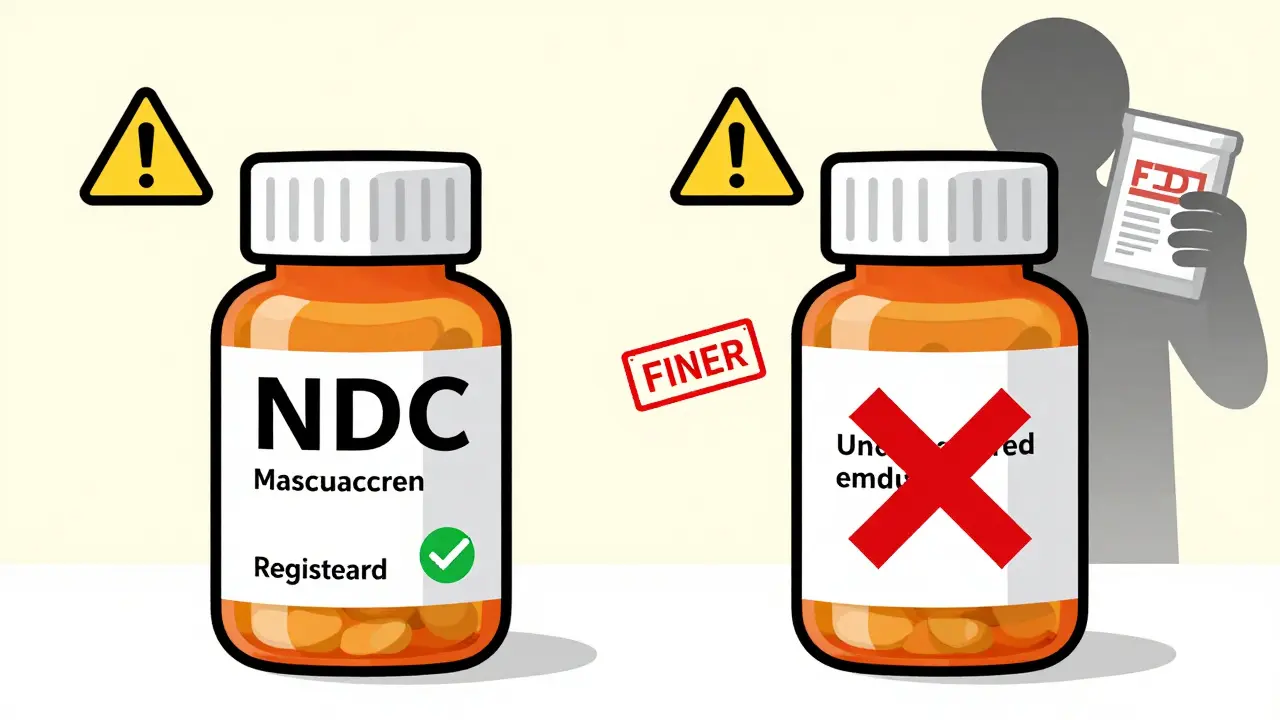
What About Online Pharmacies?
The FDA warns that 96% of online pharmacies don’t follow U.S. laws. Many sell drugs from unregulated countries like India or China, where counterfeit rates are high. Even if the label looks perfect, the drug inside might be laced with chalk, rat poison, or nothing at all.Here’s how to avoid them:
- Only buy from pharmacies that require a prescription.
- Check if the site has a verified internet pharmacy practice sites (VIPPS) seal from the National Association of Boards of Pharmacy.
- Look up the pharmacy’s physical address. If it’s a PO box or a warehouse in a foreign country, don’t trust it.
- Call your local pharmacy and ask if they’ve ever heard of the online seller. Pharmacists hear about shady sites all the time.
In 2021, the FDA shut down over 1,500 illegal online pharmacies. Most were selling insulin, erectile dysfunction drugs, and antibiotics-exactly the kinds of meds people buy without thinking twice.
What’s Changing in 2025 and Beyond
The FDA is upgrading the NDC system. By 2026, all drug codes will be standardized to 12 digits. That’s to reduce confusion from old 10-digit formats that were inconsistently formatted. It’s also preparing to add product images to the NDC Directory-so you can compare the real pill or bottle to the one you have.AI tools are starting to appear too. Companies like IBM and Google are testing machine learning models that scan supply chain data for anomalies. If a shipment of insulin suddenly appears from a factory that’s never made it before, the system flags it. These tools aren’t public yet-but they’re coming.
For now, your best defense is still the same: use the FDA’s databases. They’re free. They’re accurate. And they’re updated daily.
What to Do If You Find a Counterfeit
If you suspect a drug is fake:- Stop taking it.
- Keep the packaging and any receipts.
- Report it to the FDA’s MedWatch program at fda.gov/medwatch.
- Call your doctor. Some counterfeit drugs cause delayed harm-like liver damage from fake antibiotics.
The FDA gets about 1,200 reports of suspected counterfeit drugs each year. Most come from consumers. Your report could save someone’s life.
Common Misconceptions
- “If it’s sold in the U.S., it’s safe.” False. The FDA can’t inspect every import. In 2022, 35% of foreign manufacturers didn’t comply with U.S. verification rules.
- “Generic drugs are more likely to be fake.” No. Generics are held to the same standards as brand names. The Orange Book confirms this.
- “The FDA will tell me if a drug is counterfeit.” Not unless you report it. They don’t monitor every sale.
Final Checklist: Is Your Drug Legit?
Before you take any prescription:- ✅ Does the NDC match the FDA’s NDC Directory?
- ✅ Is the manufacturer listed in the Drug Establishments Current Registration Site?
- ✅ Is the packaging sealed and free of spelling errors or blurry printing?
- ✅ Did you buy it from a licensed U.S. pharmacy or a VIPPS-certified site?
- ✅ Did you get a prescription from a licensed provider?
If you answered yes to all five, you’re likely safe. If even one is no, stop. Contact your pharmacist. Report it. Don’t risk your health for a discount.
Can I trust drugs I buy from Canada or Mexico?
Some Canadian pharmacies are legitimate and regulated, but many websites claiming to be Canadian are fake. The FDA doesn’t endorse importing drugs from abroad, even if they’re cheaper. A 2022 FDA study found that 73% of drugs imported from Mexico and Canada were either expired, mislabeled, or counterfeit. Stick to U.S.-licensed pharmacies.
Do I need to check every pill I take?
No. If you get your medication from a trusted U.S. pharmacy-like CVS, Walgreens, or your local independent pharmacy-you don’t need to check the NDC every time. But if you refill online, buy from a new source, or notice anything odd about the pill’s color, shape, or taste, verify it. Most counterfeits are found in online purchases, not brick-and-mortar stores.
What if the NDC number isn’t on the bottle?
That’s a major red flag. All FDA-approved drugs sold in the U.S. must have an NDC on the label. If it’s missing, the product is either not approved, expired, or counterfeit. Don’t take it. Return it to the pharmacy or report it to the FDA.
Are over-the-counter (OTC) drugs checked too?
Yes. The NDC Directory includes OTC drugs like Tylenol, Pepcid, and allergy pills. Counterfeit OTC meds are common-especially pain relievers and sleep aids. Always check the NDC if you’re buying OTC drugs online.
How often is the FDA database updated?
Every business day. The NDC Directory, registration site, and Orange Book are refreshed daily. If a company gets shut down or a drug gets recalled, it’s removed from the database within 24 hours. That’s why using outdated info or third-party apps can be dangerous.
What to Do Next
If you take any prescription meds, bookmark the FDA’s NDC Directory now. Spend five minutes searching one of your pills. See if it’s there. Check the manufacturer. You’ll be surprised how many people don’t know this exists-and how many lives it could save.Counterfeit drugs don’t just hurt individuals. They erode trust in the entire healthcare system. You have the power to protect yourself-and others-by using the tools the FDA already built. You don’t need to be an expert. You just need to be careful.

Aboobakar Muhammedali
I never knew you could check if your meds are real just by typing in a number
Just looked up my metformin-turned out the company was legit
Feeling a lot safer now
Thanks for this
anthony funes gomez
The NDC system, while ostensibly a robust identifier framework, is fundamentally constrained by its lack of cryptographic provenance and granular serialization-rendering it vulnerable to label replication attacks
Moreover, the DSCSA’s implementation, though a necessary evolution, remains opaque to end-consumers due to structural asymmetries in supply chain visibility
Until blockchain-based serialization becomes consumer-accessible, we’re merely performing performative verification
Laura Hamill
THEY’RE LYING TO US!!!
EVERY SINGLE PHARMACY IS IN ON IT!!
THE FDA IS JUST A FRONT FOR BIG PHARMA!!!
THEY WANT YOU TO THINK THIS NDC THING IS SAFE BUT IT’S ALL FAKE!!!
MY PILL LOOKED DIFFERENT AND NOW I CAN’T SLEEP AND MY TOES ARE TINGLING!!! 😱
THEY PUT MICROCHIPS IN THE COUNTERFEITS TO TRACK US!!!
AND THE 2D BARCODE? THAT’S JUST A LIE TO MAKE US FEEL SAFE!!!
CALL THE GOVERNMENT NOW!!!
THEY’RE HIDING THE TRUTH!!!
MY DOCTOR WON’T TELL ME ANYTHING!!!
WE NEED TO BURN THE PHARMACIES DOWN!!! 🔥🔥🔥
Alana Koerts
So you’re telling me the solution to counterfeit drugs is… checking a website?
Wow. Groundbreaking.
And yet 96% of online pharmacies are illegal, and most people don’t even know what an NDC is.
So what’s the point?
It’s like giving people a flashlight and saying ‘the cave is safe now’
Meanwhile, the whole system is a dumpster fire
James Stearns
It is of paramount importance that the public understands the gravity of pharmaceutical integrity in the context of public health infrastructure.
The FDA’s databases represent not merely a convenience, but a foundational pillar of regulatory sovereignty.
One must not treat these tools as casual utilities, but as solemn instruments of civic responsibility.
To neglect their use is to abdicate one’s duty to self and society.
One cannot, in good conscience, purchase medication from an unverified source-especially when the means of verification are freely accessible.
It is not merely a matter of safety; it is a moral imperative.
Guillaume VanderEst
Man, I just checked my blood pressure med-turns out the company’s legit
But I still wouldn’t buy it from some sketchy site
Even if the NDC checks out, I’ve seen too many fake bottles with perfect labels
Just stick to CVS or your local pharmacy
Not worth the risk, man
And yeah, the price thing? Always too good to be true
Dominic Suyo
Let’s be real-the FDA’s system is a glorified Rolodex with a website
It tells you who *says* they made it, not what’s actually inside
And don’t get me started on how 73% of ‘Canadian’ drugs are just Chinese factory rejects with a fake flag on the box
They’re playing whack-a-mole with counterfeiters while the whole supply chain’s a sieve
Meanwhile, the real solution? Nationalize pharma. Or at least ban online sales.
But nope. Let’s keep pretending a search bar fixes capitalism.
Alisa Silvia Bila
My grandma takes 6 pills a day. I showed her how to check the NDC.
She cried.
She said she never knew she could do that.
Thank you for making this simple.
People deserve to know.
Marsha Jentzsch
OMG I just realized I’ve been taking fake Adderall for 3 years!!!
My doctor never told me to check!!!
And now I’m addicted to chalk?!?!
WHY IS NO ONE TALKING ABOUT THIS?!
MY MENTAL HEALTH IS A MESS BECAUSE OF THIS!!!
AND YOU PEOPLE ARE JUST COMMENTING LIKE IT’S A TUTORIAL?!
WE NEED A MOVEMENT!!!
WHERE’S THE PROTEST?!
MY PILLS ARE LIES!!! 😭😭😭
Hussien SLeiman
Actually, you’re all missing the bigger picture.
The FDA’s database is just a symptom of a broken system.
Why are we relying on a government agency to verify drugs when the entire pharmaceutical supply chain is outsourced to countries with zero transparency?
And let’s not pretend the Orange Book is some holy grail-it’s just a list of what’s been approved, not what’s safe.
Meanwhile, the real issue is that Americans are forced to pay 10x more for the same drugs because of patent monopolies.
So we turn to online pharmacies.
And then we get mad when the drugs are fake.
It’s not the consumer’s fault-it’s the system.
Fix the pricing, fix the incentives, fix the supply chain.
Not the NDC.
And don’t even get me started on how the DSCSA only applies to the U.S. supply chain, while 70% of active ingredients come from China and India.
This is all theater.
mary lizardo
It is regrettably evident that the dissemination of this information lacks the requisite precision and scholarly rigor.
The term 'NDC' is incorrectly referenced as a 10- or 11-digit identifier; in fact, it is a 10-digit code, with optional hyphenation, and the FDA's own documentation explicitly states that the 11-digit format is deprecated.
Furthermore, the reference to 'product images' being added by 2026 is misleading-the current roadmap indicates only enhanced metadata, not visual verification.
One must question the editorial oversight of such a publication.
It is not merely inaccurate-it is dangerously misleading.
jessica .
THEY’RE PUTTING 5G IN THE PILLS TO CONTROL OUR MINDS
AND THE FDA DATABASE IS A TRAP TO MAKE US THINK WE’RE SAFE
THEY WANT US TO TRUST THE NDC SO WE DON’T ASK QUESTIONS
THEY’RE LYING ABOUT THE MANUFACTURERS TOO
THEY’RE ALL CONNECTED TO THE ILLUMINATI
AND THE ‘VIPS’ SEAL? THAT’S JUST A FAKE LOGO THEY MADE TO LOOK LEGIT
MY NEIGHBOR’S DOG GOT SICK FROM A PILLS HE ATE-AND IT WAS FROM A PHARMACY
WE’RE ALL BEING POISONED AND NO ONE CARES
WHY WON’T THE GOVERNMENT TELL US THE TRUTH??
Connie Zehner
Wait… so you’re telling me I could’ve been taking fake insulin? 😭
I bought it from Amazon because it was cheaper…
Oh my god I’m gonna cry right now
I just checked it and it’s legit… but what if it wasn’t?
Why didn’t anyone tell me this before??
Can I get a hug? I feel so stupid
Also… can you send me the link again? I wanna check all my meds
And… can we make this a thing? Like… NDC Check Day?
Pls?? 😭💖