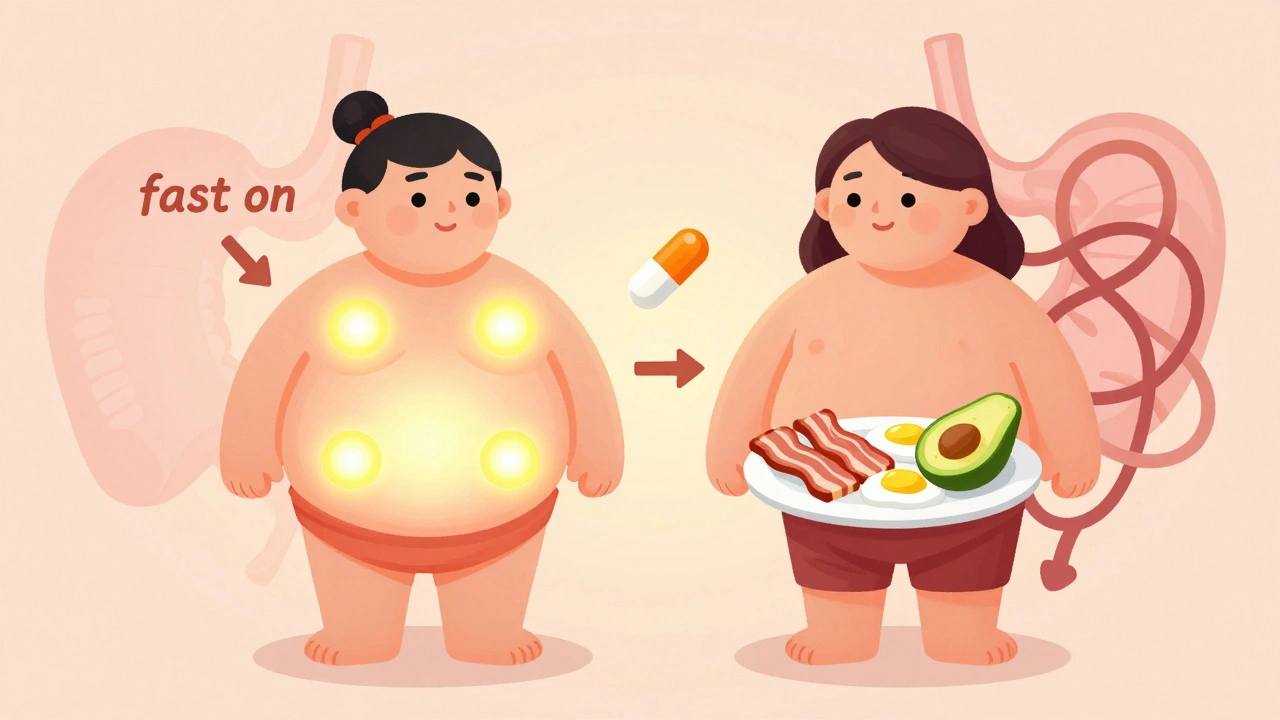
When you take a pill, your body doesn’t respond the same way whether you’ve eaten or not. That’s not just common sense-it’s science. And it’s why fasted vs fed state testing is now a non-negotiable part of how drugs are approved and how athletes train. These two conditions aren’t just different-they’re opposites in how your body handles nutrients, drugs, and energy. Understanding both isn’t optional anymore. It’s the standard.
What Fast and Fed Really Mean
Fasted state means you haven’t eaten for at least 8 to 12 hours. Water is allowed. Coffee without sugar or cream? Usually okay. But no food. Your body is running on stored fuel-fat, glycogen, whatever’s left. In pharmaceutical terms, this is the cleanest baseline: no food interfering with how a drug gets absorbed. Fed state? That’s after a meal. Not just any meal. For drug testing, it’s a high-fat, high-calorie meal-around 800 to 1,000 calories, with 500 to 600 of them coming from fat. Think bacon, eggs, cheese, avocado. This isn’t a snack. It’s a controlled, standardized meal designed to mimic the worst-case scenario for drug absorption. Your stomach is full, your gut is busy, your pH has dropped, and your emptying time has slowed from under 15 minutes to over an hour.Why the Pharmaceutical Industry Can’t Ignore This
In the 1990s, the FDA realized something alarming: some drugs worked great on an empty stomach, but vanished in the gut if taken with food. Others? They only worked when food was around. Griseofulvin, an antifungal, gets 40% less absorbed when taken with food. Fenofibrate, used for cholesterol? Its absorption jumps by 200% to 300% after a fatty meal. That’s not a minor fluctuation. That’s the difference between a drug being effective or useless. Or worse-between safe and toxic. If a drug has a narrow therapeutic index-meaning the gap between a helpful dose and a dangerous one is tiny-food effects over 20% in bioavailability require fed-state testing. That’s not a suggestion. It’s a rule. The European Medicines Agency says 35% of all new drugs show clinically meaningful food interactions. That’s one in three. And it’s why dual-state testing is now mandatory for nearly every oral drug application. The FDA and EMA don’t just want to know how a drug works on an empty stomach. They need to know how it behaves when you take it with breakfast, lunch, or dinner-because that’s what real people do.How Your Gut Changes Between States
It’s not just about what’s in your stomach. It’s about what’s happening inside it. In fasted state, your stomach empties in about 14 minutes. The pH hovers around 2.5-acidic, but not extreme. Gastric pressure is low and variable. Drugs zip through quickly. In fed state? Everything changes. Gastric emptying slows to nearly 80 minutes. pH drops to 1.5-more acidic than vinegar. Pressure spikes above 240 mbar, constant and strong. The bile and enzymes are flowing. The food matrix physically traps some drugs, delays others, or helps dissolve fat-soluble ones. SmartPill studies-tiny sensors swallowed like capsules-have mapped this in real time. The difference isn’t theoretical. It’s measurable. And it’s why two people taking the same pill at the same time can have completely different blood levels, depending on whether they ate an hour ago or not.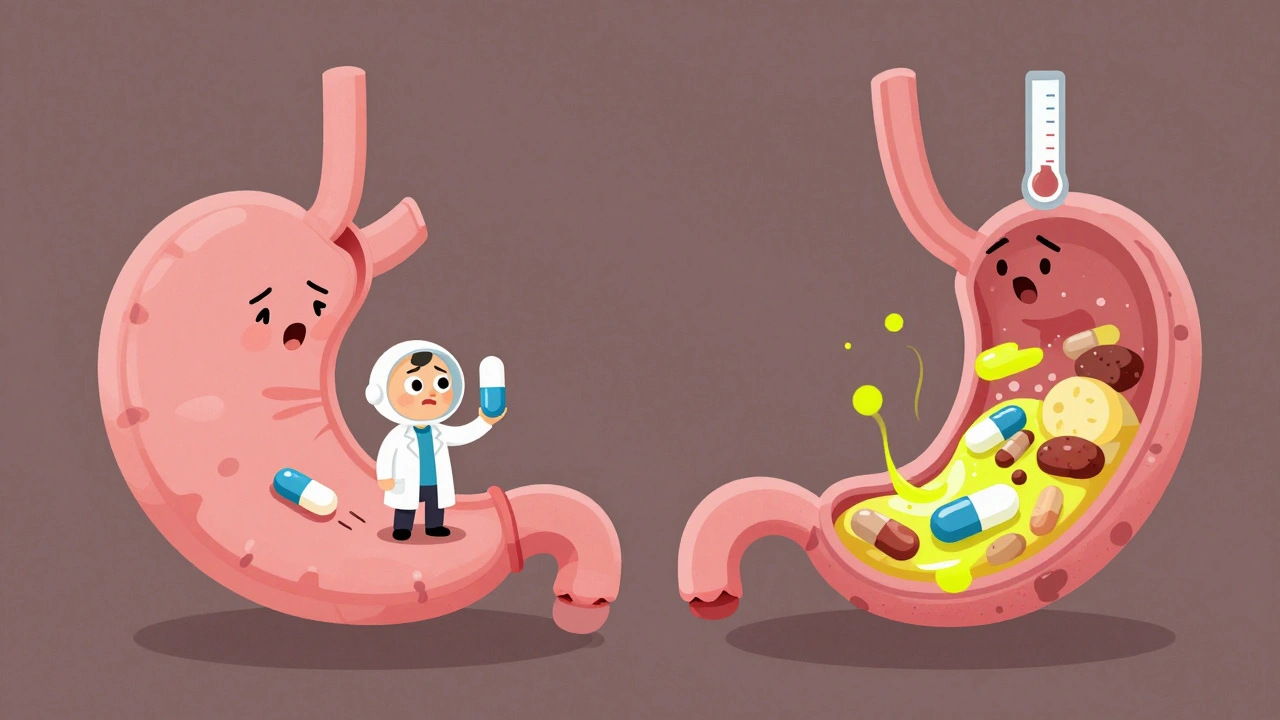
Exercise Science Isn’t Just About Fat Loss
You’ve probably heard that training fasted burns more fat. That’s true-on the surface. In fasted state, free fatty acids in the blood are 30% to 50% higher. Your body is forced to tap into fat stores. PGC-1α, the gene that triggers mitochondrial growth, spikes 40% to 50% after fasted exercise. That’s a signal for your muscles to become more efficient at burning fuel. But here’s the catch: you can’t go hard in a fasted state. High-intensity intervals? Strength training? Those need glycogen. Fed-state exercise gives you 15% to 25% more glycogen to burn. That means you can push harder, longer. A 2018 meta-analysis of 46 studies found fed-state exercise improved prolonged aerobic performance by 8.3%. But for workouts under 60 minutes? No difference. And here’s what most people miss: body composition doesn’t change based on fasted vs fed training over time. A 2021 study found no difference in fat loss or muscle gain between groups after six weeks-even though fasted group burned more fat during the workout. Your total calorie balance over days matters more than what’s happening in a single session.Who Should Train Fasted? Who Should Eat First?
If you’re a competitive athlete, you train fed. You want peak power, speed, endurance. You don’t risk hitting the wall because you skipped breakfast. The American College of Sports Medicine recommends fed-state training for anyone competing or training at high intensity. If you’re sedentary and trying to improve insulin sensitivity? Fasted training might help. Studies show 5% to 7% better improvements in insulin response when training in a fasted state. That’s meaningful for prediabetes or metabolic syndrome. But it’s not one-size-fits-all. Some people feel dizzy, weak, or nauseous fasted. Others thrive. A 2022 Reddit survey of over 1,200 people found 68% performed better when fed. But in keto-focused communities, 42% preferred fasted training for fat loss. Thirty-one percent reported dizziness. Twenty-two percent said their workout intensity dropped. The key? Match your state to your goal. Want endurance? Eat. Want fat adaptation? Try fasted-but only on low-intensity days. Don’t try to max out your squat on an empty stomach.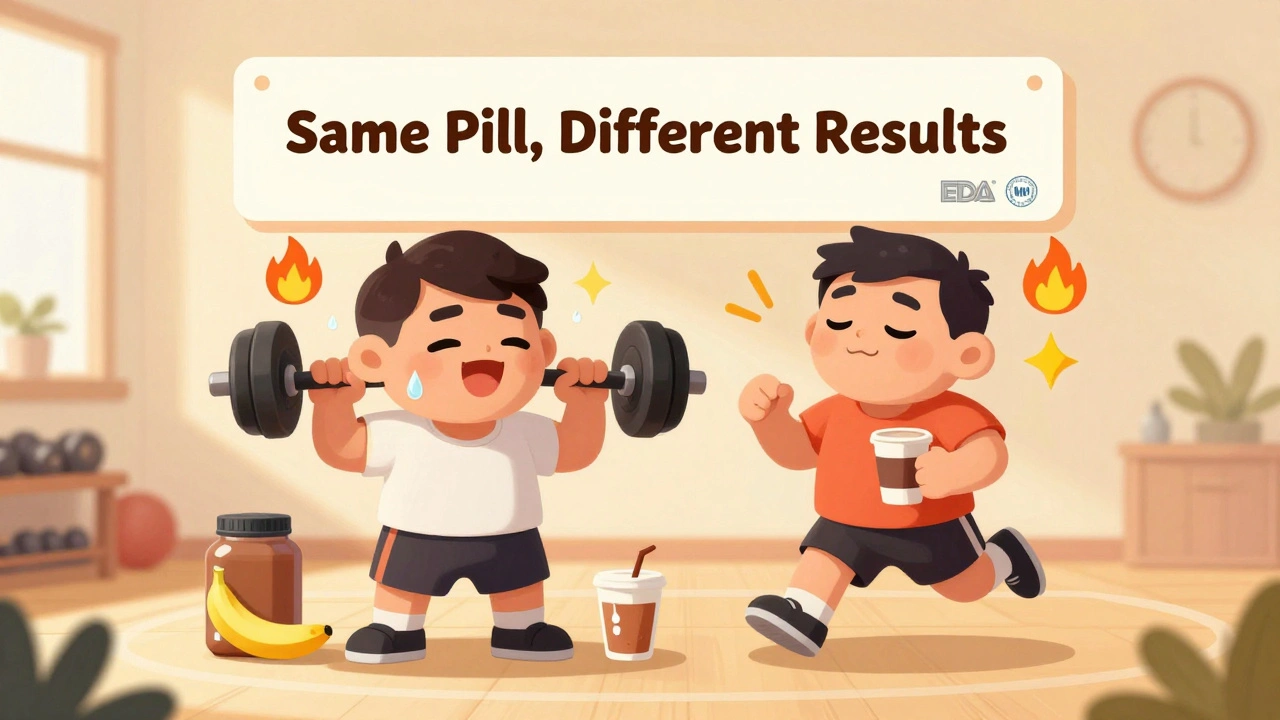
Personalization Is the Future
Not everyone reacts the same. Genetic differences explain why. A 2022 study found that variations in the PPARGC1A gene account for 33% of how someone responds to fasted vs fed training. Some people’s muscles are wired to burn fat better when fasted. Others need carbs to perform. The same applies to drugs. A 2022 study showed Asian populations have 18% to 22% slower gastric emptying in fed state than Caucasian populations. That means a drug that works fine for one group might underperform in another. The FDA is now requiring fed-state testing across diverse ethnic groups-not just as an afterthought, but as a core part of approval.The Bottom Line
Fasted and fed states aren’t just two ways to take a pill or do a workout. They’re two different physiological worlds. Ignoring one means you’re not seeing the full picture. For drug developers: testing only in fasted state is outdated. You’re leaving 35% of your patients at risk of under- or over-dosing. For athletes: fasted training isn’t magic. It’s a tool. Use it for endurance adaptation, not peak performance. For everyone else: if you’re taking medication, read the label. Does it say “take on an empty stomach”? Or “take with food”? That’s not random. That’s science. And that’s why both states matter.What You Can Do Today
- If you’re on a new prescription, check if food affects it. Ask your pharmacist.
- If you train fasted, don’t do high-intensity sessions. Save those for after eating.
- If you’re trying to lose fat, focus on total calories and protein-not whether you trained fasted.
- If you’re a researcher or developer, never skip fed-state testing. It’s not optional anymore.
The science is clear. The regulations are strict. The data is in. There’s no such thing as a one-size-fits-all state. There’s only the right state for the right goal.

Kenny Leow
Interesting breakdown. I’ve been taking my statin with food for years because the label said so, but never knew why. Turns out it’s not just ‘avoid stomach upset’-it’s about absorption kinetics. Mind blown. 🤯
Suzanne Mollaneda Padin
As a clinical pharmacist, I see this daily. Patients skip doses because they forget whether to take it with or without food. We need better labeling-not just ‘take with food’ but ‘take with a high-fat meal like eggs and bacon.’ Simple changes save lives.
Bonnie Youn
YES. I trained fasted for 6 months thinking it was magic fat burn. Then I hit a wall. My lifts dropped 30%. Switched to eating a banana before workouts. Boom. New PRs. Stop believing in myths. Fuel your body like the machine it is.
Alexander Williams
The pharmacokinetic variance between fasted and fed states is statistically significant across CYP3A4 substrates, particularly for lipophilic compounds with low solubility. The food effect on AUC and Cmax is non-linear and genotype-dependent, especially in carriers of the CYP3A5*3 allele. Most clinical trials still underrepresent ethnic diversity in fed-state cohorts.
Edward Hyde
So what you’re saying is… big pharma’s been lying to us about ‘fasting for purity’ so they can sell more pills? And now they’re using ‘science’ to justify charging extra for ‘personalized’ meds? Classic. I’m not taking anything unless it works on a donut.
Lauryn Smith
This is so helpful. I’ve been confused about whether to eat before my morning walks. Now I know: if I’m just walking to the mailbox, fasted’s fine. If I’m doing a 45-min hike? Eat something. No guilt. Just science.
Charlotte Collins
Let’s be real-this entire post is just a marketing ploy by supplement companies and elite athletes to sell protein shakes and ‘fasting protocols.’ The ‘35% of drugs show food interactions’ stat? That’s from industry-funded studies. The real data? It’s buried in FDA 510(k) appendices no one reads.
Kelly Essenpreis
Why are we letting the FDA and EMA tell us how to eat? This is just another way to control the population. I take my meds with whiskey and pizza. My body knows better than some bureaucrat in Brussels
Mary Ngo
It’s fascinating how the body’s response to food isn’t just biochemical-it’s epigenetic, sociopolitical, and even spiritual. The fed state represents capitalism’s domination over natural rhythms. Fasting? That’s ancestral resistance. We’ve been conditioned to believe that food = safety, but true healing comes from surrendering to the void. The body remembers what the mind forgets. The gut is the second brain, yes-but it’s also the first temple. Are you listening to it? Or are you just another consumer of pharmaceutical propaganda?
Margaret Stearns
Thanks for this. I read the label on my blood pressure med and it says 'take on empty stomach.' I've been taking it with oatmeal. I'll change it tomorrow. Small change, big difference.