If you’ve ever looked at a patch of irritated skin and wondered whether it’s eczema or psoriasis, you’re not alone. These two conditions look similar at first glance - red, itchy, flaky patches - but they’re fundamentally different. Getting them mixed up can lead to the wrong treatment, longer suffering, and even worsening symptoms. The key isn’t just in how they feel, but in how they look. And that’s where the real clues hide.
Where the Rash Shows Up Tells You a Lot
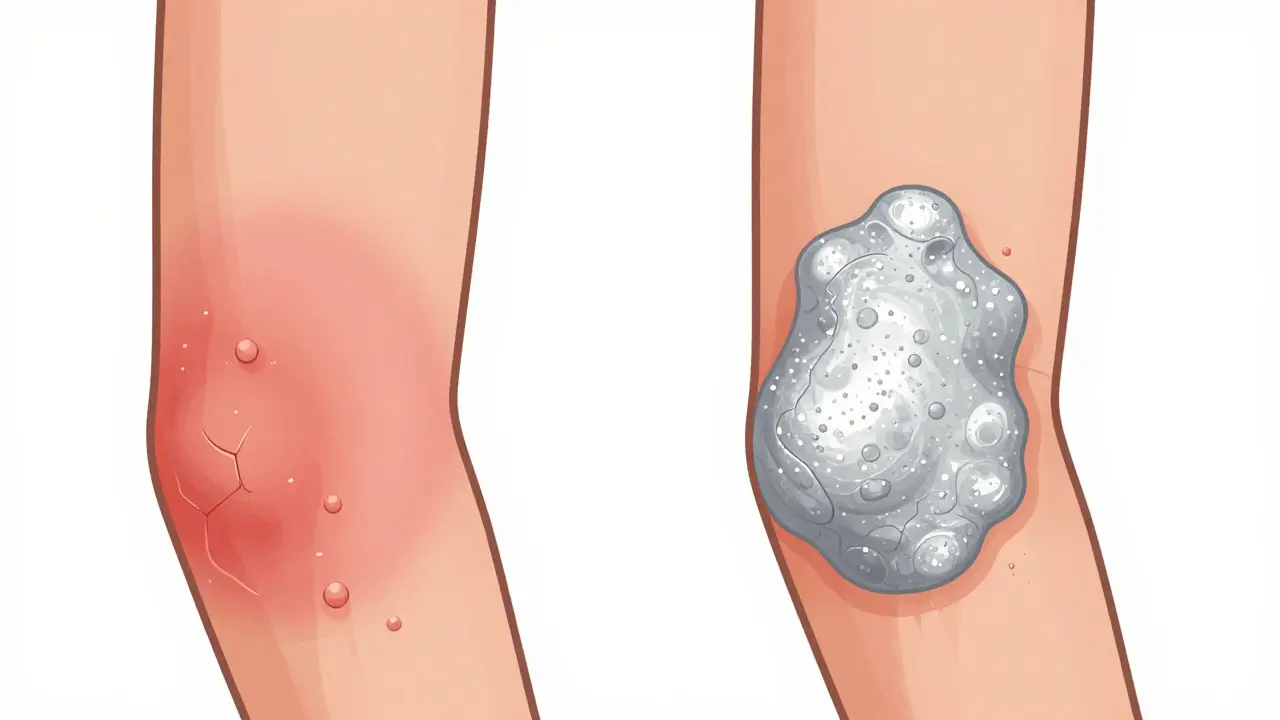
One of the fastest ways to tell eczema and psoriasis apart is by location. Think of your body like a map. Eczema loves the bends and folds. You’ll most often find it on the inside of your elbows, behind your knees, on the neck, wrists, and ankles. In babies, it’s common on the cheeks and scalp. This pattern isn’t random - it’s tied to how the immune system reacts in skin that’s more sensitive and prone to moisture loss. Psoriasis, on the other hand, prefers the outside edges. It likes the outer elbows, the front of the knees, the scalp, lower back, and even the nails. If you see thick patches on the outside of your joints, that’s a strong signal. A 2020 study of over 1,200 patients found that 88.6% of psoriasis cases affected extensor surfaces, while only 9.1% of eczema cases did. That’s a massive difference. There’s one exception: inverse psoriasis. It can appear in skin folds like the armpits or groin. But here’s how to spot it - it’s smooth, shiny, and doesn’t have the thick, flaky scale you’d see in plaque psoriasis. Eczema in those areas looks more like raw, weepy skin.What the Rash Actually Looks Like
Now look closer. Eczema usually has blurry edges. The borders between the rash and normal skin aren’t sharp. The color changes depending on your skin tone. On lighter skin, it’s bright red. On darker skin, it can look purple, gray, or ashen. The surface is often dry, cracked, or even oozing - especially during flare-ups. You might notice crusts or tiny weepy spots. Over time, repeated scratching can make the skin thick and leathery, a sign called lichenification. Psoriasis is the opposite. It has clear, defined borders, like a stamp pressed onto the skin. The patches are raised, not flat. The hallmark is thick, silvery-white scales that stick to the skin. These aren’t just flakes - they’re heavy, stubborn layers. When you gently scrape them off, you might see tiny spots of blood underneath. That’s the Auspitz sign, and it’s almost never seen in eczema. A 2023 study in the British Journal of Dermatology found that 78% of psoriasis lesions had visible scaling, compared to just 32% of eczema cases. On darker skin tones, psoriasis doesn’t look red. It appears as dark brown, violet, or ashen patches. The scale might be finer, but it’s still there. Many people with darker skin are misdiagnosed because doctors only recognize the classic red plaque version.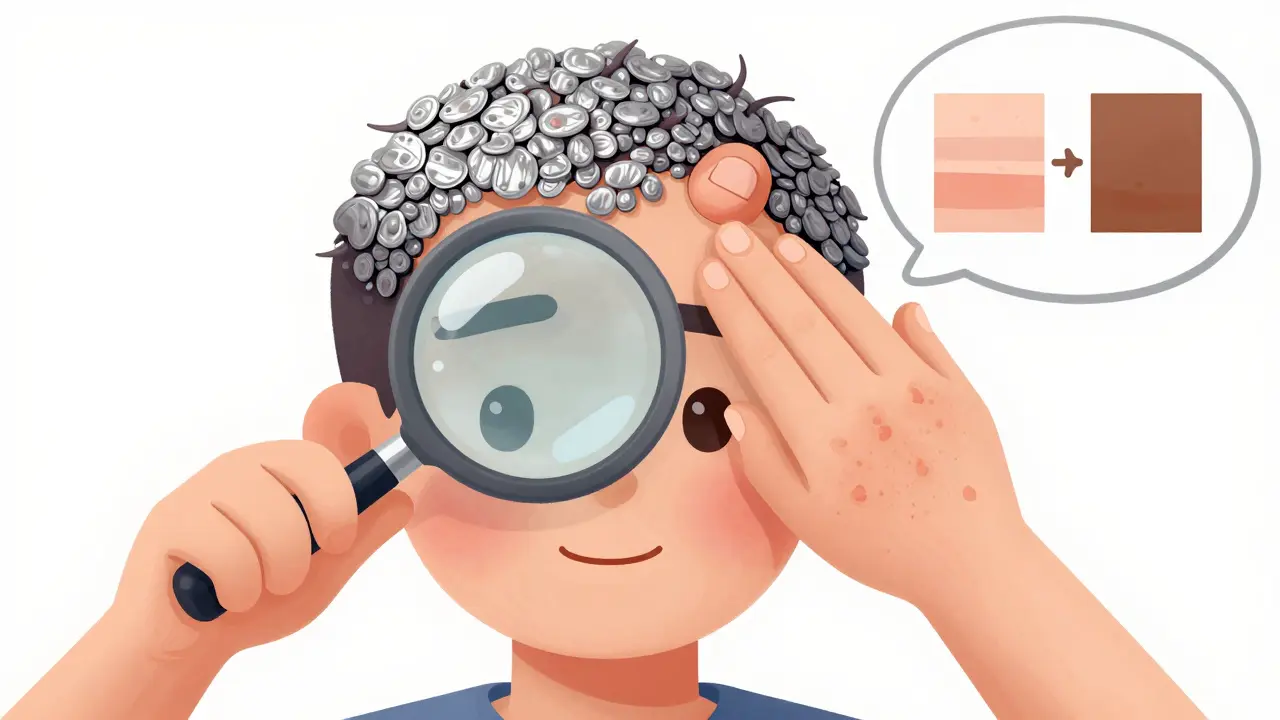
Nails and Skin Texture Give It Away
Nail changes are a big clue. Psoriasis can mess with your nails in ways eczema never does. Look for tiny pits in the nail surface - like someone stuck a pin in it. Or see if the nail is lifting from the nail bed. That’s called onycholysis. About half of people with psoriasis get this. Eczema? Rarely affects nails. If it does, you might see ridges or discoloration, but never true pitting. The texture of the skin around the rash matters too. Eczema often feels wet, sticky, or weepy. You might even notice crusts that look like dried honey. Psoriasis stays dry. Even when it’s flaring, it doesn’t ooze. It’s more like armor - hard, scaly, and stubborn. There’s another trick: the Koebner phenomenon. If you get a cut, burn, or scrape and new patches show up right at the injury site, that’s a sign of psoriasis. It happens in 25-30% of people with psoriasis. It’s rare in eczema. If you’ve ever noticed a rash appearing after scratching too hard, that’s more likely psoriasis.How Skin of Color Changes the Picture
This is critical - most textbooks still show eczema and psoriasis on white skin. But that’s not the real world. People with darker skin (Fitzpatrick IV-VI) experience these conditions differently. Eczema on darker skin doesn’t look red. It looks darker than the surrounding skin - hyperpigmented - or sometimes lighter - hypopigmented. The scaling is often subtle, so it’s easy to miss. Many patients are told they’re just “dry,” when it’s actually eczema. Psoriasis on darker skin doesn’t look bright red either. It shows up as deep purple, dark brown, or grayish. The scale might be fine, not thick. But here’s a key sign: a light ring or halo around the patch. A 2023 study found this halo appears in 68% of psoriasis cases on darker skin - and it’s not seen in eczema. The problem? A 2023 survey of 500 dermatologists found 68% felt undertrained to diagnose these conditions on darker skin. That means delays. Patients of color wait an average of 14.3 months for a correct diagnosis - compared to just 5.2 months for white patients. Visual recognition isn’t just about accuracy - it’s about equity.
What You Can Do at Home
You don’t need a dermatologist to start noticing differences. Try the scale test. Gently scrape a patch with a glass slide or the edge of a credit card. If thick, silvery scales come off and you see pinpoint bleeding underneath - that’s psoriasis. If it’s fine, powdery flakes with no bleeding - that’s eczema. Take photos. Use the same lighting and angle every time. Psoriasis plaques stay stable - they don’t change much day to day. Eczema flares and fades quickly. If your rash disappears after moisturizing and comes back with soap or stress, it’s likely eczema. If it stays stubborn, even with lotions, it’s probably psoriasis. There are now AI tools that can help. In January 2024, the FDA approved the first app - DermAI Psoriasis/Eczema Classifier - that analyzes smartphone photos against 250,000 verified cases. It’s 85% accurate. But here’s the catch: it’s less accurate on darker skin. One study showed 22% lower accuracy for skin types V-VI. So use it as a guide, not a diagnosis.Why Getting It Right Matters
Using the wrong treatment can make things worse. Eczema responds to moisturizers, gentle cleansers, and topical steroids. Psoriasis needs stronger treatments - like calcipotriene, phototherapy, or biologics that target the immune system. If you treat psoriasis like eczema, you might use too much steroid cream, thinning the skin. If you treat eczema like psoriasis, you might use harsh scaling agents that dry it out even more. A 2022 study in the Journal of the American Academy of Dermatology found that 15-20% of cases are misdiagnosed. That’s one in five people getting the wrong care. The cost? More itching, more sleepless nights, more anxiety, and more money spent on treatments that don’t work. The good news? Dermatology is changing. New training programs now require 40 hours of skin of color education - up from just 8 hours in 2019. A global registry called GRSCD launched in 2024 to collect 100,000 images of skin conditions across all skin tones. And tools like multispectral imaging - which analyzes how skin reflects light - are hitting 92.7% accuracy in research labs. But until those tools are everywhere, your eyes are your best diagnostic tool. Look at location. Look at borders. Look at scales. Look at nails. Look at how it changes with triggers. You don’t need a medical degree to spot the difference - just a little knowledge and attention.Can eczema turn into psoriasis?
No, eczema cannot turn into psoriasis. They are two separate conditions with different causes. Eczema is triggered by environmental factors and immune overreaction to irritants. Psoriasis is an autoimmune disorder where the body attacks its own skin cells. You can have both at the same time, but one doesn’t evolve into the other.
Why does psoriasis have silvery scales but eczema doesn’t?
Psoriasis speeds up skin cell production - cells go from the deep layer to the surface in days instead of weeks. These extra cells pile up, forming thick, dead layers that look like silvery scales. Eczema doesn’t cause this rapid turnover. Instead, the skin barrier breaks down, leading to dryness and fine flaking, not thick buildup.
Is psoriasis contagious?
No, psoriasis is not contagious. You can’t catch it from touching someone’s rash, sharing towels, or being near them. It’s caused by genetics and immune system dysfunction, not bacteria or viruses. The same goes for eczema - neither condition spreads from person to person.
Can stress cause both eczema and psoriasis?
Yes, stress is a common trigger for both. But how they react differs. Eczema flares up quickly with emotional stress - you might notice itching and redness within hours. Psoriasis flares are slower. Stress can push the immune system into overdrive, causing new plaques to form over days or weeks. Managing stress helps both, but it won’t cure either.
Should I use steroid cream for both?
Topical steroids can help both, but they’re used differently. Eczema responds well to low-to-mid strength steroids applied short-term. Psoriasis often needs stronger, longer-term use - but only on thick plaques. Using steroids on thin, sensitive skin (like the face or folds) for psoriasis can cause damage. Always follow a doctor’s guidance - overuse can thin skin or cause rebound flares.
Can I diagnose myself based on photos?
Photos can help you track changes, but they shouldn’t replace a professional diagnosis. Many conditions - like fungal infections, contact dermatitis, or even skin cancer - can mimic eczema or psoriasis. Even AI tools have limitations, especially on darker skin. If you’re unsure, see a dermatologist. A quick exam with a magnifying tool can give you answers in minutes.

Elan Ricarte
So let me get this straight - we’re now expected to be amateur dermatologists just to figure out if our skin is throwing a tantrum or staging a full-blown autoimmune coup? I got a rash behind my knee, moisturized it, and now I’m Googling ‘psoriasis vs. eczema’ at 2 a.m. while my cat judges me. Thanks, modern medicine. You’ve turned my body into a mystery novel with no ISBN.
And don’t even get me started on the ‘silvery scales’ thing. I scraped mine with a credit card like I was trying to get gum off my shoe. Got zero blood. Got zero answers. Just a weird feeling like I’m in a bad sci-fi movie where my skin is the alien.
Also, why is every study cited from 2020–2024? Did dermatology hit a time machine or is this just the internet’s way of pretending everything is brand new? I miss when doctors just said ‘it’s dry’ and handed me Vaseline. Simpler times.
And yeah, AI tools are 85% accurate - but only if you’re white. So if you’re brown? Congrats, you’re now a beta tester for medical bias. How’s that feel? Like a glitch in the matrix? Or just another Tuesday?
Susan Kwan
Wow. Just… wow. This post should be mandatory reading for every med student. I’ve had both eczema and psoriasis, and no one ever told me the difference until I was 32. I thought I was just ‘bad at skincare.’ Turns out I was being misdiagnosed by three different doctors who clearly only learned from textbooks with white models.
The nail pitting thing? Yeah. I had that. Thought it was just ‘bad nails.’ Turns out it was psoriasis. Took two years and a Reddit thread to figure it out. Meanwhile, my dermatologist kept prescribing hydrocortisone like it was a magic wand.
Also - the ‘halo sign’ on darker skin? That’s wild. I’ve never seen that in any textbook. Why aren’t we teaching this in med school? Or at least in the damn dermatology YouTube videos? I’m not mad. I’m just disappointed.
And yes - I used the credit card test. Got the pinpoint bleeding. Felt like a forensic scientist. And yes - I cried. Not from pain. From relief.
Ritteka Goyal
OMG I LOVE THIS POST SO MUCH!! I AM FROM INDIA AND I HAVE PSORIASIS SINCE I WAS 14 AND NO ONE EVER TOLD ME THE DIFFERENCE BETWEEN ECEMA AND PSO I THOUGHT IT WAS JUST DRY SKIN UNTIL I WENT TO A DOCTOR IN MUMBAI AND SHE SAID OH THIS IS PSORIASIS HONEY ITS AUTOIMMUNE!! I WAS LIKE WHAT??
AND THE HALO THING?? YES YES YES!! MY PATCHES ON MY ELBOWS LOOK LIKE THEY HAVE A PURPLE GLOW AROUND THEM AND I THOUGHT IT WAS JUST LIGHTING BUT NOW I KNOW ITS A SIGN!! I AM SO HAPPY I FOUND THIS!!
AND THE AI THING?? LOL I TRIED IT WITH MY PHONE AND IT SAID ECEMA BUT I KNEW IT WAS PSO BECAUSE MY NAILS ARE PITTIED AND IT DOESNT GO AWAY EVEN WITH COCONUT OIL!!
INDIA NEEDS MORE OF THIS CONTENT!! I WANT TO SHARE THIS WITH EVERYONE IN MY VILLAGE!! THEY ALL THINK ITS JUST ALLERGIES OR BAD WATER!!
PS: I LOVE THE PART ABOUT DERMATOLOGISTS BEING UNDERTRAINED!! I WAS TOLD BY ONE DOCTOR THAT I JUST NEED TO STOP EATING SPICY FOOD!! I WAS LIKE I’M A VEGAN AND I EAT ONLY RICE AND DAL??
THANK YOU FOR WRITING THIS!! YOU ARE A LIFESAVER!!
Chelsea Deflyss
So let me get this straight - you’re telling me that people with darker skin have been getting misdiagnosed for decades because doctors are lazy and only trained on white skin? And now we’re supposed to be impressed because they’re finally adding 40 hours of training? That’s like saying ‘we used to teach kids to read using scrolls, now we use PDFs - progress!’
And you think the AI tool is ‘85% accurate’? Bro. That’s not accuracy. That’s a coin flip with extra steps. And it’s worse on brown skin? Shocking. Never seen that before. /s
Also - ‘use photos to track changes’? Yeah, because nothing says ‘medical diagnosis’ like a blurry selfie taken in bathroom lighting while holding your phone at a 47-degree angle. I’m not a dermatologist. I’m a human being with a rash. Don’t turn my body into a TikTok challenge.
And psoriasis isn’t contagious? Tell that to my cousin who refused to hug me for three years because ‘it looked like leprosy.’ I’m not mad. I’m just tired.
MANI V
Let me just say - I’ve been living with psoriasis for 17 years. I’ve been told I have eczema. I’ve been told I have fungal infection. I’ve been told it’s stress. I’ve been told it’s God’s punishment. I’ve been told to ‘pray more.’
And now you’re telling me the real signs? The silvery scales? The Auspitz? The Koebner? The halo? I feel like I’ve been handed a decoder ring after years of wandering in the dark.
But here’s the thing - no one in my family ever understood. My mom said ‘you’re just being dramatic.’ My boss said ‘just cover it up.’ My ex said ‘it’s gross.’
So yeah - I’m grateful for the info. But I’m not grateful for the system that made me suffer alone for so long.
And to the dermatologists reading this: if you’re not trained on skin of color, you’re not trained at all. Period. I’m not asking. I’m telling.
Ryan Vargas
Let’s zoom out for a second. We’re treating skin conditions like they’re software bugs - just ‘glitches’ in the system that can be fixed with apps and algorithms. But here’s the deeper truth: eczema and psoriasis aren’t just skin-deep. They’re symptoms of a society that commodifies health, ignores racial disparity in medicine, and outsources diagnosis to Silicon Valley startups with venture capital funding.
The fact that a 2023 survey found 68% of dermatologists feel ‘undertrained’ on darker skin? That’s not negligence. That’s systemic. It’s the same pattern as maternal mortality, cardiovascular misdiagnosis, and chronic pain under-treatment in Black and Brown communities.
AI tools? They’re trained on datasets that are 89% white skin. So of course they fail. That’s not a bug - it’s a feature. Designed to exclude. The ‘halo sign’? It’s not just a dermatological clue - it’s a metaphor. A ring around the truth that no one wanted to see until now.
And the real tragedy? We’re celebrating ‘progress’ when what we need is justice. Not better algorithms. Better accountability. Not more studies. More funding for clinics in marginalized communities. Not a 40-hour training module. A complete overhaul of medical education.
So yes - I’m glad this post exists. But don’t mistake awareness for change. We’re still waiting for the latter.
Tasha Lake
As someone who works in dermatology research, I’ve seen the data firsthand. The 85% AI accuracy rate? That’s based on curated datasets from tertiary care centers - not primary care or community clinics where most patients actually get seen.
And the 22% drop in accuracy on skin types V-VI? That’s not a technical limitation. That’s a data gap. We’ve collected over 120,000 images for GRSCD, but only 18% are from non-white populations. Why? Because most image repositories are sourced from Western hospitals with homogeneous patient pools.
Also - the Koebner phenomenon? It’s not just ‘25-30%’ - it’s a key diagnostic red flag. I’ve seen patients develop psoriatic plaques along surgical scars, tattoo lines, even burn marks. It’s wild. And it’s underreported because most clinicians don’t ask about trauma history.
And for the love of science - please stop calling it ‘the scale test’ with a credit card. That’s not clinical. That’s a TikTok hack. We need standardized dermoscopy, not DIY dermatology.
But I’m glad this is getting attention. We’re close. Just not there yet.
Brett Pouser
As a guy who grew up in Nigeria and now lives in Atlanta, I’ve seen both sides. In Lagos, my auntie put shea butter and turmeric on my rash. In Atlanta, my dermatologist prescribed a steroid cream and told me to ‘avoid stress.’
Neither worked. Not really.
Then I found this post. And the ‘halo’ thing? Oh man. I’ve had that for years. Thought it was just a weird shadow. Now I know it’s psoriasis. And the nail pitting? Yeah. I’ve had that since I was 16. Thought it was ‘just how my nails are.’
What’s wild is how culture shapes diagnosis. In Nigeria, people say ‘it’s the heat.’ In the U.S., it’s ‘stress.’ In India, it’s ‘bad karma.’ In my family? It’s ‘you’re too sensitive.’
But here’s the truth: skin doesn’t care about borders. It doesn’t care about your nationality, your religion, or your Instagram feed. It just reacts. And if we stop looking at it through a cultural lens - and start looking at it with real observation - we might actually heal.
Thanks for writing this. I’m sharing it with my whole WhatsApp group.
Simon Critchley
LOL I JUST TRIED THE CREDIT CARD TEST ON MY ELBOW AND GOT A TINY BLOOD DOT 😍 I WAS LIKE ‘OH MY GOD I’M A MEDICAL GENIUS’ 🤓
Also - psoriasis isn’t contagious? Bro. I had a coworker who refused to sit next to me for 6 months. I showed her this post. She apologized. Then asked if I could ‘lend her my skin’ so she could use the AI app to ‘test her own rash.’ I said no. She cried. I felt bad. But also… no. Your skin is not a diagnostic tool, Karen.
Also - I used to think eczema was just ‘dry skin.’ Now I know it’s a full-on barrier breakdown. And psoriasis? It’s like your body’s immune system is doing a rave in your dermis and forgot to turn off the strobe lights.
Also - the AI app? I tried it. Said ‘eczema.’ I said ‘nope.’ Took a pic of my scalp. Said ‘psoriasis.’ I said ‘BINGO.’ Then I screamed. My dog ran away.
TL;DR - this post saved my life. Also, I’m now obsessed with skin morphology. I’ve started a subreddit. Join me. #SkinGeek
Frank Baumann
Let me tell you about the time I went to the dermatologist with a rash on my scalp. I said, ‘I think it’s psoriasis.’ He looked at it, said ‘probably eczema,’ and handed me a bottle of hydrocortisone. I went home. I cried. I Googled. I found this post. I took a picture. I went back. He looked at it again. Said ‘oh. You’re right. It’s psoriasis.’ I didn’t say a word. Just nodded. Took the prescription. Left. Didn’t thank him.
Because here’s the thing - I didn’t need him to be right. I needed him to be curious. To ask questions. To listen. To not assume I was just ‘overreacting.’
And now I’m telling everyone I know. My sister. My cousin. My barista. My dog walker. I’m not trying to be a hero. I’m just trying to make sure no one else has to wait 3 years to get diagnosed because their doctor didn’t know what a ‘halo’ looked like.
Also - I used the credit card. Got the blood. Felt like a detective. I’m now obsessed with skin texture. I touch my arms in public. People stare. I don’t care.
Angie Datuin
I just wanted to say thank you. I’ve had eczema since I was a baby. I’m 31 now. I’ve never seen anyone talk about how it changes on darker skin. I thought I was broken. I thought I was just ‘not moisturizing enough.’
This post made me feel seen. Not fixed. Not cured. Just seen.
I’m going to print this out and put it on my bathroom mirror. Not because I need to diagnose myself. But because I need to remember - I’m not alone. And I’m not wrong.
Sam Dickison
As a former medical student who switched to public health, I’ve seen how clinical guidelines lag behind reality. The ‘classic’ red plaque psoriasis? That’s the textbook version. The real-world version? It’s purple. It’s gray. It’s subtle. It’s hidden.
And here’s the kicker - most patients don’t even know to describe what they’re seeing. ‘It’s just dark’ isn’t a diagnosis. But it’s what they say because they’ve been told ‘it’s normal.’
This post isn’t just about skin. It’s about power. Who gets to define ‘normal’? Who gets to be seen? Who gets to be believed?
I’m not a dermatologist. But I’m a believer in listening. And this? This is listening made visible.
Random Guy
psoriasis is just your body’s way of saying ‘i’m tired of being ignored’
Elan Ricarte
Oh, so now you’re a dermatologist? Congrats. You scraped your elbow with a credit card and suddenly you’re an expert. Meanwhile, I’ve been living with this for 12 years and I still don’t know if my rash is psoriasis or just my body screaming ‘I HATE THIS WORLD.’
And now you’re telling me the AI tool is ‘less accurate on darker skin’? No shit. It was trained on 90% white faces. You think that’s an accident? Nah. It’s a feature. Like how facial recognition fails on Black faces. Same playbook.
So now what? We all start taking selfies with a credit card? Great. Next up: ‘How to diagnose melanoma using a selfie stick.’
And hey - thanks for the ‘halo sign.’ I’ve had that for years. Thought it was a shadow. Turns out it’s a symptom. And a metaphor. And a cry for help. All in one.
But seriously - stop treating skin like a quiz game. This isn’t a puzzle. It’s a person.