
Most people assume that if a generic drug has the same active ingredient as a brand-name drug, it will behave exactly the same in the body. And for the vast majority of cases, that’s true. But sometimes, people report strange side effects or unexpected reactions after switching to a generic version - even when their doctor says it’s "the same thing." So why does this happen? And more importantly, should you be worried?
Generics Are Supposed to Be Identical - So Why the Differences?
The U.S. Food and Drug Administration (FDA) requires generic drugs to contain the same active ingredient, strength, dosage form, and route of administration as the original brand-name drug. They must also prove they’re absorbed into the bloodstream at nearly the same rate and amount - within 80% to 125% of the brand-name version. That’s called bioequivalence. For most medications, this tiny variation doesn’t matter. But for drugs with a narrow therapeutic index, even small differences can matter.
Drugs like warfarin, levothyroxine, phenytoin, and digoxin fall into this category. Their effective dose range is very tight. Take too little, and the drug doesn’t work. Take too much, and you risk serious harm - bleeding, thyroid dysfunction, seizures, or heart rhythm problems. That’s why the FDA applies stricter bioequivalence rules for these: 90% to 112% instead of the usual range. Still, even with tighter standards, some patients report changes after switching generics.
It’s Not the Active Ingredient - It’s the Inactive Ones
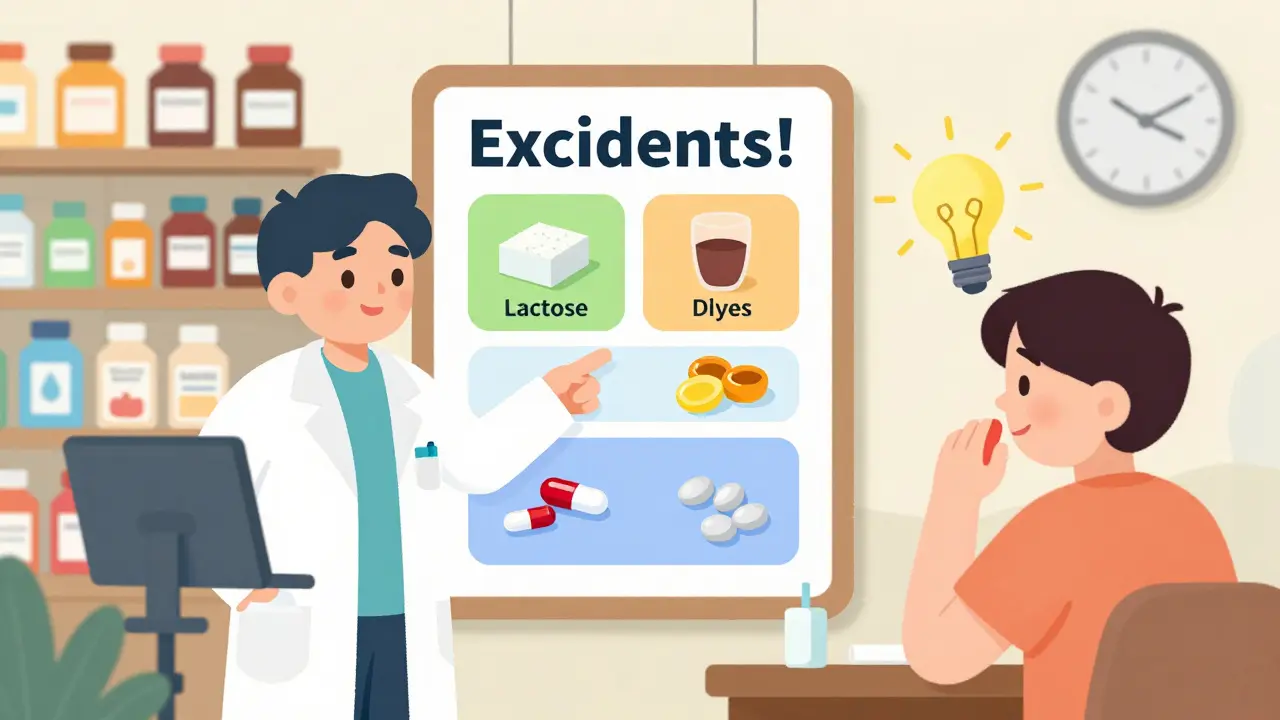
The real culprits behind most unexpected reactions aren’t the active ingredients. They’re the inactive ones - the fillers, binders, dyes, and preservatives that hold the pill together or help it dissolve. These are called excipients. Brand-name manufacturers often stick with the same excipients for years. Generic makers, however, may switch suppliers or formulas between batches to cut costs or improve production. And sometimes, those changes affect sensitive patients.
One documented case involved a patient taking levothyroxine. The brand-name version didn’t cause issues, but after switching to a generic, they developed bloating, diarrhea, and fatigue. Turns out, the generic used lactose as a filler. The patient had a mild, undiagnosed lactose intolerance. The brand-name version used a different filler - no lactose. Same active ingredient. Different excipient. Different symptoms.
Another example: some generic sertraline tablets use sodium benzoate as a preservative, while the brand version uses hydrochloride salt. For people with certain metabolic conditions or those taking other medications that affect liver enzymes, this small difference can slightly alter how the body processes the drug. It’s rare - but it happens.
Psychology Plays a Bigger Role Than You Think
It’s not just chemistry. Your brain matters too. There’s a well-documented phenomenon called the nocebo effect - when you expect something to cause side effects, your body actually starts showing them, even if the drug hasn’t changed.
A 2022 Kaiser Family Foundation survey found that nearly half of patients believed generics work differently than brand-name drugs. Over a quarter said they experienced more side effects with generics. But when researchers looked at actual medical records, only 3.7% of those reports matched up with measurable physiological changes. The rest? Likely nocebo.
Think about it: if you’ve been on a brand-name drug for years and your doctor suddenly switches you to a cheaper generic, you might start watching your body like a hawk. A slight headache? Must be the generic. Trouble sleeping? Must be the generic. That’s not always the drug’s fault - it’s your expectation shaping your experience.
Real Cases: What Actually Went Wrong?
Let’s look at warfarin, one of the most commonly reported drugs for "generic interaction issues." On patient forums like Inspire.com, over 100 people reported strange INR fluctuations after switching generics. INR measures how long it takes your blood to clot. Too high, you risk bleeding. Too low, you risk clots.
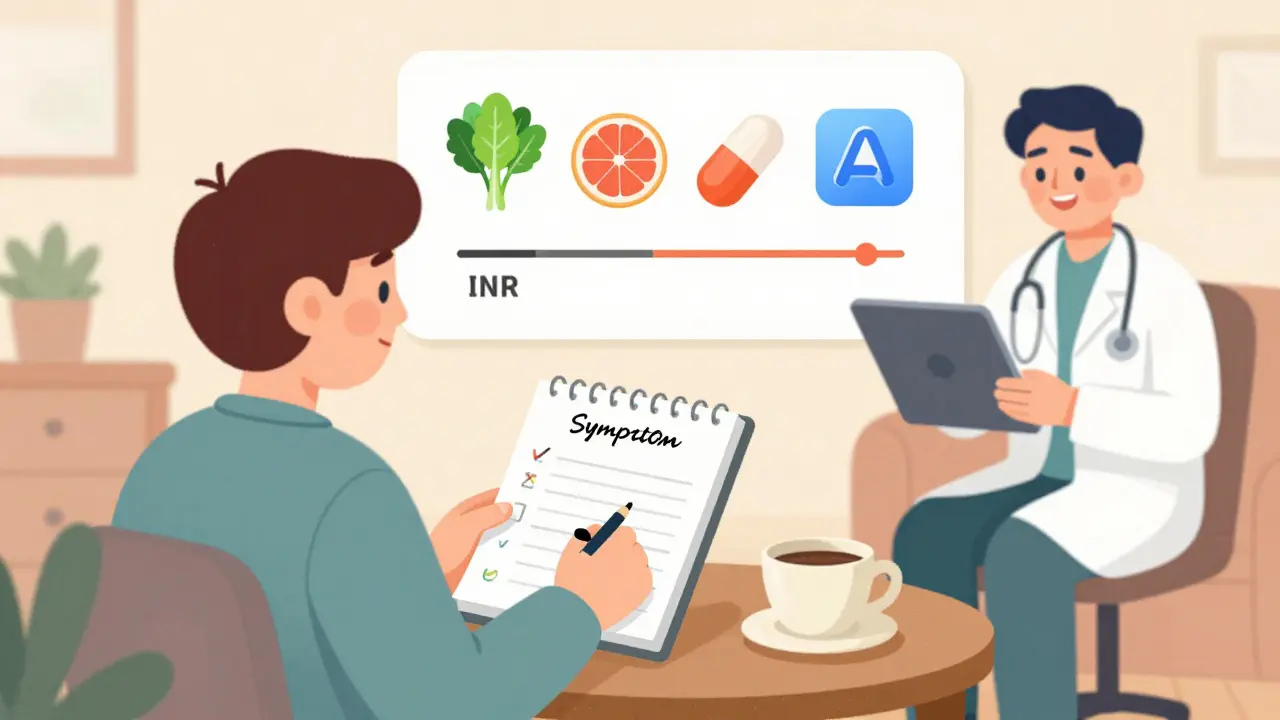
Pharmacists followed up on these cases. What did they find? In 89% of cases, the real cause wasn’t the generic pill. It was dietary changes - eating more leafy greens (which affect vitamin K levels), starting a new supplement, or even drinking more grapefruit juice. These are known to interfere with warfarin. But because the switch to generic happened around the same time, patients blamed the pill.
Another study in the Journal of Clinical Pharmacy and Therapeutics reviewed 127 patient reports over five years where people claimed generics caused different side effects. Only 17 cases - just 13.4% - had actual pharmacological reasons. The rest? Dosing errors, missed pills, or psychological factors.
What Should You Do If You Notice a Change?
If you switch to a generic and feel different - whether it’s more fatigue, dizziness, nausea, or mood changes - don’t panic. But don’t ignore it either.
- Check the pill. Look at the imprint code on the tablet or capsule. Generic manufacturers use different codes. If you’ve switched generics more than once, you might be getting different versions. Write down the name and imprint.
- Don’t stop taking it. Abruptly stopping a medication like warfarin or thyroid hormone can be dangerous. Talk to your pharmacist or doctor first.
- Ask about excipients. Your pharmacist can tell you what’s in each version. If you have known allergies (like to lactose, gluten, or dyes), ask if the generic contains them.
- Request consistency. If you’re on a narrow therapeutic index drug, ask your doctor to prescribe a specific generic manufacturer. Many hospitals do this for critical medications. You can too.
- Track your symptoms. Keep a simple log: date, medication, dose, symptoms. Bring it to your next appointment. Patterns help doctors spot real issues.
Healthcare Providers Are Catching Up
Doctors and pharmacists are now trained to recognize these issues. The American Pharmacists Association includes 3.5 hours of continuing education on generic excipients and patient communication. Hospitals often use a single preferred generic manufacturer for critical drugs like levothyroxine to avoid variability.
The FDA’s 2023 pilot program using AI to track real-world drug interactions has already analyzed over 12 million prescriptions. So far, it confirms what we already know: 99.8% of the time, generics behave exactly like brand-name drugs. But the remaining 0.2%? That’s where the real work is - identifying the rare cases where excipients, patient sensitivity, or dosing errors cause problems.
Bottom Line: Trust the Science, But Stay Aware
Generic drugs save the U.S. healthcare system over $250 billion a year. They’re safe, effective, and rigorously tested. For most people, switching to a generic is a smart, cost-saving move with zero downside.
But if you’re on a medication where small changes matter - like warfarin, thyroid hormone, or seizure drugs - be proactive. Know what’s in your pill. Ask questions. Don’t assume all generics are the same. And if something feels off, speak up. It’s not your imagination. It might be the filler.
The goal isn’t to scare you away from generics. It’s to help you use them wisely. Because when you understand the difference between active ingredients and inactive ones, you take control - not just of your health, but of your treatment.

Jacob Paterson
Oh wow, another ‘trust the science’ lecture. Meanwhile, my cousin switched from Synthroid to a generic and ended up in the ER with atrial fibrillation. Yeah, sure, ‘99.8% safe’ - until it’s your heart failing. The FDA doesn’t test for how your body *feels*, just how much drug hits your bloodstream. Excipients? Please. That’s just corporate speak for ‘we don’t care if your gut hates it.’
Matthew Maxwell
It is imperative to clarify that the regulatory framework governing bioequivalence is neither arbitrary nor lax. The 80–125% confidence interval for AUC and Cmax, as stipulated by the FDA’s Guidance for Industry on Bioequivalence, is statistically validated across thousands of pharmacokinetic studies. To conflate anecdotal reports with systemic failure is a logical fallacy bordering on anti-scientific sentiment.
Pooja Kumari
OMG I had the EXACT same thing happen!! I was on the brand levothyroxine for 7 years and felt AMAZING, like I had super energy and my skin was glowing?? Then my insurance switched me to this generic and I turned into a zombie. Bloating, brain fog, crying for no reason, my hair was falling out in clumps?? I cried for three days straight. I even went to a naturopath and she said my cortisol was through the roof. I switched back to brand and now I’m back to my old self. I’m so mad because I know I’m not the only one. Why do they make us pay more for the brand if the generic is ‘the same’?? I just don’t understand how they can be so heartless!! 💔😭
Maggie Noe
It’s wild how we treat medicine like a magic pill instead of a conversation with our biology. 🤔 The active ingredient is just the script - the excipients are the delivery system, the tone, the rhythm. If your body’s been singing along to Synthroid for a decade, suddenly switching to a generic is like changing the band mid-song. The lyrics are the same, but the instrumentation? Totally different. And if you’re sensitive? You notice the dissonance. It’s not ‘nocebo’ - it’s your body whispering, ‘Hey, something’s off.’
Heather Wilson
It’s not about the drug. It’s about compliance. People forget to take pills. They change diets. They start taking ‘natural’ supplements that interact with warfarin. Then they blame the generic. The real issue is lazy patients and overworked pharmacists who don’t follow up. This article is a distraction from systemic healthcare failures.
Jeffrey Hu
Look, I’m a pharmacist. I’ve seen this a hundred times. A patient comes in saying their generic Adderall doesn’t work. Turns out they switched from the 10mg tablet to the 20mg capsule and thought it was the same dose. Or they stopped taking it for three days and thought the generic was ‘weaker.’ The real problem? Patient education. Not the pill.
Drew Pearlman
Hey, I just want to say - if you’re feeling weird after a switch, you’re not crazy. I was on warfarin for years and switched generics three times. Each time I felt off, but I didn’t say anything because I didn’t want to be ‘that guy.’ Then I started tracking my INR and symptoms in a notebook. One generic had a different dye - I got a weird rash. I asked my pharmacist and they switched me back. It wasn’t a big deal once I spoke up. You deserve to feel good. Don’t stay quiet.
Chris Kauwe
The commodification of pharmaceuticals is a symptom of late-stage capitalism’s erosion of biological sovereignty. Generic manufacturers operate under profit-maximizing imperatives that prioritize supply chain efficiency over physiological fidelity. The FDA’s bioequivalence thresholds are relics of a pre-precision-medicine era - a regulatory lag that treats the human body as a black box. We must demand pharmacogenomic labeling, not just chemical equivalence.
Meghan Hammack
YOU ARE NOT ALONE. Seriously. I was terrified to say anything too - scared I’d sound like a hypochondriac. But when I finally told my doctor, she said, ‘Good you noticed. That’s why we’re here.’ I got my prescription switched back to the brand. It cost more, but I slept again. Your body knows. Trust it. And tell someone. 💪❤️
RAJAT KD
Excipients matter. Lactose intolerance is underdiagnosed. I’ve seen patients with chronic GI issues resolve after switching from a lactose-containing generic levothyroxine to a lactose-free version. The science is clear. The system is slow. But change is possible.
Angela Stanton
So let me get this straight - 99.8% of people are fine, but the 0.2%? They’re the ones who end up in the ER. And you’re telling me to just ‘track symptoms’? Meanwhile, my insurance won’t cover the brand, and my doctor won’t fight for it. This isn’t empowerment - it’s gaslighting with footnotes. 🤷♀️💊 #GenericHell