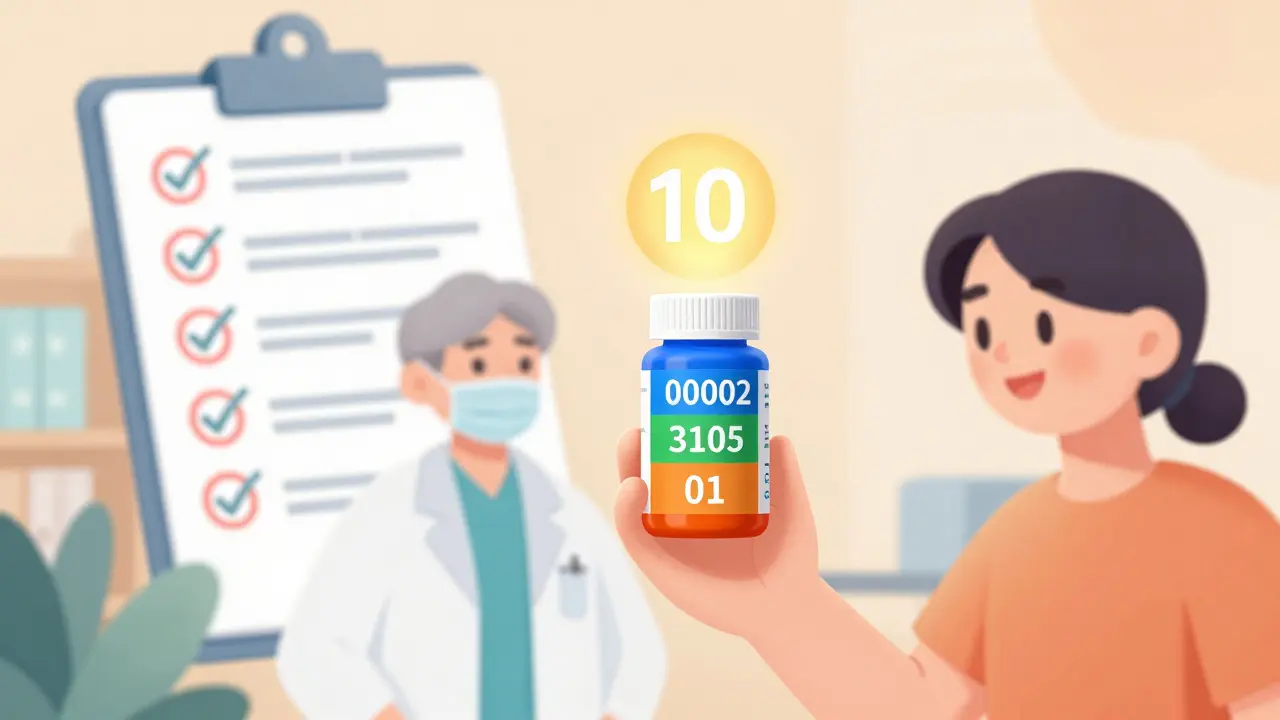
Getting the right medication isn’t just about matching a name on a prescription. It’s about making sure the exact drug, strength, form, and package size are handed to the patient. One small mistake - swapping a 10mg tablet for a 20mg capsule - can lead to serious harm. The NDC number is the key to preventing these errors. It’s not just a barcode or a label. It’s a detailed code that tells you everything you need to know about the medicine in your hand.
What Is the NDC Number?
The National Drug Code, or NDC, is a unique 10-digit number assigned by the U.S. Food and Drug Administration (FDA) to every prescription and over-the-counter medication sold in the United States. It’s required by law under the Drug Listing Act of 1972. Every pill bottle, vial, or blister pack has it printed on the label. This number isn’t random. It’s broken into three clear segments that each answer a specific question:
- Who made it?
- What is it exactly?
- How is it packaged?
Without this code, pharmacies, hospitals, and insurers wouldn’t be able to track, bill, or verify medications accurately. The FDA’s National Drug Code Directory lists over 150,000 active products as of October 2023. That means every time you pick up a prescription, someone is using the NDC to confirm it’s the right one.
The Three Segments of the NDC
Think of the NDC like a phone number with area code, exchange, and line number. Each part has meaning.
Segment 1: Labeler Code (4-6 digits)
This identifies the company that makes, repacks, or distributes the drug. It’s assigned by the FDA. For example, if you see “00002” at the start of an NDC, that’s Eli Lilly. “50458” belongs to Teva. There are around 3,500 active labelers in the system. If the labeler code doesn’t match what you expect - say, you ordered a generic from Teva but the NDC says it’s from a company you’ve never heard of - that’s a red flag.
Segment 2: Product Code (3-4 digits)
This is the most critical part. It tells you the active ingredient, strength, and dosage form. For example, “3105” might mean 10mg capsules of fluoxetine (Prozac). “4465” could mean 20mg capsules of the same drug. The difference between these two codes is a 100% increase in dose. One mistake here can be deadly. The product code doesn’t include inactive ingredients like fillers or dyes. So two pills might look identical and have the same NDC product code but differ in allergens or absorption rates. Always cross-check with the prescribing information.
Segment 3: Package Code (1-2 digits)
This tells you the size and type of packaging. “01” might mean a 30-count bottle. “02” could mean a 100-count bottle. “10” might mean a 100-unit blister pack. If your prescription says 30 tablets but the NDC shows a package code for 100, something’s off. You might have received a bulk container meant for a hospital, not a retail patient.
Reading the NDC Format
The NDC is printed in one of three formats on the packaging:
- 4-4-2 (e.g., 1234-5678-90)
- 5-3-2 (e.g., 12345-678-90)
- 5-4-1 (e.g., 12345-6789-0)
But here’s the catch: when you bill insurance, you need an 11-digit version in the 5-4-2 format. That means you have to convert it.
For example:
- Original: 5-3-2 → 12345-678-90
Converted: 12345-0678-90 (add a zero to make the product code 4 digits) - Original: 4-4-2 → 1234-5678-90
Converted: 01234-5678-90 (add a zero to make the labeler code 5 digits) - Original: 5-4-1 → 12345-6789-0
Converted: 12345-6789-00 (add a zero to make the package code 2 digits)
Most pharmacy systems auto-convert this, but if you’re doing manual checks - like in a clinic or during inventory - you need to know how. Misreading the format leads to billing errors, delayed refills, or worse, wrong meds being dispensed.
How to Verify the NDC Step by Step
Here’s how to use the NDC to confirm the right medication every time:
- Locate the NDC on the packaging. It’s usually printed near the barcode, often in a red circle or bold text. Don’t assume - always check the actual container, not just the prescription label.
- Identify the format. Count the digits between the hyphens. Is it 4-4-2? 5-3-2? 5-4-1? This tells you how to split it correctly.
- Break it into the three segments. Write them down: Labeler, Product, Package.
- Compare each segment to the prescription.
- Does the labeler match the brand or generic you ordered?
- Does the product code match the drug name, strength, and form? (e.g., tablet vs. liquid, 5mg vs. 10mg)
- Does the package code match the quantity? (e.g., 30 vs. 90 tablets)
- Convert to 11-digit billing format if needed. If you’re submitting a claim, add zeros where necessary to make it 5-4-2. Never use the 10-digit version for billing.
- Double-check with the FDA’s NDC Directory. Go to the FDA’s website or use their mobile app. Type in the full 11-digit code. It will show you the official product name, manufacturer, and approved use. If it doesn’t match what’s on the bottle - stop. Call the supplier.
Why This Matters: Real-World Mistakes
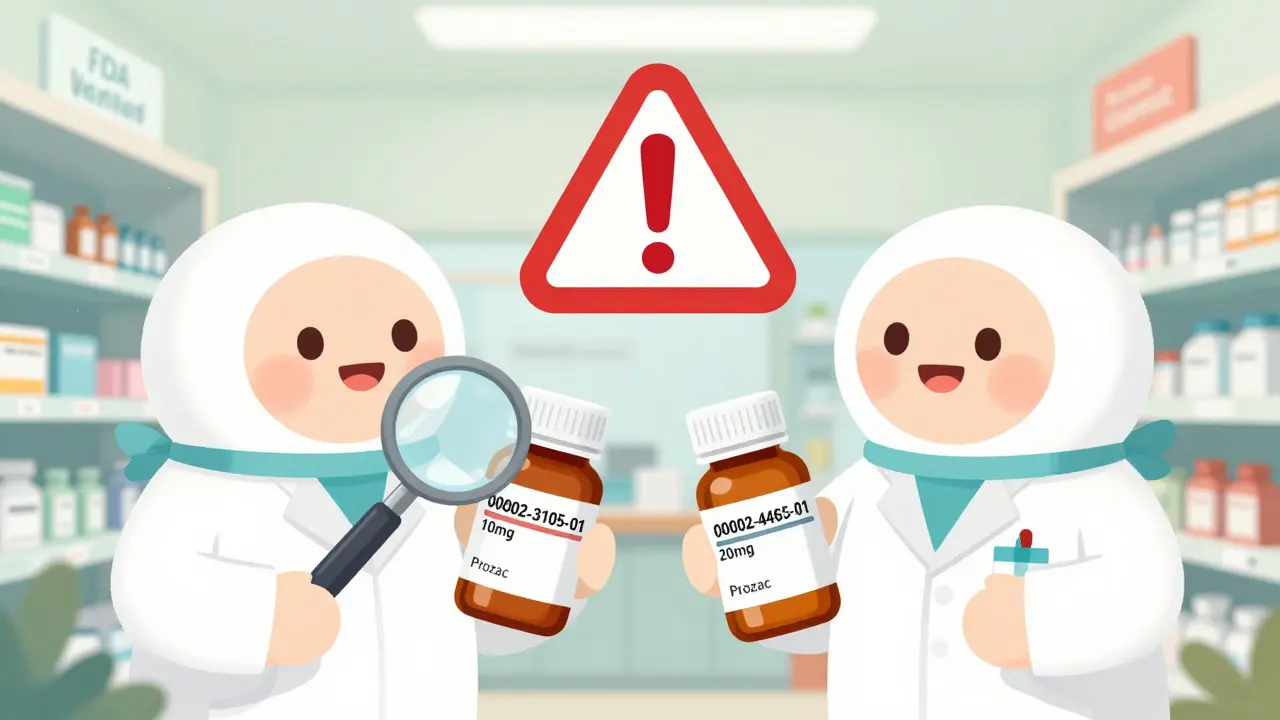
One pharmacist in Arizona caught a near-fatal error when a patient’s NDC was misread. The prescription was for Prozac 10mg capsules (NDC: 00002-3105-01). The pharmacy pulled a bottle labeled Prozac 20mg capsules (NDC: 00002-4465-01). The product code changed from 3105 to 4465 - a clear difference. But because the technician didn’t check the middle segment, they almost gave a double dose. The patient had a history of seizures. A 20mg dose could have triggered a seizure. The NDC saved the day.
On the flip side, a hospital tech in Ohio spent 20 minutes every shift fixing NDC format errors. A new shipment of insulin came with a 5-4-1 format. The billing system only accepted 5-4-2. They didn’t know to add a zero at the end. Claims were rejected. Patients missed doses. Training fixed it - but only after two weeks of delays.
A 2023 survey of 1,200 pharmacists found that 63% had at least one NDC-related mix-up per month. The most common? Mistaking the product code for the package code. Confusing 3105 (10mg) with 01 (30-count) is easy if you’re rushing.
Tools and Tips for Accuracy
Here’s what works:
- Use the FDA’s NDC Directory app. It’s free. Updated daily. Lets you scan barcodes or type in codes to verify instantly.
- Always verbalize the segments. Say it out loud: “Labeler: zero-zero-zero-zero-two. Product: three-one-oh-five. Package: zero-one.” Hearing it helps catch errors your eyes miss.
- Use two-person verification for high-risk drugs. Insulin, blood thinners, chemo - these need a second set of eyes. Studies show it adds 37 seconds per check but cuts errors by over 70%.
- Know your format conversions. Memorize the three rules: Add zero to labeler if it’s 4 digits. Add zero to product if it’s 3 digits. Add zero to package if it’s 1 digit.
Many pharmacies now use software that auto-converts and flags mismatches. But if you’re working in a small clinic, urgent care, or long-term care facility - you’re still doing this manually. Don’t skip the steps.
What’s Changing? The Future of NDC
The FDA is moving toward a 12-digit NDC by 2025. No more formats. No more conversions. Just one standard: 6-4-2. That means:
- Labeler code: 6 digits (to handle more manufacturers)
- Product code: 4 digits (fixed)
- Package code: 2 digits (fixed)
This will eliminate the confusion caused by today’s three formats. It’s already being tested by major manufacturers. But small pharmacies are worried. Upgrading systems costs money. Training staff takes time. Still, the goal is clear: reduce the 8.7% of pharmacy claims that get rejected because of NDC errors.
And it’s not just about billing. The Drug Supply Chain Security Act (DSCSA) now requires every package to be tracked using its NDC. By 2025, every pill bottle will have a digital fingerprint tied to its NDC. That means if a drug is recalled, you’ll know exactly which batch is affected - down to the individual bottle.
Final Checklist: NDC Verification
Before handing any medication to a patient, run through this:
- ✅ Did I find the NDC on the actual container?
- ✅ Did I count the digits to identify the format (4-4-2, 5-3-2, or 5-4-1)?
- ✅ Did I split it into labeler, product, and package?
- ✅ Does the product code match the prescribed strength and form?
- ✅ Does the package code match the quantity ordered?
- ✅ Did I convert to 5-4-2 if billing?
- ✅ Did I verify against the FDA’s NDC Directory?
If you answer yes to all of these, you’ve done your job. Medication safety isn’t about trust. It’s about verification. The NDC is your tool. Use it right.
What if the NDC on the bottle doesn’t match the prescription?
Stop. Do not dispense. Contact the prescribing pharmacy or provider immediately. There could be a mix-up in manufacturing, labeling, or ordering. Never assume the prescription is wrong. Double-check the NDC in the FDA’s directory. If the product listed there matches the bottle but not the script - the error is likely on the prescriber’s side. Always document the discrepancy.
Can two different drugs have the same NDC?
No. Each NDC is unique to one product. But two different brands of the same generic drug can have different NDCs because they’re made by different companies. For example, generic lisinopril from Teva and generic lisinopril from Mylan will have different labeler codes. The product code may be identical if strength and form are the same, but the full NDC will differ. Always verify the full 11-digit code.
Is the NDC the same as the barcode?
The barcode usually contains the 11-digit NDC, but they’re not the same thing. The NDC is the code itself - the numbers you read. The barcode is the machine-readable version of that code. If the barcode scans but the printed NDC doesn’t match the scanned result, the label is faulty. Always verify both. Never rely on the barcode alone.
Why do some NDCs have leading zeros?
Leading zeros are added during conversion to the 11-digit billing format. For example, a 4-digit labeler code like 1234 becomes 01234 to meet the 5-digit requirement. These zeros aren’t part of the original label - they’re added for systems that require fixed-length fields. The FDA’s official directory lists NDCs in their original 10-digit format. Always convert, don’t guess.
What should I do if the NDC is faded or unreadable?
Do not use the medication. Contact the supplier or manufacturer for a replacement. If it’s an emergency and you must dispense, call the FDA’s NDC hotline (1-855-543-3784) with the lot number and drug name. They can verify the product. Never guess the NDC from memory or assumption. A single digit wrong can be fatal.

Maddi Barnes
Okay so let me get this straight - we’re using a 10-digit code that’s split into three random-length segments, then we have to convert it to 11 digits with random zeros for billing, and if you mess up ONE digit, someone could die? 😅
And this is the system we trust with people’s lives? I mean, I get it - it’s not random, it’s *structured*… but it’s like building a house out of Legos and then saying ‘don’t turn the pink one sideways’.
Also - who thought ‘add a zero here, but only if it’s 4 digits and not 5’ was a good idea? Was there a meeting? Did someone say ‘I got this’ and then immediately go on vacation for 3 weeks?
Also also - I just scanned my insulin bottle and the barcode said one thing, the printed NDC said another. I’m not even mad. I’m just… impressed. 🤖💊
Benjamin Fox
This whole NDC thing is why America still works lmao
Somebody got paid to make this system and now we're all stuck with it
But hey at least we got the FDA yelling at manufacturers
USA!!! 🇺🇸
Michaela Jorstad
Thank you for this incredibly clear breakdown. I’ve worked in a small clinic for 12 years, and I’ve seen too many near-misses because someone skimmed the NDC and assumed the package size matched the script.
I especially appreciate the reminder to verify against the FDA directory - it’s easy to get lazy when you’ve seen the same code a thousand times. But one time, I caught a mislabeled amoxicillin because the product code said 500mg, but the FDA listed it as 250mg. Turned out the batch was misprinted. We held it. Called the distributor. Saved a kid from an allergic reaction.
It’s not glamorous work. But this? This is how we keep people alive.
Arshdeep Singh
You know what’s funny? You think this is complicated? In India, we don’t even have NDCs. We just trust the pharmacist. And guess what? We don’t have 8.7% rejection rates. We have 87% trust rates. Maybe the problem isn’t the code - it’s the obsession with control. Sometimes, human judgment is more reliable than a 12-digit algorithm.
Chris Beeley
Oh wow. So we’re going to a 12-digit NDC? 6-4-2? That’s… actually kind of elegant.
Let’s be real - the current system is a Rube Goldberg machine built by a committee that had too much coffee and not enough sleep. The fact that we’re still using 4-4-2, 5-3-2, and 5-4-1 in 2024 is a national embarrassment.
I work in health IT. I’ve spent 3 years fighting legacy systems that can’t handle variable-length NDCs. The new standard? It’s not just a fix - it’s a liberation.
Also - the DSCSA tracking? That’s the real game-changer. Imagine a world where you can trace a single pill back to the factory floor, the batch, the shipping truck, and the pharmacist who dispensed it. That’s not just safety - that’s accountability.
Yes, it costs money. Yes, it takes time. But if we don’t do this now, we’ll be fixing it in 2035 while another child dies from a 10mg vs. 20mg mix-up.
Let’s not wait for tragedy to force change. Let’s be smart.
Davis teo
So I just got off a call with my mom’s pharmacy.
She’s on 4 meds. 3 of them had NDC mismatches between the bottle and the e-prescription. The pharmacist said, ‘Oh, that happens all the time, we just go with what the system says.’
Wait. WHAT.
I asked if they checked the FDA directory. They said, ‘Nah, we just scan the barcode.’
So let me get this straight - we’ve got a system designed to prevent deadly errors, and we’re letting people skip the verification step because ‘it’s easier’?
And then we wonder why people die from medication errors?
I’m not angry. I’m just… disappointed.
My mom is 78. She doesn’t know what an NDC is. She trusts you.
And you’re just… scanning?
Ashley Paashuis
This is the most important post I’ve read all year.
I’m a nurse in a long-term care facility. We don’t have fancy software. We use paper logs, handwritten scripts, and a 1997 barcode scanner that beeps like a dying robot.
Every time we get a new med order, I read the NDC out loud to my partner. ‘Labeler: zero-zero-zero-zero-two. Product: three-one-oh-five. Package: zero-one.’
It sounds silly. But last month, we caught a wrong strength because I said ‘three-one-oh-five’ and she said ‘that’s not what the script says.’
Turns out, the script said 20mg - but the bottle was labeled 10mg. The labeler was right. The product code was wrong.
We called the pharmacy. They apologized. They sent a corrected batch.
That’s not luck. That’s procedure.
Thank you for giving me the words to explain why this matters. I’m printing this out and taping it to our med cart.
Robin bremer
bro i just realized the ncd code on my zoloft bottle was missing a zero and the app said it was a different drug 😭 i almost took it
now i just stare at the barcode like it's a sacred text
also i think the FDA is a cult and i'm scared
Jonathan Rutter
You people are acting like this is some kind of miracle system. Let me tell you something - I’ve worked in 3 different pharmacies. I’ve seen NDCs that didn’t match the drug name on the bottle. I’ve seen bottles with no NDC at all. I’ve seen techs just copy-paste the code from the last prescription.
The FDA directory? Most of us don’t even know it exists.
And the ‘11-digit billing format’? Half the pharmacies still use 10-digit. Insurance rejects claims. Patients don’t get their meds. They call. We panic. We call the manufacturer. They say ‘oh, that’s not our code.’
So we give them a different drug. Sometimes it works. Sometimes it doesn’t.
This isn’t about accuracy. This is about a broken system that’s held together by duct tape and hope.
And now you want to add 2 more digits?
Good luck.
I’m not saying don’t fix it.
I’m saying - you’re late.
People have been dying for years because of this. And now you’re giving us a PowerPoint?
Jeremy Williams
As someone who has spent 15 years working in international pharmaceutical logistics, I can say with absolute certainty that the U.S. NDC system - flawed as it is - is one of the most robust drug identification frameworks in the world.
Compare it to systems in the EU, where drug codes vary by country, or in parts of Asia where labeling is inconsistent, or in regions where counterfeit medications account for over 30% of the market.
The NDC isn’t perfect. But it is traceable, standardized, and federally enforced. Even with its quirks, it allows for real-time tracking, recalls, and audit trails that simply don’t exist elsewhere.
Yes, the format conversions are archaic. Yes, the zero-padding is confusing. But these are implementation issues - not design failures.
The real problem isn’t the NDC.
The problem is the lack of mandatory training for pharmacy technicians and the absence of federal oversight in small clinics.
Fix the training. Fix the accountability.
Then, the system will work.
And yes - I have personally prevented a fatal error by noticing a 3105 vs. 4465 mismatch. It was a Tuesday. I was tired. But I read the code anyway.
Because I know what happens when we don’t.
aine power
NDC. 11 digits. Zero padding. FDA directory. Got it. Done.
Jana Eiffel
There’s a deeper philosophical question here, buried beneath the digits and hyphens.
We live in a world that demands precision - in medicine, in finance, in law - yet we build systems that are intentionally ambiguous. We create codes with variable-length segments because ‘it’s easier to assign’. We force humans to convert numbers because ‘that’s how the legacy system works’. We rely on manual verification because ‘automation is too expensive’.
But why?
Is it because we fear perfect systems? Do we believe that if everything were perfectly tracked, we’d lose the human element? Or worse - that we’d have to admit we’ve been neglecting this for decades?
The NDC isn’t just a code.
It’s a mirror.
And what it reflects is this: we value safety enough to create a system… but not enough to maintain it properly.
Maybe the real fix isn’t adding digits.
Maybe it’s finally choosing to care.
John Cena
I read this whole thing while waiting for my coffee.
Then I went to the pharmacy.
Asked the tech to show me the NDC on my prescription.
She looked at me like I asked her to recite the Constitution.
Then she said, ‘It’s on the bottle.’
I said, ‘Yeah, but what’s the product code?’
She shrugged.
I left.
Went to a different pharmacy.
They pulled up the FDA app.
Scanned it.
Confirmed it.
Then handed me the bottle and said, ‘You good?’
I said, ‘Yeah. Thanks.’
That’s the difference.
Not the code.
The care.
Caleb Sciannella
As a former FDA compliance officer, I can confirm that the NDC system was designed with extraordinary foresight - but its implementation has been tragically inconsistent.
The original intent was to create a universal, machine-readable, and human-verifiable identifier - and it succeeded, despite the formatting inconsistencies.
What’s often overlooked is that the NDC isn’t just for pharmacies.
It’s used by Medicaid, Medicare, insurers, hospitals, and even the CDC for adverse event reporting.
When a patient has an allergic reaction to a drug, the NDC is how we trace it back to the batch, the manufacturer, and the distribution chain.
Without it, we’d be flying blind during recalls.
Yes, the 5-4-2 billing format is clunky.
Yes, the conversion rules are confusing.
But they are *standardized* - and that’s what matters.
What we need now is not a new code.
But a nationwide mandate: every pharmacy technician, nurse, and clinician must complete a 30-minute NDC verification module - annually.
Not optional.
Not ‘recommended’.
Mandatory.
Because lives aren’t managed by software.
They’re managed by people.
And people need training.
Not more zeros.