When a nurse walks into a patient’s room to give an IV medication, they’re not just handing over a vial-they’re holding a life in their hands. One wrong dose of insulin, heparin, or potassium chloride can kill someone in minutes. That’s why high-alert medications aren’t just another item on the med cart. They’re the ones that demand a second pair of eyes, a second set of calculations, and a second moment of pause before anything reaches the patient’s bloodstream.
What Makes a Medication "High-Alert"?
High-alert medications aren’t dangerous because they’re rare. They’re dangerous because when they’re used wrong, the consequences are immediate, severe, and often irreversible. The Institute for Safe Medication Practices (ISMP) first defined this category in 2001, and their latest list, updated January 9, 2024, still holds as the industry standard. These aren’t just "strong" drugs-they’re drugs with a razor-thin line between healing and harm.
Think about insulin. A patient needs 10 units. You give 100. That’s not a typo. That’s a crash, a seizure, brain damage, or death. Potassium chloride? Give it too fast, and the heart stops. Heparin? A tiny overdose can turn internal bleeding into a death sentence. These aren’t hypotheticals. They happen every day-sometimes in hospitals that should know better.
The ISMP’s 2024 list includes 19 categories, but not all of them require the same level of safeguards. Some need automated alerts. Some need barcode scanning. But for the highest-risk ones, the gold standard is still the independent double check-two licensed clinicians verifying every detail, alone, apart, and without talking to each other beforehand.
Which Medications Absolutely Require a Double Check?
Not every high-alert medication needs a manual double check. That’s the key point many hospitals get wrong. Overuse makes the process meaningless. But for these, skipping the second verification is asking for trouble:
- IV insulin (both infusions and bolus pushes)
- Neuromuscular blocking agents (like rocuronium or succinylcholine)
- Potassium chloride concentrate (1 mEq/mL and above)
- Potassium phosphate concentrate (1 mEq/mL and above)
- Sodium chloride solutions above 0.9% (especially in critical care)
- IV heparin (including flushes over 100 units/mL)
- Direct thrombin inhibitors (argatroban, bivalirudin)
- Injectable narcotic PCA (patient-controlled analgesia pumps)
- Chemotherapy agents (all forms, all doses)
- Total parenteral nutrition (TPN) and lipid emulsions
- Continuous renal replacement therapy (CRRT) solutions (like Prismasol)
- All controlled substances (especially IV opioids like fentanyl or morphine)
Some institutions go further. Providence Health System includes all continuous infusions and ketamine. WVU Medicine adds all heparin flushes, even if they’re low-dose. But the core group? Those 12 are non-negotiable. If you’re giving one of these and you’re not doing a true independent double check, you’re gambling with someone’s life.
The Truth About "Double Checks"-Most Are Broken
Here’s the uncomfortable truth: most double checks aren’t double checks at all.
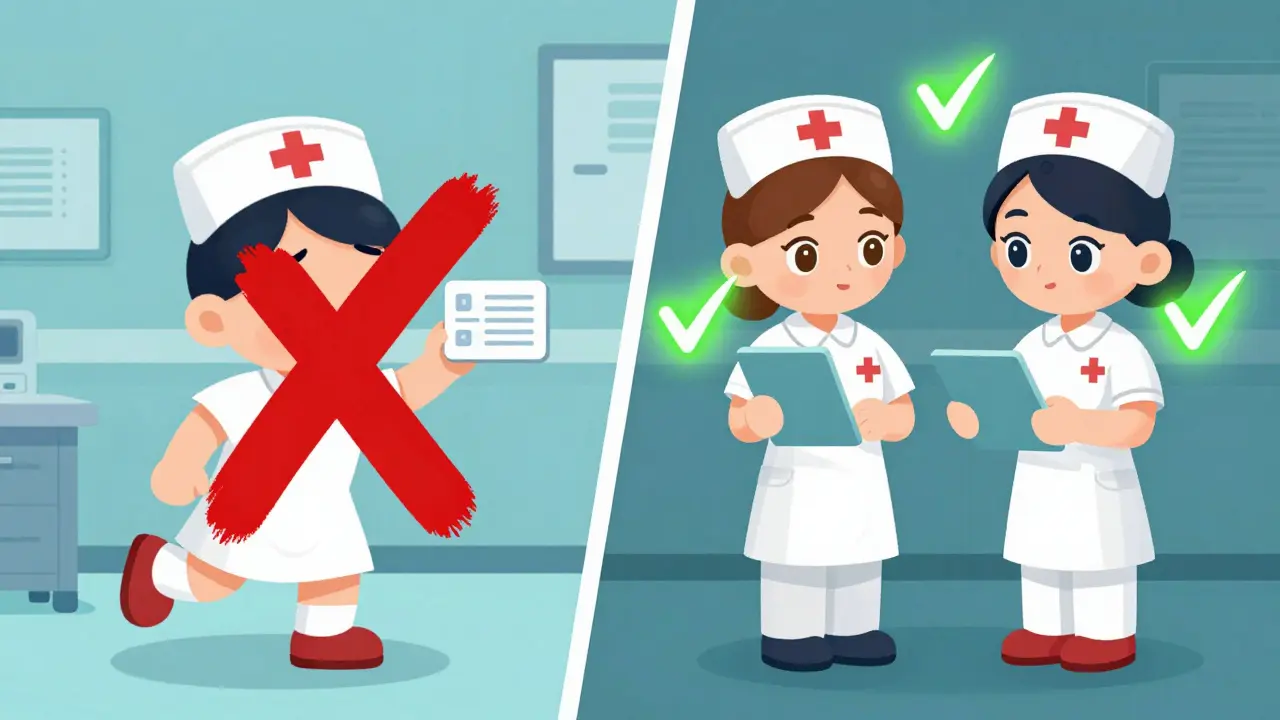
Picture this: Nurse A grabs the med, reads the label, checks the pump setting, and says, "Okay, this looks right." Then Nurse B walks over, glances at the same label, nods, and signs off. That’s not independent. That’s a performance. That’s a ritual. And it’s useless.
The Veterans Health Administration (VHA) defines it clearly in their October 2024 Directive 1195: two clinicians must check alone and apart. One doesn’t tell the other what they saw. They don’t compare notes before they finish. They verify each component separately-patient ID, drug name, dose, route, time-and only then do they compare results.
ECRI Institute found in 2023 that when done right, this process prevents 95% of errors. But when nurses just "check together," effectiveness drops to 40%. That’s not safety. That’s a false sense of security.
One ICU nurse in a 2023 Reddit thread put it bluntly: "I’ve caught three critical errors in six months because I insisted on doing it right. I’ve seen 12 rushed checks that missed errors. The difference? One was a real double check. The others were just signing a box."
The Five Things You Must Verify Every Time
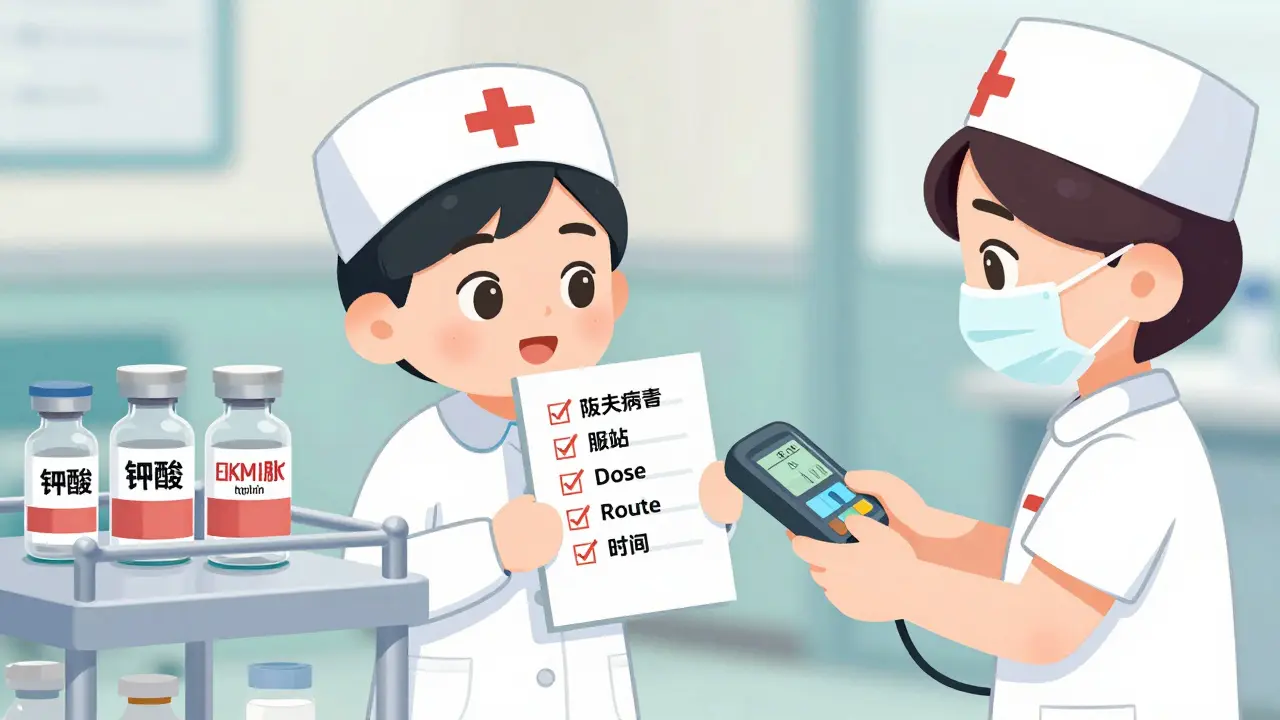
A real independent double check isn’t just about looking at the label. It’s about checking five critical elements, each one, every time:
- Right patient - Two forms of identification. No exceptions. Name and date of birth. Not just a wristband.
- Right medication - Match the drug name on the label to the electronic order. Don’t assume. Read it aloud.
- Right dose - Calculate it yourself. Don’t rely on someone else’s math. If it’s a concentration like potassium chloride, verify the mEq/mL. If it’s insulin, double-check the units.
- Right route - Is this meant to go IV? Or is it supposed to be oral? Giving a concentrated IV solution orally? That’s a death sentence.
- Right time - Is this dose due now? Or was it held? Did the provider change the schedule? Check the eMAR.
And don’t forget the pump settings. For infusions, verify the rate, volume, and duration. A pump set to 10 mL/hr instead of 1 mL/hr? That’s 10 times the dose. No one catches that unless someone looks at the screen independently.
Why Technology Alone Isn’t Enough
Smart pumps. Barcode scanners. E-prescribing. These are great. But they’re not magic.
ECRI Institute’s 2023 analysis showed that hospitals using smart pumps alongside limited double checks reduced errors by 63%. Hospitals relying only on manual double checks? Only 42% reduction. That’s progress. But here’s the catch: technology can fail. A barcode can be misread. A pump can glitch. A nurse can override a warning.
At Johns Hopkins Hospital, they cut IV heparin dosing errors from 12.7% to 2.3% over 18 months-not just by upgrading pumps, but by enforcing true independent double checks. Nurses resisted at first. Each check added 2-3 minutes. But after seeing how many errors were caught, they stopped complaining.
Technology supports. Humans verify. You need both.
How to Build a Real Double Check System
If your hospital doesn’t have a clear protocol, here’s how to fix it:
- Start with data - Look at your own error reports. Which drugs caused the most near-misses? Focus there first.
- Write it down - Create a simple checklist. What exactly must be checked? Who signs? How is it documented? Make it visual. Post it near med rooms.
- Train, don’t assume - Run a 2-hour competency session. Show videos of bad checks. Show videos of good ones. Make people practice. Require a passing score. Do annual refreshers.
- Use eMAR - Require dual electronic signatures. No signature, no medication. No exceptions.
- Measure compliance - Audit 10-20 double checks per week. Don’t just count them. Watch how they’re done. Are they independent? Are they thorough?
Mayo Clinic builds double-check time into staffing ratios. Cleveland Clinic requires 95% pass rates on competency tests. These aren’t perks-they’re safety standards.
What Happens When You Skip It?
In 2021, a 68-year-old man in a community hospital received 100 mL of concentrated potassium chloride instead of 10 mL. The nurse didn’t do a double check. The pharmacy didn’t flag it. The pump didn’t have a limit. He went into cardiac arrest within minutes. He didn’t survive.
That case was reviewed by the Joint Commission. Their finding? "Failure to implement appropriate safeguards for high-alert medications." The hospital lost accreditation for six months.
This isn’t about blame. It’s about systems. One person can’t catch every error. But two people, working independently, can catch almost all of them.
Final Reality Check
You’re not just following a rule. You’re preventing a death.
Some nurses say, "I’m too busy." Others say, "There’s no second nurse available." But in emergency rooms, ICUs, and oncology units, these are the moments that define your profession. If you’re giving a high-alert medication and you don’t have time for a real double check, you shouldn’t be giving it.
The ISMP says it plainly: "Overuse of manual double checks weakens their effectiveness." But they also say: "For the highest-risk medications, they remain essential."
So know your list. Know your process. Do it right. Every time.
What medications absolutely require an independent double check?
According to the ISMP’s 2024 list and major hospital protocols, these include IV insulin (infusions and boluses), neuromuscular blocking agents, potassium chloride concentrate (1 mEq/mL and above), potassium phosphate concentrate (1 mEq/mL and above), sodium chloride solutions above 0.9%, IV heparin (including flushes over 100 units/mL), direct thrombin inhibitors (argatroban, bivalirudin), injectable narcotic PCA pumps, chemotherapy agents, total parenteral nutrition (TPN), CRRT solutions like Prismasol, and all controlled substances (especially IV opioids). These are the top 12 that consistently trigger mandatory double checks across U.S. hospitals.
Is a double check the same as a witness check?
No. A witness check is when two people are present and one observes the other. An independent double check requires two licensed clinicians to verify each component of the medication order alone and apart, then compare their results. The key difference is independence: no communication before verification. VHA and ISMP both require independent checks for high-alert meds-witness checks don’t meet the standard.
Can you use smart pumps instead of double checks?
Smart pumps with dose error reduction systems (DERS) are powerful tools and should be used, but they don’t replace independent double checks. Studies show hospitals using both together reduce errors by 63%. Relying only on pumps reduces errors by 42%. Technology can fail, be overridden, or misread. Human verification is still the final safety net for the highest-risk medications.
What if there’s no second nurse available during an emergency?
In true emergencies (like cardiac arrest), safety protocols may be temporarily modified-but only if the medication isn’t on the high-alert list. If it is, you delay the dose until a second qualified clinician is available. Never give a high-alert med without verification. Some hospitals designate on-call pharmacists or rapid response teams to assist. Skipping verification is never acceptable, even in emergencies.
How do you document an independent double check?
Documentation must be electronic and include two digital signatures-one from each verifier. The eMAR should record the time, the medication, the dose, and both clinicians’ IDs. Some systems require a checkbox confirming all five rights were verified. Shift change reports must include verification status for all infusions and PCAs. Paper signatures are outdated and not compliant with Joint Commission standards as of 2024.

Aisling Maguire
Just spent my shift double-checking insulin doses and honestly? It’s exhausting but worth it. I had a guy yesterday who needed 8 units, and the pump was set to 80. No alarm triggered. Just me, the label, and a cold sweat. Thank god I paused. These meds don’t forgive mistakes.
Byron Duvall
Look, I get the theory, but let’s be real-90% of these double checks are just two people nodding at the same screen while scrolling TikTok. I’ve seen it. The system’s broken. They’re not checking-they’re checking off a box. And don’t get me started on how pharmacies just auto-fill orders without looking. This whole thing’s theater.
Katherine Farmer
Oh please. You’re all romanticizing manual double checks like they’re some sacred ritual from the pre-digital age. The real issue is that hospitals treat compliance as a checkbox, not a culture. You need standardized protocols, mandatory simulation training, and real consequences for bypassing checks-not just more posters in the med room. And for heaven’s sake, stop calling it a ‘double check’ if they’re standing side by side. That’s not independent-that’s a group hug with a clipboard.
Full Scale Webmaster
Let me tell you what happened last week. I was on night shift. A nurse brought up a heparin bag-1000 units/mL. I said, ‘Wait, let’s do the double check.’ She rolled her eyes and said, ‘We’re understaffed, we’ve done this a thousand times.’ So I did it alone. Turned out the pharmacy had labeled it as 100 units/mL. I caught it. Then I got written up for ‘delaying care.’ The director said, ‘You’re overcomplicating things.’ Overcomplicating? Overcomplicating is when a patient codes because someone assumed. I’m not overcomplicating-I’m preventing a coroner’s report. And now? I’m on mandatory ‘team cohesion’ training. Like that’s gonna fix this.
Meanwhile, the hospital just bought a new smart pump system. Guess what? It doesn’t detect if the label is wrong. It just beeps if you type in the wrong number. So if the label says 500 units and you type 500? It’s fine. Even if the vial says 5000. That’s not safety. That’s a joke.
I’ve been a nurse for 14 years. I’ve seen three deaths from these errors. One was a 12-year-old. She got potassium instead of saline. They didn’t double-check. They didn’t even look at the vial. Just scanned the barcode. And the barcode? It was wrong. The system failed. The humans failed. And now? We’re supposed to trust tech more? Please. I’d rather have a drunk intern with a checklist than a robot with a glitch.
Brandie Bradshaw
There is a fundamental flaw in the assumption that human verification is inherently superior to technological safeguards. The data does not support this. What the data supports is that when human verification is performed as a ritualized, non-independent, untrained, and unmonitored procedure, it fails catastrophically. The solution is not more manual checks. The solution is layered, redundant, intelligent systems-where smart pumps, eMAR validation, AI-driven dose boundary detection, and mandatory dual electronic signatures operate in parallel, not sequentially. Human error is not the enemy. Poor system design is. We are treating symptoms while ignoring the disease.
And yes, I know the ISMP says double checks are essential. But the ISMP also said in 2018 that barcode scanning reduces errors by 80%. We now have studies showing that when combined with AI-driven alerts, the error rate drops to 94%. So why are we still clinging to the 1990s? Because it feels like doing something. But feeling like you’re doing something is not the same as actually preventing harm.
Martin Halpin
Okay, but what about the nurses who are working 12-hour shifts with no breaks, no help, and three patients on high-alert meds? You want them to stop, pause, and do a full independent double check on every single one? That’s not safety-that’s burnout waiting to happen. And don’t tell me about ‘competency training.’ I’ve seen training videos where the instructor says, ‘Just ask your coworker if it looks right.’ That’s not independent. That’s a lie. The system is designed to fail. The administrators don’t care. They care about bed turnover rates. They care about the budget. They don’t care that you’re the one holding the syringe when the patient goes into arrest.
I once caught a potassium error. I got praised for two days. Then they cut my shift by an hour because ‘we don’t need that many nurses.’ So now I’m expected to do double checks on five high-alert meds while managing five other patients. And if I take five minutes to verify? I’m ‘slow.’ If I skip one? I’m ‘negligent.’ There’s no winning. The system is rigged.
Charity Hanson
Y’all are overthinking this. Just make it simple: one nurse reads it out loud, second nurse nods and signs. Done. No need for fancy jargon. I work in a rural hospital-we don’t have 20 nurses on shift. But we’ve had zero errors in 3 years because we talk to each other. Real talk. Not just checking boxes. If you’re too busy to say, ‘Hey, this is 10 units of insulin,’ then you’re too busy to be giving meds. Period.
Noah Cline
It’s not about double checks-it’s about cognitive load management. The current model violates the principles of human factors engineering. The dual-verification paradigm introduces latency, task-switching overhead, and confirmation bias. The optimal solution is a closed-loop medication administration system with real-time decision support, automated dose-calculation validation, and machine-learning anomaly detection. Manual checks are a legacy workaround for a broken workflow. We’re applying a band-aid to a hemorrhage.
Sumit Mohan Saxena
As a pharmacist with over 18 years of experience in clinical medication safety, I must emphasize that the foundation of safe administration lies not in the number of people involved, but in the rigor of the verification process. The independent double-check protocol, as defined by ISMP and VHA, is not a redundancy-it is a critical control point. However, its efficacy is entirely contingent upon standardization, training, and accountability. In my institution, we have implemented a mandatory video-recorded verification for all high-alert medications, where each clinician independently verifies and verbally states the five rights before signing electronically. This has reduced near-misses by 89% over two years. The technology is secondary; the discipline is primary. Without consistent, documented, and audited adherence, even the most advanced systems will fail. Safety is not a policy-it is a habit.