When your doctor says you need an ECG or a stress test, it’s not just another routine check. These tests are among the most reliable tools we have to catch heart problems before they become emergencies. Many people think an ECG is just a quick snapshot of the heart - and it is - but when paired with a stress test, it becomes a powerful way to see how your heart handles real-life demands. This isn’t science fiction. It’s everyday medicine that’s saved countless lives.
What an ECG Really Shows
An electrocardiogram - often called an ECG or EKG - records the electrical signals that make your heart beat. It doesn’t measure blood flow or muscle strength. It watches the timing and pattern of those tiny electrical impulses. When those signals are off, it can mean something serious: a past heart attack, an irregular rhythm, or even poor blood flow to the heart muscle.
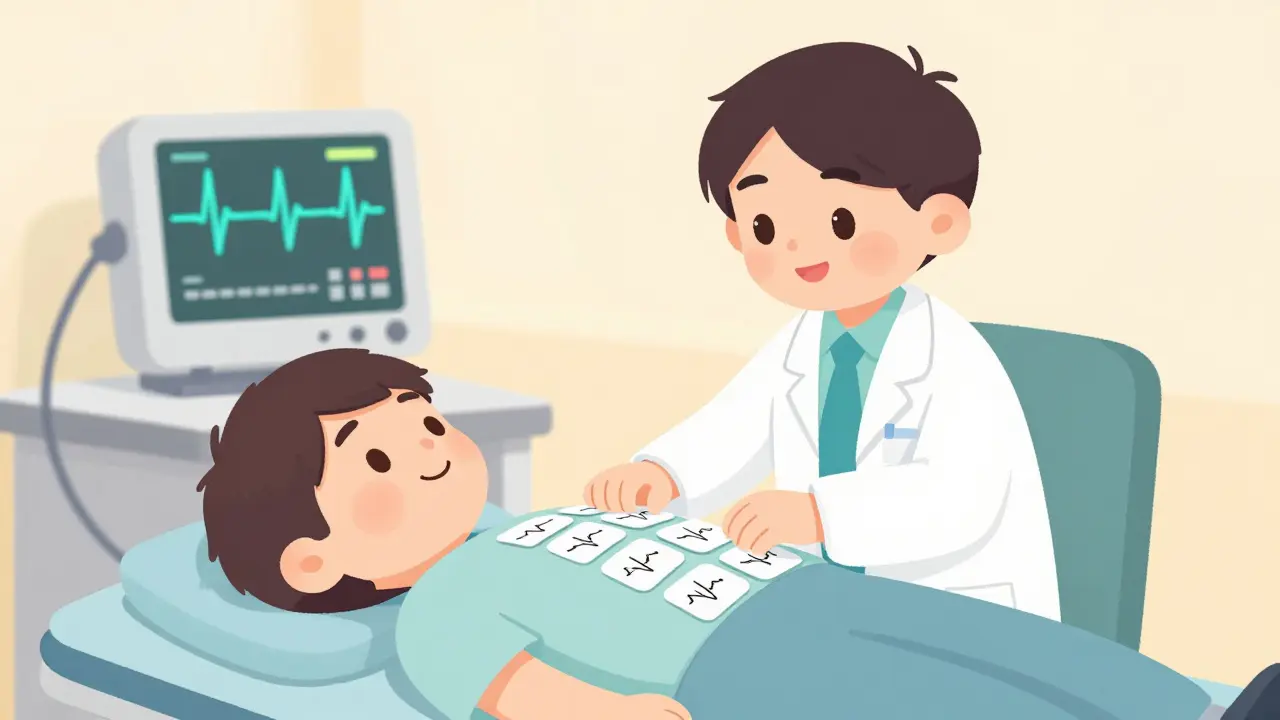
The test itself takes less than five minutes. Ten small sticky pads are placed on your chest, arms, and legs. You lie still while the machine records your heart’s activity. No needles. No pain. Just a quiet beep and a graph of squiggly lines on a screen. But those lines? They tell a story. A flat line where there should be a peak? That could mean damaged heart tissue. A rhythm that skips or jumps? That might be atrial fibrillation. An ECG won’t tell you everything, but it’s the first clue.
Doctors use ECGs for more than just diagnosing heart attacks. They also check for enlarged chambers, electrolyte imbalances, and even side effects from certain medications. It’s the starting point. If the ECG looks normal, it doesn’t mean your heart is perfectly healthy - just that it’s not showing signs of trouble at rest.
Why Stress Tests Are Different
Here’s the thing: your heart doesn’t always act up when you’re lying still. Many problems only show up when your heart is working hard - like when you’re climbing stairs, running, or carrying groceries. That’s where the stress test comes in.
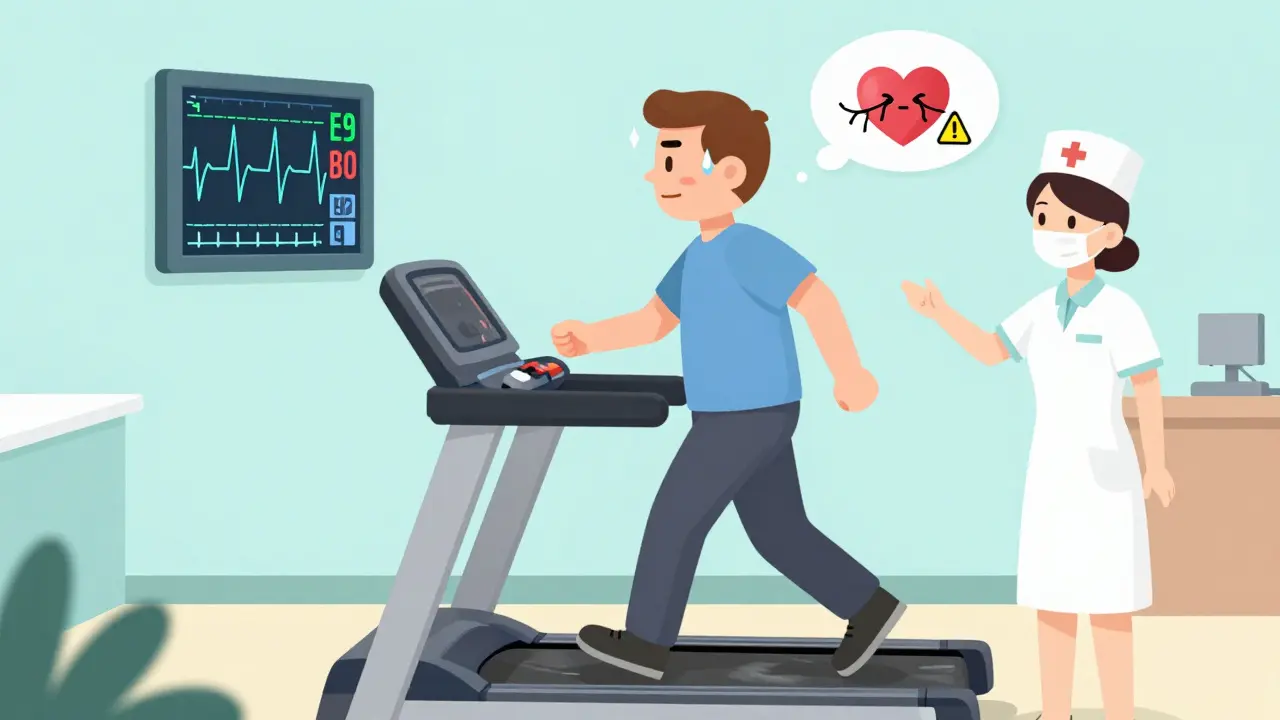
A stress test forces your heart to pump harder. In most cases, that means walking on a treadmill. The speed and incline go up every three minutes, just like a workout that gets harder and harder. You’re monitored the whole time - heart rate, blood pressure, and the ECG pattern. If your heart can’t keep up, or if the ECG shows signs of strain, that’s a red flag.
Not everyone can walk on a treadmill. If you have arthritis, severe asthma, or a recent surgery, your doctor might use a chemical stress test instead. You get a medication - like adenosine or dobutamine - that tricks your heart into behaving like it’s under stress. It’s not as natural as exercise, but it works. You might feel hot, short of breath, or have chest pressure. It’s uncomfortable, but it’s not dangerous. The staff is right there to watch you.
What Happens During a Stress Test?
The whole process usually takes 15 to 30 minutes. You start by having a resting ECG and your blood pressure taken. Then you begin the treadmill. The goal isn’t to run a marathon - it’s to reach 85% of your maximum heart rate. That’s calculated as 220 minus your age. So if you’re 55, your target is around 142 beats per minute.
As you walk, the machine keeps recording. The staff will ask you how you’re feeling. Any chest pain? Dizziness? Shortness of breath? These aren’t just polite questions - they’re critical data points. If you can’t keep going because of fatigue, that’s one thing. If you stop because your chest feels like it’s being squeezed, that’s another.
After you stop, you’re monitored for another 5 to 10 minutes. Your heart doesn’t calm down instantly. How fast it returns to normal tells doctors a lot about your heart’s health. A slow recovery? That’s a warning sign.
Stress Echo vs. Nuclear Stress Test
Not all stress tests are the same. The most common type just uses the ECG. But there are two more advanced versions: stress echocardiography and nuclear stress testing.
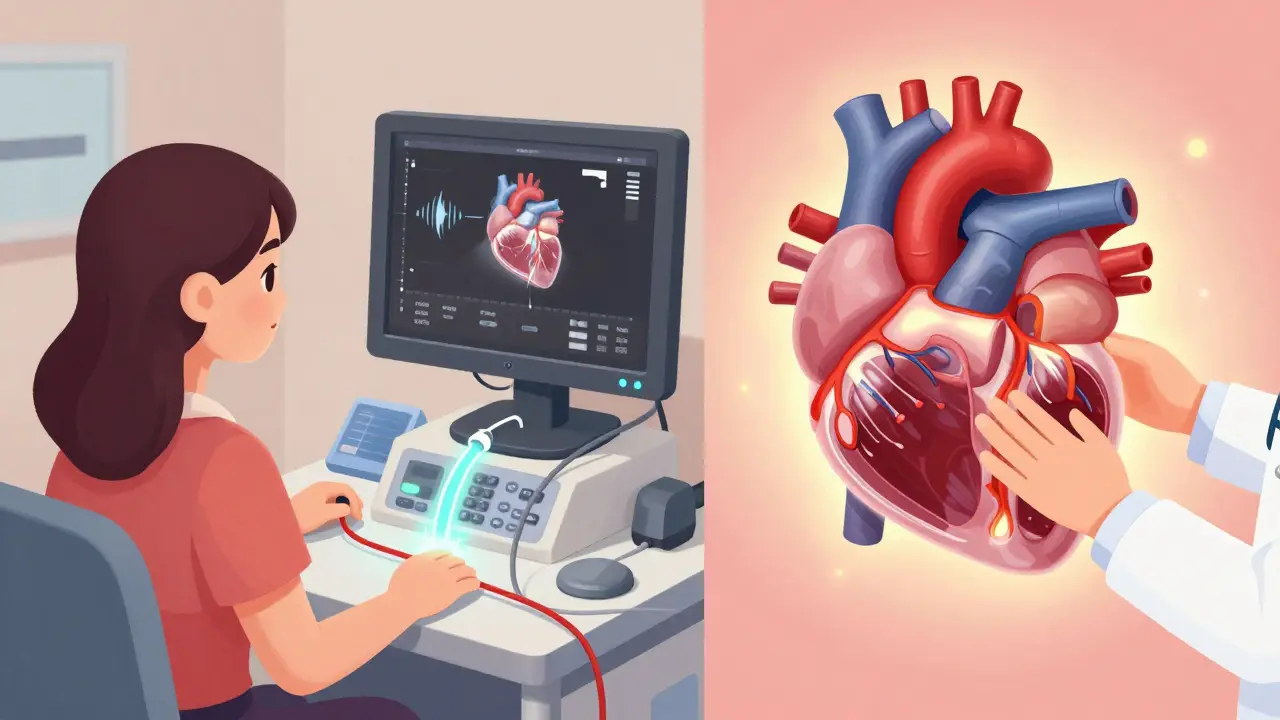
Stress echocardiography adds ultrasound. Before and after exercise, a probe is placed on your chest to take real-time images of your heart. If a part of the heart muscle doesn’t move well when it’s stressed, it means that area isn’t getting enough blood. This test is especially good for women, because it doesn’t use radiation and picks up subtle problems that ECG alone might miss.
Nuclear stress testing uses a small amount of radioactive tracer - either thallium or technetium. It flows through your bloodstream and lights up areas of the heart that are getting good blood flow. Areas with blockages stay dark. This test is more sensitive than a regular stress test - it finds about 85% of blockages - but it exposes you to radiation. Think of it like 3 to 4 years of natural background radiation in one go. It’s safe for most people, but not ideal if you’re young or pregnant.
Cost-wise, a nuclear test can run close to $1,000. A stress echo is about $500. A regular ECG stress test? Often under $400. Insurance usually covers them if they’re medically necessary, but knowing what you’re getting helps you ask the right questions.
Who Needs These Tests?
You don’t need a stress test just because you’re over 50. Doctors use them when there’s a reason to suspect heart disease. The American College of Cardiology recommends stress testing for people with:
- Chest pain or pressure that comes with activity
- Shortness of breath with mild exertion
- Diabetes and other risk factors like high blood pressure or smoking
- Abnormal resting ECG
- Intermediate risk of heart disease - meaning there’s a 15% to 65% chance you have blocked arteries
It’s not for everyone. If you’re healthy, active, and have no symptoms, these tests won’t help. And if you’ve had a recent heart attack, are in heart failure, or have unstable arrhythmias - you shouldn’t have one at all. Safety comes first.
What the Results Mean
Normal results? That’s great news. It means your heart is handling stress well. But even then, it doesn’t guarantee you’re risk-free. Small blockages can still be there.
Abnormal results? That doesn’t mean you need surgery. It means you need more investigation. Maybe a heart CT scan. Maybe a catheter-based angiogram. Or maybe just lifestyle changes - better diet, more walking, quitting smoking.
One key thing doctors look for: how long you lasted on the treadmill. Every extra minute you walk increases your survival rate by about 12%. That’s not a magic number - it’s a powerful message. Your fitness level is tied to your heart health.
What Patients Really Say
On patient forums, people describe these tests in very different ways. One man, 61, said: “I thought the treadmill test would be brutal. I lasted 12 minutes. They found a blockage I didn’t even know I had. I’m alive because of it.”
Another woman, 48, shared: “The adenosine made me feel like I was having a panic attack. My chest tightened. I broke out in sweat. But the nurse said it was normal. I didn’t want to do it again - but I’m glad I did.”
Most people agree on one thing: the tests are uncomfortable, but not scary. And the peace of mind? Priceless.
What’s New in 2026
Technology is changing how these tests are done. In 2022, the FDA cleared a portable device called Cardiac Dynamics StressPal. It lets doctors run a stress test in a doctor’s office, a nursing home, even a mobile clinic. It’s 94% as accurate as the big treadmill machines.
Artificial intelligence is now helping doctors read ECGs during stress tests. A study from 2023 showed AI improved accuracy by up to 22%. It spots patterns humans might miss - especially in women, where traditional tests often fail.
And for women with chest pain but no major artery blockages? New techniques using ultrasound strain analysis can now detect tiny blood vessel problems that used to be invisible. That’s huge. Many women were told their symptoms were “just anxiety.” Now, there’s proof it was their heart.
What to Do Before Your Test
Don’t show up on an empty stomach - but don’t eat a big meal either. Skip caffeine for 24 hours. Coffee, tea, soda, chocolate - all interfere with the chemicals used in some tests. Wear loose, comfortable clothes and walking shoes. Leave jewelry at home. If you take heart medications, ask your doctor if you should skip them that day.
And if you’re nervous? Tell the technician. They’ve seen it all. They know how to calm you down. This isn’t a test of strength. It’s a test of your heart’s health. And you’re not alone.
Is an ECG the same as a stress test?
No. An ECG records your heart’s electrical activity while you’re at rest. A stress test watches how your heart responds when it’s working hard - either through exercise or medication. The ECG is part of the stress test, but the stress test adds the element of physical or chemical stress to uncover problems that don’t show up at rest.
Can I drive myself home after a stress test?
Yes, if you had a standard exercise stress test. You can usually drive, eat, and resume normal activities right after. If you had a chemical stress test, you might feel dizzy or tired for a short time. Most people are fine to drive, but it’s smart to have someone with you just in case.
Do stress tests hurt?
No, they don’t hurt. The electrodes on your chest are just sticky pads. The treadmill is like a workout. The chemical stress test might make you feel hot, short of breath, or have a strange taste in your mouth. Some people get chest pressure - but it’s temporary and monitored closely. It’s uncomfortable, not painful.
Are stress tests accurate for women?
Traditional ECG stress tests have higher false-negative rates in women, especially before menopause. That’s because women often have microvascular disease - small artery problems - that don’t show up on standard tests. Stress echocardiography is much more accurate for women and is now recommended as the first choice for middle-aged women with symptoms.
How often should I get a stress test?
You don’t need one unless you have symptoms or risk factors. If you’ve had a normal stress test and no new symptoms, you likely won’t need another for 2 to 5 years - if at all. Repeat testing is only needed if your condition changes - like developing chest pain, diabetes, or if your doctor sees a reason to re-evaluate.

Carrie Schluckbier
Let me guess - they’re using ECGs to track you, right?
They say it’s ‘just a snapshot’ but what if that snapshot gets uploaded to a private database?
And don’t get me started on the stress test - treadmill? Please. That’s just a front for biometric harvesting.
Ever wonder why they need your heart rate during exercise? It’s not about blockages - it’s about mapping your emotional responses.
They’ve been doing this since the 90s. The ‘adrenaline spike’ data? Sold to insurance companies.
They don’t care if you live - they care if you’re ‘high risk’ and can be priced out.
And AI reading ECGs? That’s not accuracy - that’s predictive profiling.
They already know you’re gonna have a heart attack before you do.
And they’ll charge you for the ‘preventative’ procedure next year.
It’s not medicine. It’s surveillance with a stethoscope.
They’re not saving lives - they’re building a credit score for your arteries.
Next thing you know, your car insurance will deny you because your ECG showed ‘suboptimal rhythm variability.’
Wake up. This isn’t healthcare. It’s a monetized panic cycle.
And if you think you’re safe because you’re ‘healthy’ - you’re already in the system.
They’re not testing your heart. They’re testing your compliance.
Tony Shuman
Wow. Just… wow.
They let this kind of junk pass as medical advice?
ECG? Stress test? Please.
This is just another way to funnel people into expensive procedures so Big Pharma can sell more pills.
They don’t want you healthy - they want you dependent.
And don’t even get me started on that ‘portable device’ - that’s just the first step toward mandatory home monitoring.
Next thing you know, your smartwatch will auto-submit your ECG to the government.
They’re normalizing surveillance under the guise of ‘care.’
It’s socialism… for heart disease.
And they wonder why people don’t trust medicine anymore.
Because we’ve seen the playbook.
It’s always the same: scare them, test them, bill them.
Repeat.
And now they’re using AI to make it look ‘scientific.’
It’s not science. It’s profit.
And I’m tired of pretending otherwise.
Linda Franchock
Okay but like… have you ever actually done a stress test?
It’s not scary - it’s kinda embarrassing.
Trying to walk on a treadmill while some tech in a lab coat says ‘okay, now faster’ like you’re in a gym commercial.
And then you’re sweating and panting and they ask if you’re okay and you say ‘yeah’ because you don’t wanna look weak.
Meanwhile, your heart is screaming.
And the adenosine? Bro. That’s not a test - that’s a panic attack you didn’t sign up for.
But honestly? Worth it.
I had no symptoms. Zero.
Turns out my ‘anxiety’ was a 70% blockage.
So yeah.
It’s weird. It’s awkward.
But it saved my life.
And no, I don’t think it’s a conspiracy.
I think it’s just… medicine.
That’s all.
Dennis Santarinala
I love how this article breaks it down so clearly - really, really well done.
It’s rare to see medical info that’s accurate but also doesn’t talk down to people.
And I especially appreciate the part about women and microvascular disease - that’s so often overlooked.
My mom had chest pain for years, got told ‘it’s just stress,’ then finally got a stress echo and turned out she had tiny vessel disease.
She’s alive today because someone listened.
Also, the 12% survival increase per minute on the treadmill? That’s one of the most powerful stats I’ve ever seen.
It’s not just about ‘passing’ the test - it’s about how strong you are.
Even if you’re 60 and can barely walk - if you made it 8 minutes? That’s a win.
And yes, the tech is getting better - AI is helping catch patterns we missed for decades.
Not magic. Not surveillance. Just better science.
And that’s something to celebrate.
PRITAM BIJAPUR
Consider this: the human heart beats approximately 100,000 times per day.
That’s 36.5 million times per year.
And yet, we allow machines with sticky pads to interpret its language in five minutes.
Is this not a profound paradox?
Science measures the electrical symphony - but does it understand the soul’s rhythm?
ECG is a mirror, not a oracle.
Stress test? A forced performance.
But what if the heart’s truth lies not in peaks and troughs - but in stillness?
Perhaps the greatest diagnostic tool is not the machine - but the quiet mind that listens.
Modern medicine seeks to quantify the unquantifiable.
But life - true health - is not found in data points.
It is found in breath, in movement, in rest.
And in the courage to say: ‘I feel something - and I trust myself.’
Let the tests guide.
But do not let them define.
For the heart does not lie - but we often misread its song.
Adam Short
They’re pushing these tests like they’re some kind of national security protocol.
ECG? Stress test? Next they’ll be scanning your coronary arteries at the border.
And why? Because America’s healthcare system is a circus.
They want you scared.
They want you paying.
They want you dependent.
And now they’re using AI to make it look ‘legit.’
It’s not innovation - it’s exploitation.
They’re turning your heartbeat into a commodity.
And don’t even get me started on the ‘portable’ devices - that’s the first step toward mandatory heart monitoring for every citizen.
They’ll say it’s for ‘early detection.’
But we all know what that really means: control.
Wake up. This isn’t medicine.
This is the beginning of a cardiac surveillance state.
Agnes Miller
One thing the article missed: if you’re on beta blockers, you might not even hit your target heart rate during the test.
So yeah, the ‘85% of max HR’ thing? Kinda useless if you’re on meds.
My doc just went by symptoms and ECG changes instead.
Also - side note - the ‘strange taste’ during adenosine? It’s like licking a battery.
And yes, I cried.
Not from pain. From being so scared I couldn’t speak.
But the nurse held my hand.
And that mattered more than the machine.
Also - wear socks.
They give you those sticky pads and no socks? Cold feet = bad vibes.
And if you’re a woman? Ask for the echo.
It’s way better.
And yes, I’m still alive.
So… yeah.
Do it.
Even if you’re scared.
It’s worth it.
Liam Earney
It’s fascinating - and deeply tragic - how we’ve come to equate medical validation with emotional safety.
We are so desperate to be told we are not dying, that we willingly submit to invasive, expensive, and often psychologically taxing procedures - not because we feel unwell, but because we fear we might be.
The ECG, in its elegant simplicity, captures the electrical whisper of the heart - yet we demand more: more stress, more radiation, more algorithms, more data.
Why? Because we no longer trust our own bodies.
We no longer trust our intuition.
We no longer trust our doctors - not really.
We trust the graph.
We trust the number.
We trust the AI that has never felt a heartbeat.
And so we become patients - not people.
Our fear becomes a business model.
Our vulnerability becomes a revenue stream.
And yet - when the test comes back normal - we weep.
Not because we are healthy - but because we were allowed to hope.
That is the true cost of modern medicine.
Not the price tag.
But the surrender of our inner knowing.