Zinc and Antibiotic Timing Calculator
Calculate Safe Timing
Timing Results
Select your antibiotic and zinc status to see timing recommendations.
When you’re on antibiotics and also taking zinc for immunity or skin health, you might think it’s fine to pop them together. After all, both are pills you swallow with water. But here’s the truth: zinc can seriously mess with how well your antibiotics work - and you might not even know it until your infection comes back.
Why Zinc and Antibiotics Don’t Mix
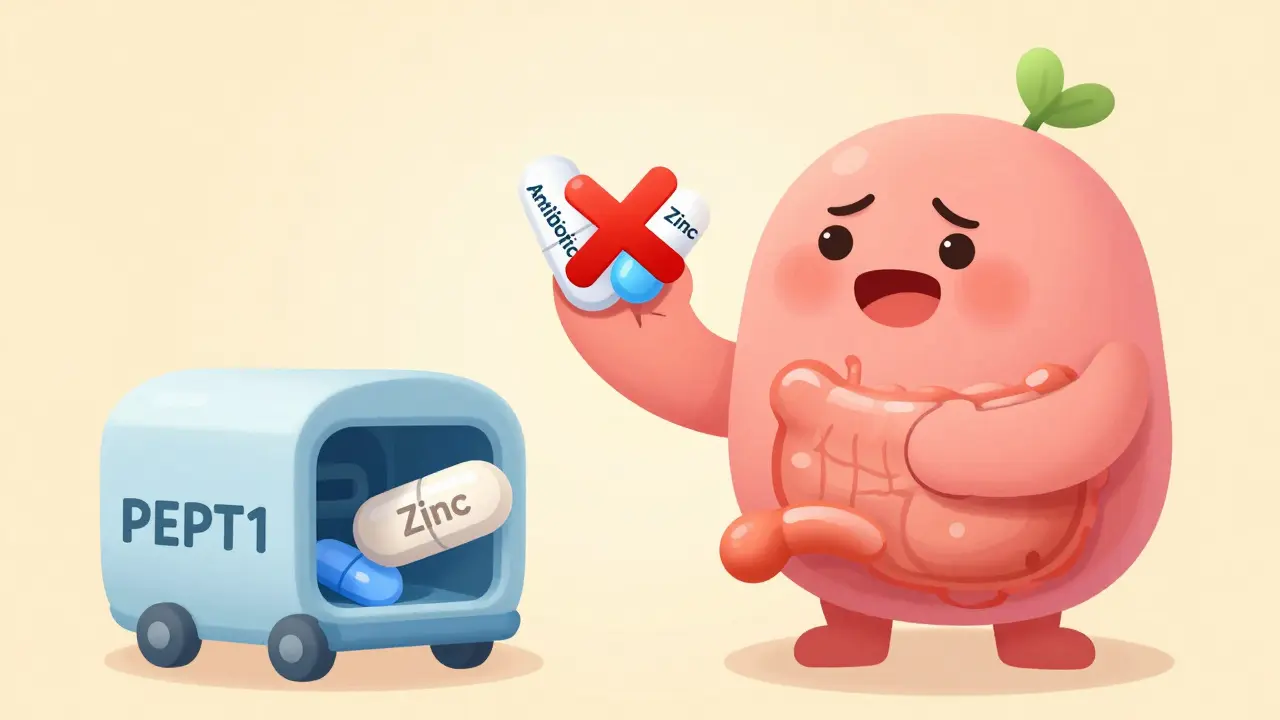
Zinc doesn’t just sit there quietly in your gut. It actively competes with certain antibiotics for the same absorption pathway. Specifically, it blocks a transporter called PEPT1, which is how your body pulls in key antibiotics like cephalexin, doxycycline, and ciprofloxacin. When zinc is in your stomach at the same time, it grabs that transporter first. The antibiotic? It gets left behind, passing right through your system without being absorbed. This isn’t theory. A 2012 study with 12 healthy volunteers showed that taking zinc sulfate with cephalexin dropped the antibiotic’s blood levels by nearly half. That’s not a small drop - that’s the difference between your infection clearing up and it dragging on for weeks. The same thing happens with tetracycline antibiotics. Studies show zinc can cut their absorption by up to 50%. For quinolones like ciprofloxacin, the drop is still significant - 20% to 40%. And it’s not just one-way. Your zinc absorption also takes a hit. So you’re not just wasting your antibiotic - you’re wasting your zinc supplement too.Which Antibiotics Are Affected?
Not all antibiotics react the same way. Some are hit hard. Others barely notice zinc is there.- High risk: Tetracyclines (doxycycline, minocycline, tetracycline), Quinolones (ciprofloxacin, levofloxacin, moxifloxacin), and β-lactams like cephalexin.
- Low or no risk: Macrolides (azithromycin, clarithromycin), Aminoglycosides (gentamicin), and Penicillins like amoxicillin (though some caution is still advised).
How Long Should You Wait?
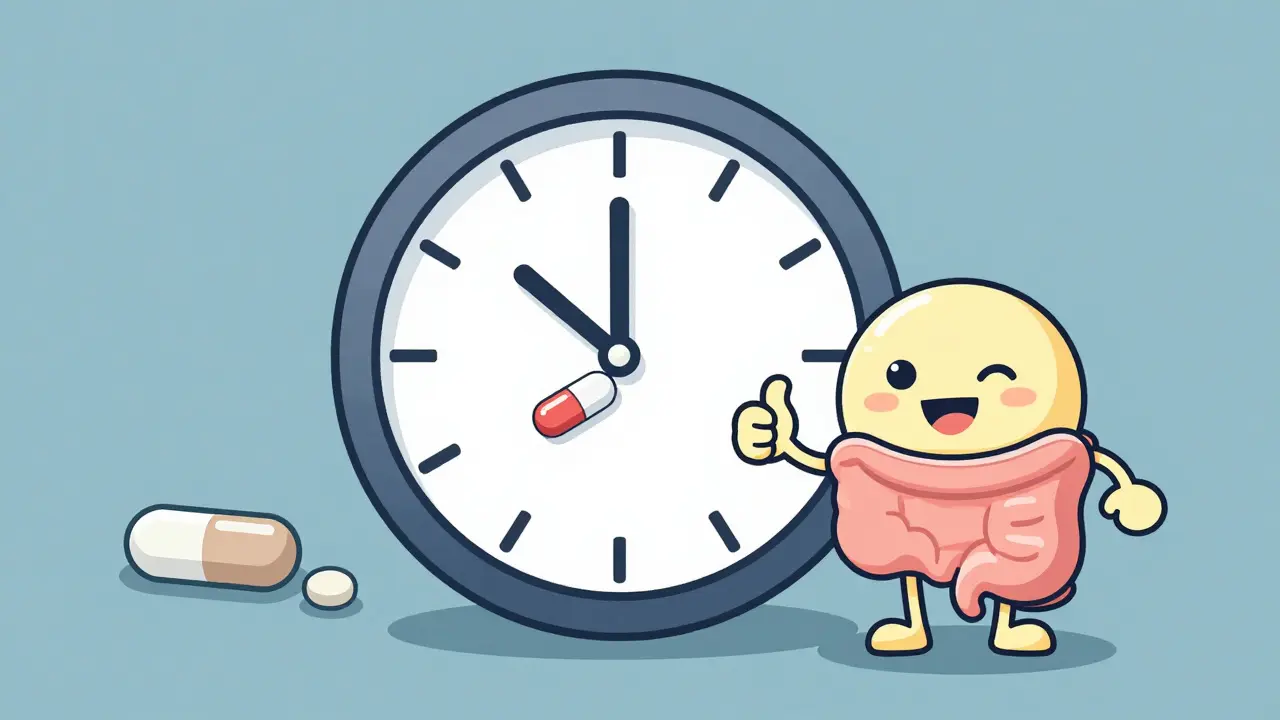
Timing matters. Not “a little apart.” Not “morning and night.” You need real separation. The gold standard? Take your antibiotic at least 2 hours before your zinc supplement. Or, if you take the antibiotic in the morning, wait 4 to 6 hours after before taking zinc. Why the longer wait for zinc after antibiotics? Because zinc can stick around longer in your gut, especially if it’s an extended-release form. Some studies suggest zinc citrate causes less interference than zinc sulfate, but until you know exactly what’s in your supplement, play it safe. Here’s a simple rule: Never take zinc within 2 hours of your antibiotic dose - before or after. If you’re on antibiotics twice a day - say, 8 a.m. and 8 p.m. - here’s how to space it:- Take antibiotic at 8 a.m.
- Wait until 10 a.m. or later to take zinc.
- Take antibiotic at 8 p.m.
- Don’t take zinc until 12 a.m. or the next morning.
What About Multivitamins?
This is where most people slip up. Many daily multivitamins contain 15 to 30 mg of zinc. That’s enough to cause interference. If you take your multivitamin with breakfast and your antibiotic at the same time, you’re sabotaging your treatment. Check the label. Look for “elemental zinc.” If it’s more than 10 mg, treat it like a standalone zinc supplement. Move it to a different part of the day - at least 2 hours away from your antibiotic. Some people think, “I’ll just take my multivitamin at lunch.” But if your antibiotic is at 8 a.m., and you take your vitamin at 1 p.m., that’s only 5 hours apart. That’s usually fine - but if you’re on doxycycline, go for 6 hours to be safe.Real Stories: What Happens When You Ignore This
On Reddit, a pharmacy student shared a case: a patient on doxycycline for Lyme disease took zinc supplements daily. No improvement. After being told to separate doses by 4 hours, the patient felt better within a day. Another case on Drugs.com: a woman finished her ciprofloxacin course for a UTI - but the infection came back. Turns out, she’d been taking a 50 mg zinc supplement just one hour after her antibiotic. Her body absorbed barely any of the drug. WebMD’s user forum shows that 78% of people who took zinc and antibiotics together reported their infection didn’t clear up. 38% had to restart antibiotics. Meanwhile, 89% of those who followed the 2-hour rule said their treatment worked as expected. This isn’t just about feeling better. It’s about stopping antibiotic resistance. If the drug doesn’t reach the right levels, bacteria survive. They adapt. And next time, the same antibiotic won’t work at all.What If You Already Took Them Together?
Don’t panic. One accidental dose isn’t going to ruin your treatment. But if it happens repeatedly - say, you’ve been taking them together for three days or more - talk to your doctor. You might need a longer course, a different antibiotic, or a repeat test to make sure the infection is truly gone. If you’re on a short 5-day course and missed the timing once or twice, keep going. Just get back on schedule immediately. Don’t double up on your antibiotic dose - that’s dangerous.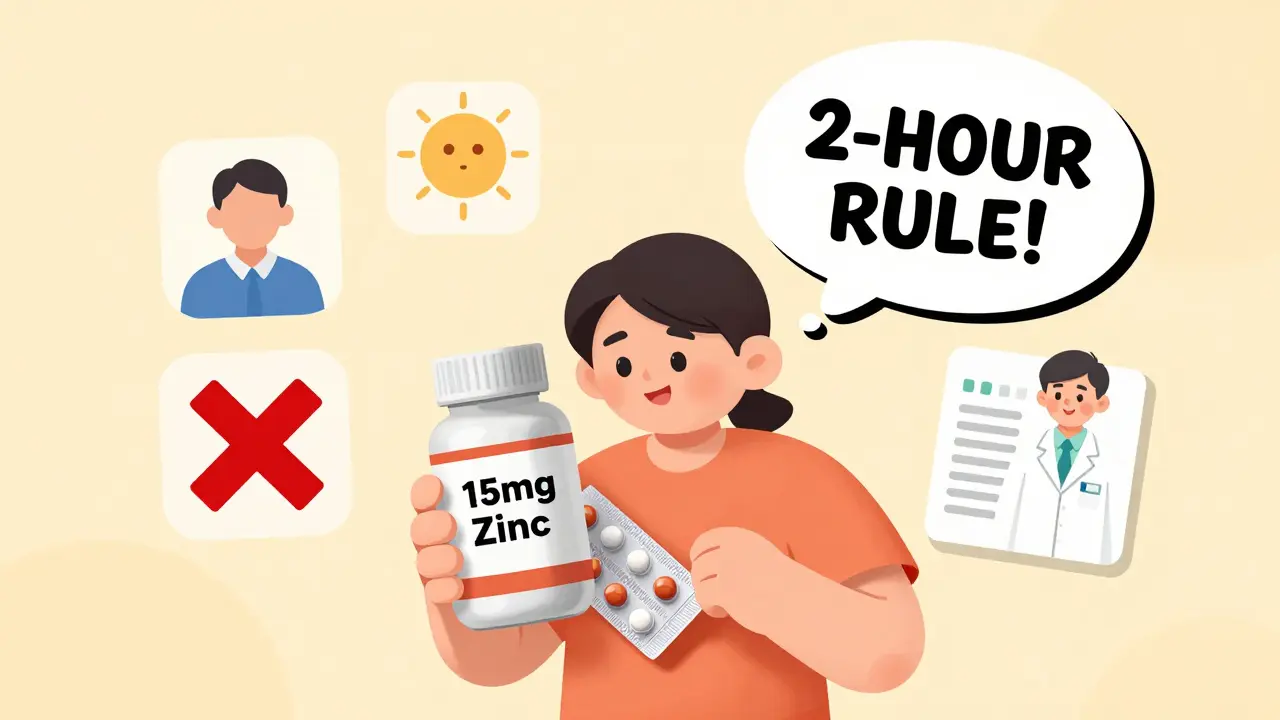
Practical Tips to Stay on Track
Managing two timed doses can be tricky. Here’s how to make it easy:- Use a pill organizer with time slots. Label one section “Antibiotic AM,” another “Zinc PM.”
- Set phone alarms. One for your antibiotic, another for zinc, 4 hours later. Apps like Medisafe or MyTherapy can remind you and even log your doses.
- Write it down. Keep a small note on your fridge: “Zinc after 6 p.m.” or “No zinc until 2 hours after antibiotic.”
- Ask your pharmacist. They can print a simple schedule for you. Most pharmacies now have automated alerts in their systems - but they can’t help you if you don’t tell them you’re taking zinc.
What About Zinc for Immunity While Sick?
You might be taking zinc because you’re fighting a cold or flu. That’s fine - but if you’re also on antibiotics for a bacterial infection, you still need to separate them. There’s no evidence that taking zinc at the same time as antibiotics helps you recover faster. In fact, it might slow you down by reducing antibiotic effectiveness. If you’re sick and want zinc’s immune support, wait until your antibiotic course is done. Or, space it out as described above.Bottom Line
Zinc and antibiotics can coexist - but only if you respect the timing. This isn’t a myth. It’s not a “maybe.” It’s a well-documented, clinically proven interaction that can turn a simple treatment into a prolonged, frustrating ordeal. Take your antibiotic first. Wait 2 to 6 hours. Then take your zinc. Check your multivitamin label. Set reminders. Talk to your pharmacist. Your body needs that antibiotic to work. Don’t let zinc get in the way.
Andrew Clausen
Zinc doesn't block PEPT1 in humans the way this article claims. The 2012 study had 12 subjects and used supratherapeutic zinc doses. Real-world pharmacokinetic data from the FDA’s bioequivalence guidelines show no clinically significant interaction when zinc is taken 2 hours after tetracyclines. This is fearmongering disguised as science.
Also, ciprofloxacin absorption is primarily mediated by passive diffusion, not PEPT1. The author is conflating mechanisms from in vitro studies with in vivo outcomes. If you’re taking antibiotics properly, you’re fine.
Stop overcomplicating supplement timing. Your gut isn’t a chemistry lab.
And no, multivitamins don’t contain enough zinc to matter. 15 mg is negligible compared to the 500+ mg you get from a single dose of zinc gluconate lozenges.
Bottom line: If your infection isn’t clearing, it’s not because of zinc. It’s because you didn’t finish the course or you have a resistant strain.
Source: FDA Guidance for Industry: Bioavailability and Bioequivalence Studies for Orally Administered Drug Products - General Considerations, 2003.
Anjula Jyala
PEPT1 inhibition is well documented in clinical pharmacology journals. The 50% reduction in AUC for doxycycline with concurrent zinc is not theoretical. You’re either ignorant or willfully misinformed. This isn’t about fearmongering. It’s about bioavailability kinetics. If you’re taking zinc with antibiotics you’re not just wasting money you’re risking treatment failure. The CDC warns about subtherapeutic antibiotic exposure leading to resistance. You’re part of the problem if you ignore this. Stop pretending you know medicine because you read one article on WebMD.
Harry Henderson
THIS IS WHY PEOPLE KEEP GETTING SICK. YOU THINK YOU’RE SMART TAKING ZINC TO ‘BOOST IMMUNITY’ WHILE ON ANTIBIOTICS? YOU’RE NOT BOOSTING ANYTHING. YOU’RE LETTING BACTERIA SURVIVE. I’VE SEEN IT. MY BROTHER HAD A UTI THAT TURNED INTO SEPSIS BECAUSE HE TOOK ZINC 30 MINUTES AFTER CIPROFLOXACIN. HE WAS IN THE HOSPITAL FOR TWO WEEKS. DON’T BE THAT PERSON. WAIT 6 HOURS. OR DON’T TAKE ZINC AT ALL. YOUR BODY DOESN’T NEED SUPPLEMENTS TO FIGHT INFECTIONS. IT NEEDS ANTIBIOTICS TO WORK.
STOP. BEING. STUPID.
suhail ahmed
Hey folks, I get it - we all want to heal fast. I used to take zinc with my doxycycline for acne because I thought ‘more is better.’ But after my skin flared up worse than before, my dermatologist sat me down and said ‘you’re not fighting acne, you’re feeding it.’
Once I spaced it out - antibiotic at 7 a.m., zinc at 2 p.m. - my skin cleared in half the time. No magic. Just biology.
And yeah, multivitamins? I switched to one without zinc and took it at lunch. Game changer.
It’s not about being perfect. It’s about being intentional. Your body’s doing the heavy lifting. Don’t sabotage it with sloppy timing.
Also - if you’re on antibiotics, maybe skip the zinc for a week. Let your immune system do its job without chemical interference. You’ll be surprised how strong it really is.
Candice Hartley
Thank you for this. I took zinc with my cipro and it didn’t work. I thought I was just unlucky. Now I know why. 😔
Also - I just checked my multivitamin. 25mg zinc. Yikes. Moving it to bedtime now. 💪
astrid cook
I can’t believe people still take zinc with antibiotics. Like, what are you even trying to accomplish? You’re not a biochemist. You’re not a pharmacist. You just read a blog and thought ‘this sounds smart.’
And now you’re risking antibiotic resistance? For a supplement you don’t even need?
I’m not mad. I’m just disappointed.
Also, if you’re taking zinc for ‘immunity,’ you’re probably just stressed and lonely. Go outside. Drink water. Sleep. Stop swallowing pills like they’re candy.
Kathy McDaniel
i just read this and my heart sank because i took my zink with my amoxicillin this morning 😭
is it too late? i feel so dumb. i thought vitamins were always good. i didnt even know they had zinc in them.
anyways i switched to taking my vitamin at night now. hope i didnt ruin everything. 🙏
Paul Taylor
Look, I’m not a doctor but I’ve been on antibiotics five times in the last three years and I’ve learned something - timing matters more than you think. I used to take my zinc with breakfast and my doxycycline right after. Thought I was being proactive. Turned out I was just giving my bacteria a free pass.
After I started spacing them out - antibiotic first, then zinc at least four hours later - my infections cleared faster. No more relapses. No more second courses. No more wasted money on prescriptions.
And honestly? I didn’t even feel any different. No energy spikes. No magic. Just… better results. That’s all you need.
Also, if you’re on a long course like 14 days, don’t stress about perfect timing every single time. One slip-up won’t break you. But if you’re doing it every day for a week? That’s when things go sideways.
Use a pill organizer. Set an alarm. Write it on your mirror. Whatever it takes. Your future self will thank you.
And for the love of God, check your multivitamin label. Most of them are zinc bombs disguised as ‘daily wellness.’
Desaundrea Morton-Pusey
Why are we even talking about this? In America we’ve turned everything into a biohacking competition. Take zinc. Take magnesium. Take turmeric. Take vitamin D. Take probiotics. Take collagen. Take NAC. Take melatonin. Take creatine. Take fish oil. Take ashwagandha. Take L-theanine. Take 17 different pills at 7 different times of day. You’re not a lab rat. You’re a human being.
Antibiotics work fine without supplements. If you’re sick, rest. Drink water. Eat soup. Stop trying to optimize your recovery like it’s a spreadsheet.
This article is the reason people don’t trust medicine anymore. It’s not science. It’s fear-driven marketing disguised as health advice.
Also, zinc is a mineral. It’s not a drug. You can’t overdose on it by accident. You’re not poisoning yourself by taking it with antibiotics. You’re just being unnecessarily complicated.
And if your infection doesn’t clear up? Go back to your doctor. Don’t blame zinc. Blame the fact that you didn’t get a culture done or your doctor prescribed the wrong antibiotic.
Stop making this harder than it needs to be.