Every day, millions of workers are exposed to sounds that quietly destroy their hearing-without pain, without warning, and without a second thought. A jackhammer at 110 decibels. A factory floor humming at 95. A chainsaw roaring at 115. These aren’t just loud noises. They’re noise-induced hearing loss waiting to happen. And the worst part? Once it’s gone, your hearing doesn’t come back.
What Happens When Noise Kills Your Hearing
Your inner ear is full of tiny hair cells. These aren’t like the hair on your head. They’re delicate, microscopic structures that turn sound waves into electrical signals your brain understands. When you’re exposed to loud noise-especially over time-these cells get damaged. And once they’re gone, they don’t grow back. That’s why noise-induced hearing loss is permanent.
It doesn’t happen overnight. Most people don’t notice until they’re struggling to hear conversations in crowded rooms, or until the TV is always too loud. The first sign? Trouble hearing high-pitched sounds-birds chirping, children’s voices, or the ding of a microwave. By the time you notice, the damage is already done.
According to the CDC, 22 million U.S. workers are exposed to dangerous noise levels each year. The Bureau of Labor Statistics lists noise-induced hearing loss as the second most common occupational illness in the country. And it’s not just factory workers. Construction crews, farmers, miners, mechanics, and even musicians are at risk. In fact, 22% of construction workers and 19% of manufacturing employees are exposed to noise above the danger threshold of 85 decibels (dBA).
The Numbers Don’t Lie: What’s Safe and What’s Not
Many people think if it’s not painful, it’s not harmful. That’s a dangerous myth. The threshold for damage isn’t when your ears ring-it’s when the noise hits 85 dBA for 8 hours. That’s about the sound of heavy city traffic or a lawnmower. At 88 dBA, you’re only safe for 4 hours. At 91 dBA? Just 2 hours. At 94 dBA? Only 1 hour.
Here’s the problem: different agencies set different rules. OSHA, the federal workplace safety agency, allows up to 90 dBA for 8 hours. But NIOSH-the research arm of the CDC-says 85 dBA is the real danger line. Why the difference? Because OSHA’s standard lets in 16 times more noise energy than NIOSH’s recommendation. That’s not a technicality. That’s the difference between protecting your hearing and letting it slip away.
Europe is ahead of the U.S. The EU’s limit is 80 dBA. California just passed new rules requiring employers to fix the noise at the source before just handing out earplugs. That’s the right way to do it. Because hearing protection alone? It’s not enough.
Why Earplugs Alone Won’t Save You
Most workplaces hand out foam earplugs like candy. Cheap, disposable, and often useless. Why? Because 75% of workers insert them wrong. You have to roll them into a thin cylinder, pull your ear up and back, then hold them in place for 20 seconds while they expand. Most people just shove them in and walk away. The result? Instead of 30 dB of protection, they get 15-barely better than nothing.
Even when inserted right, foam plugs only last a few days before they lose their shape. And if you’re in a noisy environment, you’ll take them out to hear warnings, talk to coworkers, or just because they hurt. A 2021 NIOSH survey found only 38% of workers wear hearing protection consistently throughout their shift. The top reasons? Discomfort, communication issues, and the belief that “it’s not that loud.”
Custom-molded earplugs work better-they fit snugly, last longer, and offer 25-30 dB of protection. But they cost $100-$200. Most employers won’t pay for them. And even then, they’re still the last line of defense. Not the first.
The Real Solution: Fix the Noise, Not the Worker
Engineering controls are the most effective way to prevent hearing loss. That means changing the machine, not the person. Install sound enclosures around loud equipment. Use quieter tools. Replace old air compressors with newer, low-noise models. Add vibration dampeners. Install acoustic panels on walls. These aren’t fancy ideas-they’re proven.
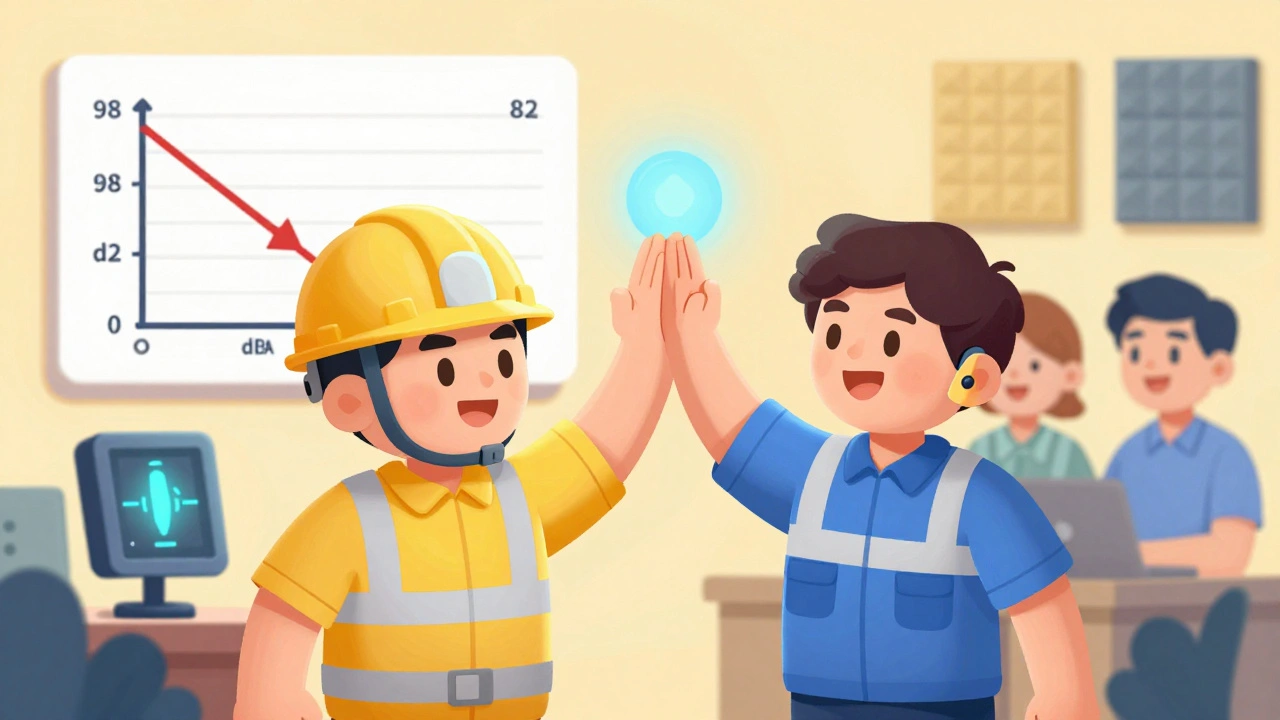
NIOSH’s 2015 mining case study showed noise dropped from 98 dBA to 82 dBA after installing noise barriers. Workers didn’t just avoid hearing loss-they reported less fatigue and better focus. That’s not a side effect. That’s a productivity boost.
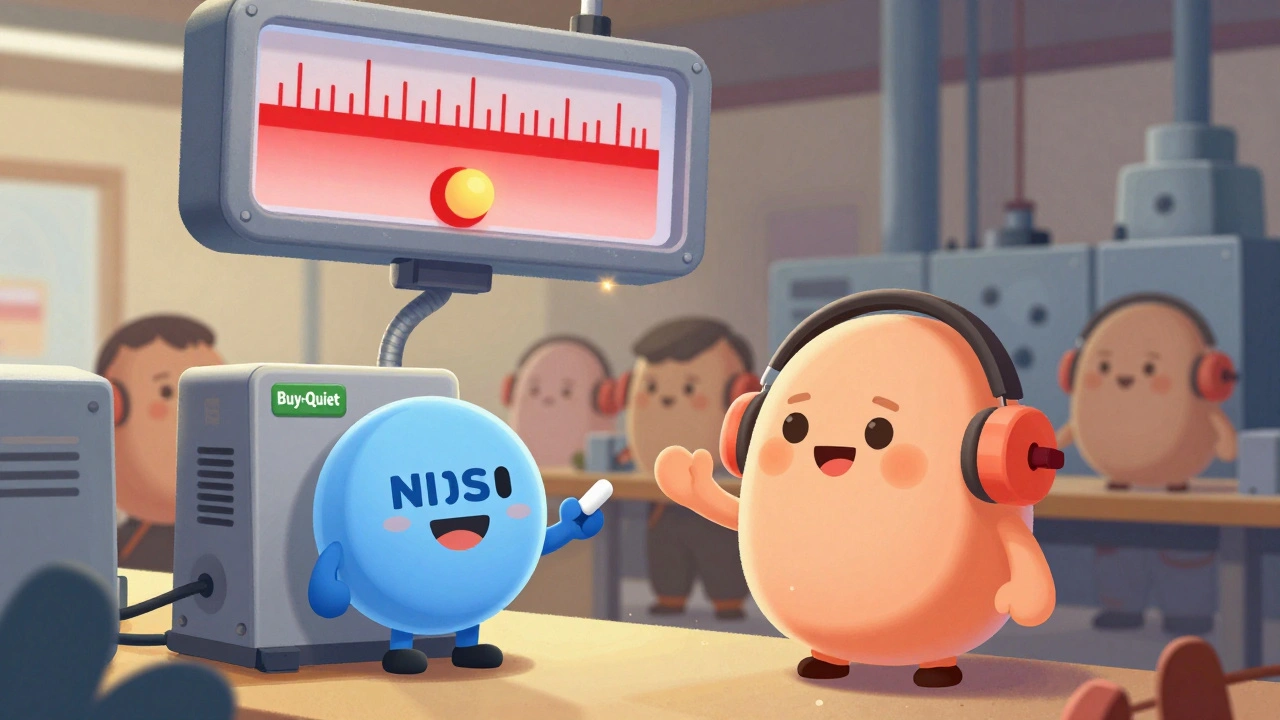
The “Buy-Quiet” initiative launched by NIOSH in 2023 lists over 1,200 low-noise tools and machines. Want a quieter saw? A quieter drill? A quieter grinder? There’s a quieter version. And it’s not just about buying new equipment-sometimes it’s about maintenance. A worn-out bearing or loose belt can double the noise output. Regular upkeep isn’t just good for machines. It’s good for your ears.
What Works in Real Life
Companies that get it right don’t just hand out earplugs. They involve workers. They ask them what’s loud. What’s annoying. What’s hard to hear. They let them help pick the right hearing protection. And they make sure managers are there-not just signing forms, but walking the floor, listening, and acting.
A 2023 CDC study found 92% of successful hearing conservation programs had strong management commitment. When bosses care, workers care. When safety is just a checkbox, it fails.
One mining company in Montana started letting workers test different earplugs and pick their favorite. They added real-time noise monitors to helmets. They trained supervisors to check fit every month. Within two years, their rate of hearing loss dropped by 68%. That’s not luck. That’s a system.
Testing and Tracking: Catching It Before It’s Too Late
Annual hearing tests aren’t optional. They’re your early warning system. The test checks your hearing at 500, 1000, 2000, 3000, 4000, and 6000 Hz. If your hearing drops by 10 dB or more at 2000, 3000, or 4000 Hz compared to your baseline, that’s called a Standard Threshold Shift. It’s a red flag.
But here’s the catch: many companies skip the baseline test. Or they do it months after hiring. Or they use outdated equipment. OSHA requires testing within six months of initial exposure. But if you wait a year, you’ve already lost hearing-and you don’t even know it.
Real Ear Attenuation at Threshold (REAT) testing measures how much protection your earplugs actually give you-on your ear. Not in a lab. Not on a box. On you. Only 12% of workplaces do this. That’s like giving someone a seatbelt without checking if it buckles.
The Hidden Cost of Silence
It’s not just about hearing. It’s about safety. If you can’t hear a warning horn, a shout, or a coworker calling out, you’re at risk of injury. A 2022 study found workers with hearing loss were 60% more likely to have workplace accidents.
And the money? The average workers’ comp claim for hearing loss costs $14,700. But the real cost? Lost productivity, retraining, morale, and the long-term toll of isolation and depression that comes with untreated hearing loss. A NIOSH analysis found every $1 spent on prevention returns $5.50 in saved costs. That’s a 550% return.
What You Can Do Right Now
- If you’re exposed to noise above 85 dBA for more than 8 hours, ask for a noise assessment. Use the NIOSH Sound Level Meter app (free on iOS) to check your environment.
- If you’re given foam earplugs, ask for training. Watch a video. Practice with a coworker. Make sure you’re getting real protection.
- Ask your employer: Are we using quieter tools? Are we fixing the noise at the source? Or just giving out plugs?
- Get your baseline hearing test within six months of starting a noisy job. Keep copies.
- If your hearing feels off, don’t wait. See an audiologist. Early action can prevent further damage.
Is It Really Preventable?
The CDC says noise-induced hearing loss is nearly always preventable. That’s not a slogan. It’s a fact. We have the tools. We know what works. We’ve seen it work in mines, factories, and construction sites across the country.
But it takes more than rules. It takes culture. It takes leadership. It takes workers who speak up. And it takes employers who listen-not just to the noise, but to the people behind it.
Your hearing isn’t replaceable. Don’t wait until it’s gone to care.
Can noise-induced hearing loss be reversed?
No. Once the hair cells in your inner ear are damaged by loud noise, they don’t regenerate. That’s why noise-induced hearing loss is permanent. The good news? It’s almost always preventable if you act before the damage occurs.
Is 85 dBA really dangerous?
Yes. 85 dBA is the level at which hearing damage begins with prolonged exposure. That’s about the sound of heavy traffic or a lawnmower. OSHA allows up to 90 dBA, but NIOSH and the CDC say 85 dBA is the real danger line. At 88 dBA, your safe exposure time drops to 4 hours. At 91 dBA, it’s just 2 hours.
Do earplugs really work?
Only if they’re used correctly. Foam earplugs are often rated for 30+ dB of protection, but in real use, most people get only 15-20 dB because they’re inserted wrong. Custom-molded earplugs work better and offer more consistent protection. But the best protection isn’t earplugs-it’s reducing the noise at the source.
What industries have the highest risk?
Construction (22% of workers exposed), manufacturing (19%), mining (17%), and agriculture (15%) have the highest rates of noise exposure. But any job with machinery, power tools, or loud equipment puts you at risk-including auto repair, woodworking, and even some retail jobs with loud music or equipment.
Should I get a hearing test even if I feel fine?
Yes. Noise-induced hearing loss is gradual. You won’t notice it until it’s significant. Annual hearing tests are required by OSHA for workers exposed to 85 dBA or higher. Your baseline test should be done within six months of starting the job. Keep a copy-it’s your record.
Are there quieter tools available?
Yes. NIOSH’s Buy-Quiet initiative lists over 1,200 low-noise tools and machines-from drills to saws to compressors. Many newer models are 3-15 dBA quieter than older versions. Switching to quieter equipment is more effective than relying on earplugs alone.
Can I use my phone to check workplace noise?
Yes. The free NIOSH Sound Level Meter app for iOS measures noise within ±2 dB accuracy. It’s not a replacement for professional equipment, but it’s a good way to check if your environment exceeds 85 dBA. Use it to start conversations with your employer about safety.

Paul Dixon
Man, I never realized how much my shop’s air compressor was killing my hearing. I just thought my ears were tired. After reading this, I got a free NIOSH app and it was hitting 92 dB. Went straight to my boss today and asked if we could look into quieter tools. He actually listened. Small win.
Jimmy Kärnfeldt
It’s wild how we treat our ears like they’re disposable. We’ll replace a phone every two years but think our hearing will just ‘get used to it.’ We don’t let our cars run without oil, so why do we let our ears run without protection? The real tragedy isn’t the loss of sound-it’s the silence that follows. The quiet where laughter used to be clear.
Ariel Nichole
My cousin’s a welder and he swears by those custom earplugs. Said they cost him a week’s pay but he doesn’t have to yell at his kids anymore. Honestly, if it lets him hear his daughter’s voice without asking her to repeat herself, it’s worth every penny. Why don’t more companies cover that?
matthew dendle
so osha says 90 dba but niosh says 85?? wow what a shocker. government agencies cant even agree on how loud is too loud. meanwhile im over here with foam plugs in my ears wondering if i should just start wearing headphones and playing lofi beats to drown out the noise. also who has time to roll em like a joint for 20 seconds??
Mia Kingsley
Wait so you’re telling me the solution to loud noise is… quieter machines?? like what next, we should stop using hammers? maybe we should all just work in libraries? also i work in retail and the music is always loud but i love it so i dont care. your article is just fearmongering. also i think earplugs are for losers.
Jean Claude de La Ronde
Canada’s been doing this right for years. We don’t just hand out foam plugs and call it a day. We fix the damn machines. My uncle works in a sawmill in Quebec-they replaced the old conveyors with silent ones, added acoustic baffles, and now they don’t even need hearing protection on the main floor. But yeah, sure, let’s keep pretending American employers care about their workers’ ears.
Monica Evan
I’m an audiologist and I see this every single day. People come in at 45 with hearing loss that looks like a ‘noise notch’-classic sign. They say ‘I thought it was just aging.’ No, honey. That’s the sound of your job slowly stealing your life. And the worst part? They didn’t know they could’ve stopped it. I wish every employer had to sit through a hearing test with their employees. You’d see the fear in their eyes when they realize they could’ve done better.
Aidan Stacey
My dad worked in a steel mill for 38 years. He lost his hearing before he turned 50. He never complained. He just nodded along at family dinners, smiling while we yelled. I didn’t understand until I read this. I’m not just angry-I’m motivated. I’m pushing my company to do a full noise audit. If we can save one person’s hearing, it’s worth it. Don’t wait until it’s too late to speak up.
Katherine Liu-Bevan
NIOSH’s Buy-Quiet database is publicly accessible and free. Employers who claim they can’t afford quieter equipment are either lying or misinformed. Many low-noise tools cost less than $500 more upfront but pay for themselves in reduced workers’ compensation claims and increased productivity within 18 months. The math is clear. The moral imperative is clearer. This isn’t a luxury-it’s basic occupational hygiene.