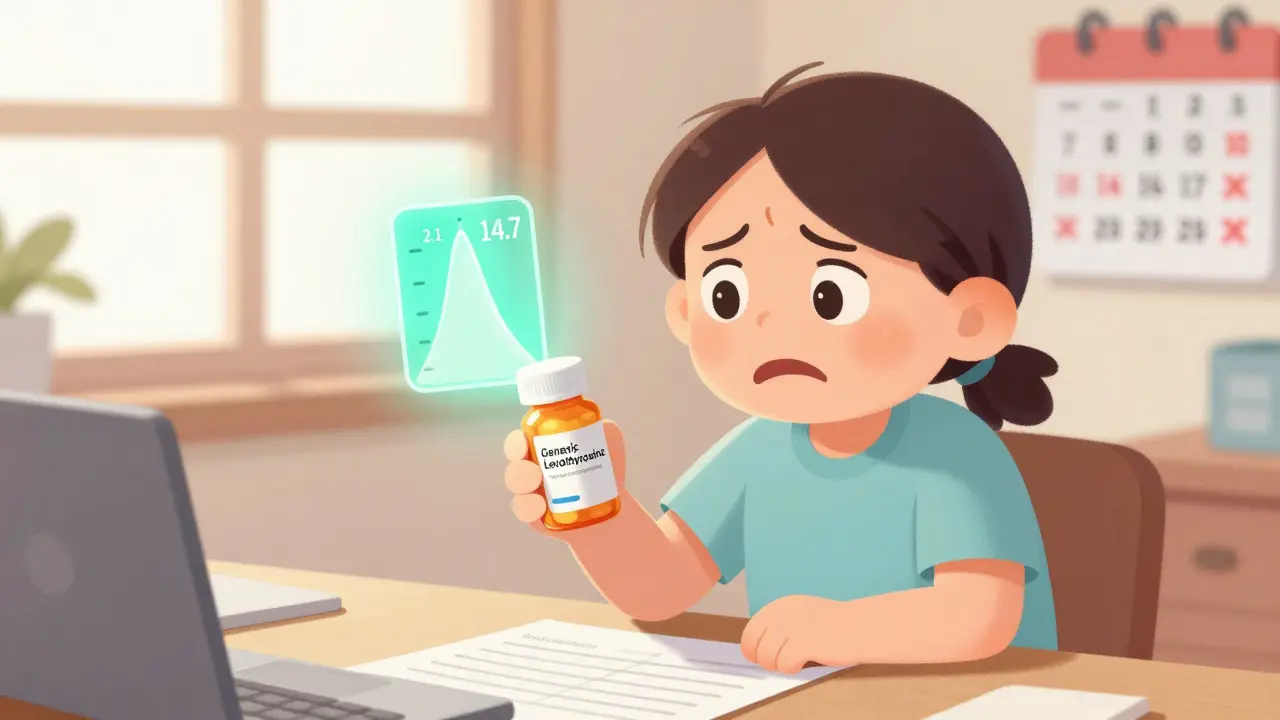
When your insurance company denies your brand-name medication because a generic is available, but that generic makes you feel worse-or doesn’t work at all-you’re not alone. Thousands of people face this every year. It’s not a mistake. It’s not laziness. It’s a systemic gap in how insurers interpret "bioequivalence." And you have rights to fight it.
Why a Generic Might Not Work for You
Generics are required by the FDA to deliver 80-125% of the active ingredient compared to the brand-name drug. That sounds precise-until you realize that for some medications, even a 20% swing in blood levels can be dangerous. Think of it like this: two cars might both be labeled "fuel efficient," but one runs on diesel and the other on ethanol. Same label. Totally different performance. This matters most for drugs with a narrow therapeutic index-medications where the difference between an effective dose and a toxic one is tiny. Examples include levothyroxine (for thyroid disorders), warfarin (a blood thinner), and antiepileptic drugs like levetiracetam or phenytoin. For people with epilepsy, a drop in blood levels from a generic switch can trigger a seizure. For someone on thyroid medication, a TSH level jumping from 2.1 to 14.7 isn’t just a number-it means fatigue, weight gain, brain fog, and sometimes heart problems. The problem isn’t the generic itself. It’s the inactive ingredients. Fillers, dyes, binders-things that don’t affect the active drug’s chemistry-can still change how your body absorbs it. Some people are sensitive to lactose, cornstarch, or specific coatings. Others have genetic differences in liver enzymes that metabolize the drug differently. That’s why 15-20% of patients on certain drug classes report therapeutic failure after switching to generics, according to the American Medical Association.How Insurance Companies Deny Coverage
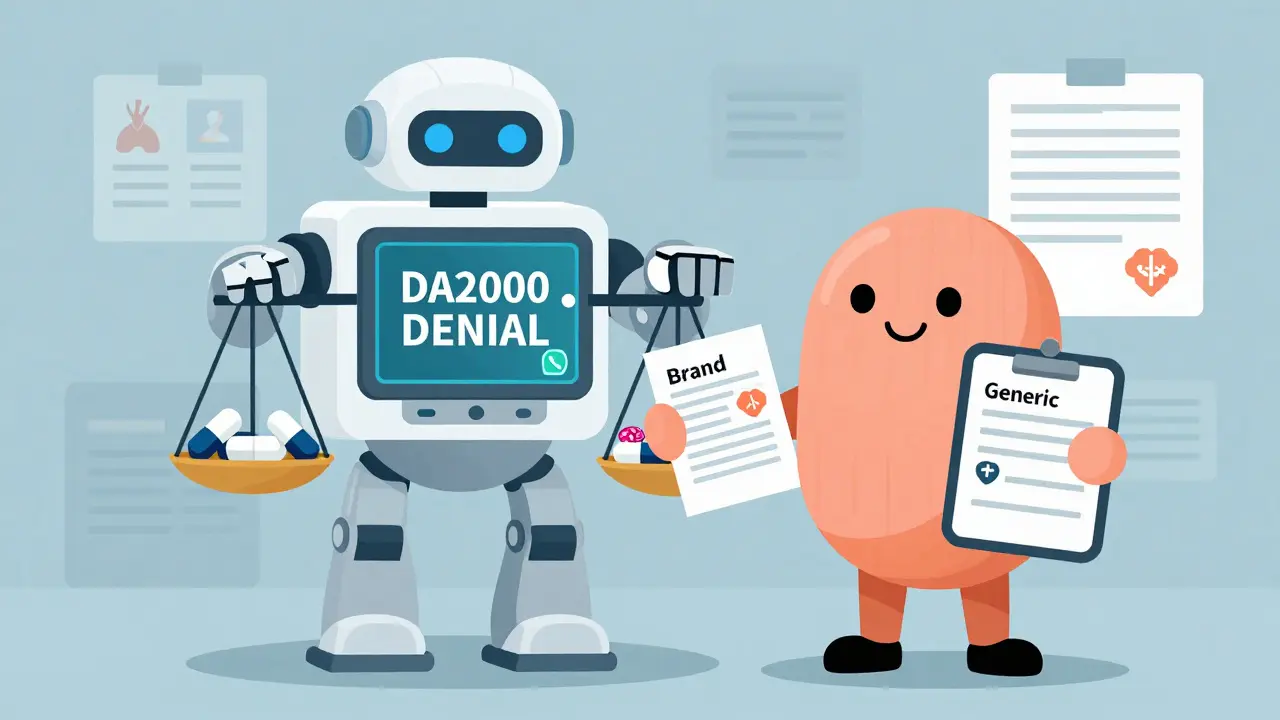
Insurers use automated systems to flag brand-name drugs when a generic exists. Their logic is simple: if it’s cheaper, use it. But they rarely ask: Did it work? When you get denied, the letter will say something like: "Generic equivalent available. Coverage denied per formulary policy." The code? Usually DA2000 or DA1200. That’s the system talking-not your doctor, not your health, not your experience. What they ignore: therapeutic inequivalence. That’s the medical term for when two drugs are chemically similar but don’t produce the same result in your body. And it’s not theoretical. Studies show 67% of appeals with solid documentation get overturned during external review.What You Need to Win Your Appeal
You can’t just say, "It didn’t work." You need proof. Here’s what works:- Medication logs: Track your symptoms daily. Note when you switched, when side effects started, and how your condition changed. Use a notebook, app, or spreadsheet. Be specific: "Day 3: headache, dizziness, TSH 14.7," not "felt bad after generic."
- Laboratory results: Blood tests showing subtherapeutic levels or worsening markers are gold. A TSH spike, INR fluctuation, or seizure frequency log are powerful.
- Physician letter: This is the most critical piece. Your doctor must write a detailed letter explaining why the brand is medically necessary. It should include: your diagnosis, the generic you tried, the clinical outcome (symptoms, lab values), and a clear statement that switching back is medically required. Mention FDA guidelines or professional society recommendations if relevant.
- History of prior failures: If you’ve tried two or more generics and they all failed, document each one with dates and outcomes. The Crohn’s & Colitis Foundation says appeals with two documented failures have an 82% approval rate.
The Appeals Process: Step by Step
The steps vary slightly depending on whether you’re on Medicare, employer insurance, or a private plan-but the structure is the same.- Get your Explanation of Benefits (EOB): Find the denial letter within 30 days. Note the denial code and deadline.
- File an internal appeal: Submit your documentation to your insurer. Deadlines: 180 days for commercial plans, 60 days for Medicare Part D.
- Wait for their response: They have 30 days to respond (72 hours for urgent cases). Most are denied at this stage-don’t panic.
- Request an external review: If denied, ask for an independent third-party review. This is where most wins happen. In 67% of cases, external reviewers overturn denials when medical evidence is strong.
- Medicare-specific steps: If you’re on Medicare Part D, you have up to four more levels: Medicare Appeals Council, then federal court. But most cases are resolved by the external review.
What Makes an Appeal Succeed
Success isn’t luck. It’s preparation. Here’s what separates winners from losers:- Specificity beats generalizations: "My TSH went from 2.1 to 14.7 after switching to generic levothyroxine" > "I didn’t feel right."
- Use official guidelines: Cite the Endocrine Society’s stance on thyroid medication, or the Epilepsy Foundation’s position on levetiracetam. Insurers respect authority.
- Get your doctor to sign off: A letter from your physician carries more weight than any patient complaint. Make sure they use medical terminology and reference ICD-10 codes.
- Don’t wait: The longer you go without your medication, the worse your condition gets. File immediately.
Real Stories, Real Wins
One patient in Brisbane, Australia, switched from Synthroid to a generic levothyroxine and saw her TSH jump from 2.1 to 14.7 in eight weeks. She kept daily logs, got her endocrinologist to write a letter citing the 2019 Endocrine Society guidelines, and submitted it with her lab results. Her appeal was approved within 11 days. Another, with SCN1A-related epilepsy, had severe neuropsychiatric side effects after switching to generic levetiracetam. His neurologist provided functional MRI data showing altered brain activation patterns. His insurer approved the brand-name Keppra after an external review. But not everyone wins. One Reddit user with chronic pain had three seizure breakthroughs on generic gabapentin. Anthem denied his appeal, saying "no clinical evidence." He didn’t have lab results. He didn’t have a detailed log. He didn’t have a physician letter that explained the mechanism. He lost.Tools and Resources That Help
You don’t have to do this alone.- GoodRx Appeal Assistant: Generates a customized appeal letter template based on your drug and insurer. Doctors say it cuts their time in half.
- Patient Advocate Foundation: Offers free case management. They help you organize documents, write letters, and navigate the system. Their 2023 report showed 92% user satisfaction.
- Crohn’s & Colitis Foundation: Provides free appeal toolkits with templates and step-by-step guides.
- Medicare Rights Center: Free counseling for Medicare beneficiaries. They know the five-tier system inside and out.
What’s Changing in 2025
The system is slowly getting better. In 2024, CMS mandated that insurers process appeals for anti-seizure medications within 72 hours. That’s huge. Nineteen states now have "right to try brand" laws-meaning insurers can’t force you to try three generics before approving a brand if you’ve already failed one. Startups like AppealCheck are using AI to predict denial reasons based on your drug, insurer, and diagnosis. It’s not perfect yet-but it’s getting closer to automating what should’ve been automatic: recognizing that not all patients respond the same way.What You Can Do Right Now
1. Check your last EOB. If you were denied a brand-name drug because a generic exists, start gathering documents today. 2. Call your doctor. Ask for a 30-minute appointment just to talk about your appeal. Bring your symptom log. 3. Download a template from GoodRx or the Patient Advocate Foundation. Fill it out. Have your doctor sign it. 4. Submit your appeal. Don’t wait. The clock starts the day you get denied.Frequently Asked Questions
What if my doctor won’t help me with the appeal?
If your doctor refuses, ask to speak with their office manager or medical records department. Many practices have staff trained to help with prior authorizations. If they still won’t help, contact the Patient Advocate Foundation-they can sometimes connect you with a volunteer physician who will write the letter. Your health matters more than administrative resistance.
Can I get my brand-name drug while my appeal is pending?
Yes, in urgent cases. If you’re experiencing seizures, thyroid crisis, or dangerous INR fluctuations, ask your doctor to request an "emergency exception." Medicare and many commercial plans must respond within 72 hours. Keep taking your current medication if it’s safe to do so-don’t stop abruptly unless your doctor advises it.
Why do insurers keep denying even when I have lab results?
Some insurers still operate on outdated assumptions-that all generics are interchangeable, or that patient reports are "subjective." But your lab values aren’t subjective. If your TSH, INR, or drug concentration levels are outside therapeutic range after switching, that’s objective evidence. Insist on an external review. That’s where denials get overturned.
Is it worth appealing for antidepressants or pain meds?
It’s harder, but still worth it. For drugs like gabapentin or SSRIs, success rates are lower because symptoms are harder to measure. But if you’ve had documented side effects-rashes, suicidal ideation, worsening anxiety-or if your quality of life has collapsed, document it. Include mental health assessments, pharmacy refill records, and notes from your therapist. There’s no rule that says only lab values count.
What if my appeal is denied again after the external review?
For Medicare, you can appeal to the Medicare Appeals Council and then federal court. For commercial plans, you may have the right to state-level review or arbitration. But in most cases, if the external review denies you, your next step is to contact your state’s insurance commissioner’s office. They can investigate whether the insurer followed state law. In 2023, over 1,200 such complaints led to policy changes by insurers.
Next Steps and Troubleshooting
If you’re just starting: get your EOB, call your doctor, and download a template. Don’t wait for perfect documentation-start with what you have. You can always add more. If you’ve been denied twice: reach out to the Patient Advocate Foundation. They’ve handled over 12,000 appeals. Their team knows which insurers are stubborn and which ones respond to specific types of evidence. If you’re running out of medication: ask your pharmacy for a temporary 30-day supply while your appeal is pending. Many pharmacies have emergency programs. This isn’t about fighting the system. It’s about making sure the system works for you. Your body doesn’t care about formularies. It only cares about what works. And you have the right to make that case.
Glendon Cone
Been there. Switched from Synthroid to generic and felt like a zombie for 3 weeks. TSH went from 2.4 to 16. My doc wrote the letter, I sent the logs, and boom - approved in 9 days. 🙌
Don’t let the system tell you you’re imagining it. Your body knows.
Also, GoodRx template saved my life. Free and stupid simple.
Henry Ward
Stop crying about generics. If you can’t handle a $5 pill, maybe you shouldn’t be on meds at all. Everyone else takes the generic just fine. This isn’t a special snowflake club.
Also, your ‘symptom log’ is just placebo noise. You’re not a scientist, you’re a whiner.
srishti Jain
Generic broke me. TSH 14.7. Seizures. No help from doctor. Insurance said ‘no’. Lost job. Now I’m on disability. They don’t care. Just money.
Kunal Karakoti
It’s fascinating how we reduce human biology to a spreadsheet. The FDA’s 80-125% window assumes uniformity in absorption, metabolism, and sensitivity - but humans aren’t lab rats.
What if the real issue isn’t the drug, but the system’s refusal to acknowledge biological individuality?
Maybe we’re not fighting insurance companies. We’re fighting the myth that medicine can be standardized like a car part.
Kelly Gerrard
THIS. IS. NON-NEGOTIABLE.
DO NOT WAIT.
DOCUMENT EVERYTHING.
GET YOUR DOCTOR TO SIGN.
EXTERNAL REVIEW IS YOUR ONLY HOPE.
YOU DESERVE TO BE WELL.
NOT A COST CENTER.
Aayush Khandelwal
Man, the bioequivalence loophole is a goddamn circus. It’s like saying two guitars with the same number of strings sound the same - but one’s tuned to E minor and the other’s in D# because the frets are 0.3mm off.
Pharmaco-genomics isn’t a buzzword - it’s the future. And insurers are still using flip phones.
Also, the Crohn’s & Colitis Foundation toolkit? Absolute gold. Used it for my gabapentin appeal. Won in 11 days.
Sandeep Mishra
Hey, if you’re reading this and you’re stuck - you’re not alone.
I’ve helped 3 people in my community file appeals this year. One was a single mom with epilepsy. Another, a vet with PTSD on sertraline.
You don’t need to be a lawyer. You just need to be persistent.
Download the template. Call your doc. Send the lab results.
It’s not about being loud. It’s about being consistent.
And if you need someone to proofread your letter - DM me. I’ve got nothing but time.
Joseph Corry
How quaint. A patient narrative. How… human.
Meanwhile, the actuarial tables don’t care about your TSH levels. They care about the 95th percentile of cost savings.
What’s next? A poetry slam for patients on warfarin?
Let’s not confuse anecdotal experience with clinical evidence. The latter is what drives outcomes - not emotional testimonials wrapped in Excel sheets.
Colin L
Oh wow, this is so detailed, I’m actually impressed - for once. But let me tell you, I’ve been through this with my sister’s levothyroxine. She’s been on 12 different generics over 7 years. Each one made her worse. One gave her tremors, another made her cry uncontrollably for 3 days. We had to hire a medical advocate because her PCP refused to write the letter. The insurance rep actually said, ‘Maybe she’s just stressed.’ Can you believe that? I mean, really? A TSH of 18.4 and they think it’s anxiety? I spent 11 months on this. 11 months. And now I’m just… tired. Like, bone-deep tired. I don’t even care if they approve it anymore. I just want them to stop pretending this is a business decision and not a moral failure.
Hayley Ash
So you want the brand name because… you’re special?
What’s next? A custom pill with your name on it?
Also, why do people always say ‘my doctor says’ like that’s a magic spell? Did your doctor also say the generic is ‘unsafe’ or just that they’re too lazy to fill out the form?
And why is everyone suddenly an expert on pharmacokinetics? You’re not a pharmacist. You’re a person with a spreadsheet.
kelly tracy
Oh here we go again. The ‘I’m not a number’ sob story.
My cousin took generic gabapentin and it worked fine. So why can’t you?
Maybe you’re just weak. Maybe you’re addicted to the brand name because it makes you feel like you’re ‘doing something’.
And don’t even get me started on ‘symptom logs’ - that’s just OCD with a side of drama.
Also, your doctor? Probably just wants the kickback from the pharma rep.
Cheyenne Sims
It is imperative to note that the FDA’s bioequivalence standard was established under the Hatch-Waxman Act of 1984 for the express purpose of ensuring therapeutic interchangeability. Any deviation from this standard constitutes a failure of pharmacovigilance, not a systemic flaw.
Furthermore, the cited studies on therapeutic failure rates are often confounded by non-adherence, placebo effects, and uncontrolled variables.
Insurers are not obligated to fund preference-based prescriptions. The burden of proof lies with the claimant, not the payer.
Therefore, the assertion that patients are being denied rights is misleading. They are being held to the same evidentiary standard as all other medical claims.