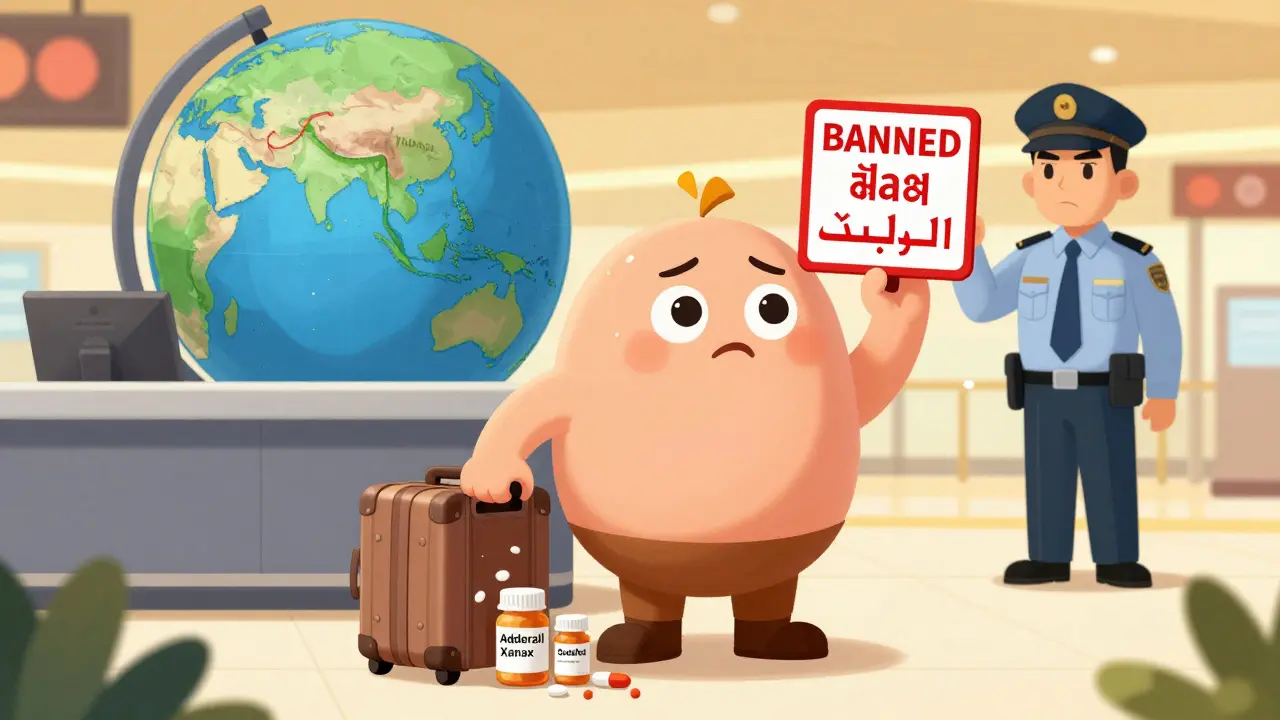
Imagine landing in Bangkok after a 14-hour flight, only to have your anxiety medication taken away by customs-and you’re left without it for the rest of your trip. Or worse, being detained because a common painkiller in the U.S. is illegal in the UAE. This isn’t rare. In 2023, over 90 million Americans traveled abroad, and nearly 1 in 7 ran into serious problems with their medications. It’s not about being careless. It’s about not knowing how complicated the rules are.
Why Your U.S. Prescription Might Not Be Enough
Just because a drug is legal in the United States doesn’t mean it’s legal anywhere else. The U.S. government doesn’t control what other countries allow. Countries like Japan, Thailand, and Saudi Arabia have strict lists of banned substances. Some medications you take daily-like ADHD pills, sleep aids, or even certain cold medicines-can land you in serious trouble. For example:- Japan bans over 1,400 medications, including pseudoephedrine (found in Sudafed), certain antibiotics, and many ADHD drugs like Adderall.
- Thailand treats zolpidem (Ambien) like a controlled narcotic. Carrying even a small amount without a notarized doctor’s letter can lead to 72-hour detention.
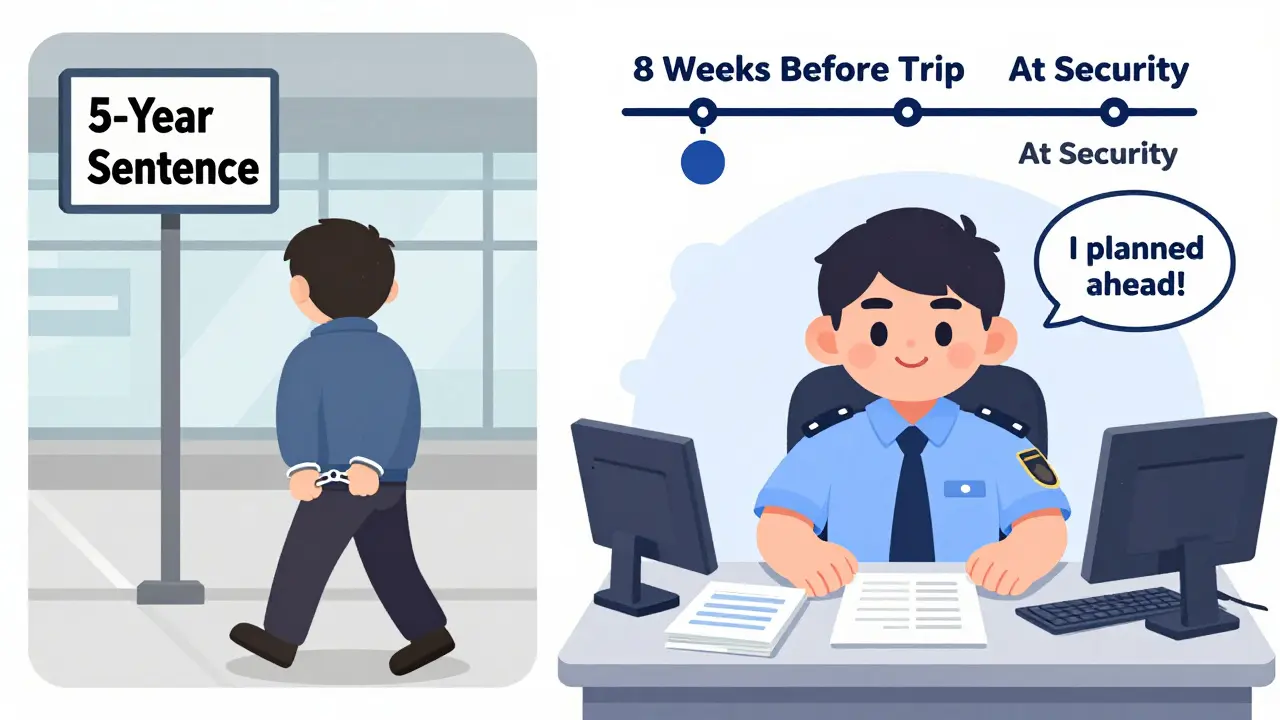
- United Arab Emirates imposes prison sentences of up to five years for carrying codeine, even if it’s in a cough syrup prescribed by your doctor.
Which Medications Are Most Likely to Cause Problems?
Some drugs are red flags everywhere. The CDC and U.S. State Department flag these categories as high-risk:- Narcotics and painkillers: Hydrocodone, oxycodone, codeine (even in cough syrup).
- Sedatives and anti-anxiety meds: Alprazolam (Xanax), diazepam (Valium), clonazepam.
- Sleep aids: Zolpidem (Ambien), eszopiclone (Lunesta).
- ADHD medications: Amphetamine/dextroamphetamine (Adderall), lisdexamfetamine (Vyvanse).
- Decongestants: Pseudoephedrine (Sudafed) is banned in Japan, Australia, and parts of Europe.
- CBD and cannabis products: Even if legal in your state, CBD is banned in 19 countries including South Korea, Malaysia, and Singapore.
How Much Medication Should You Bring?
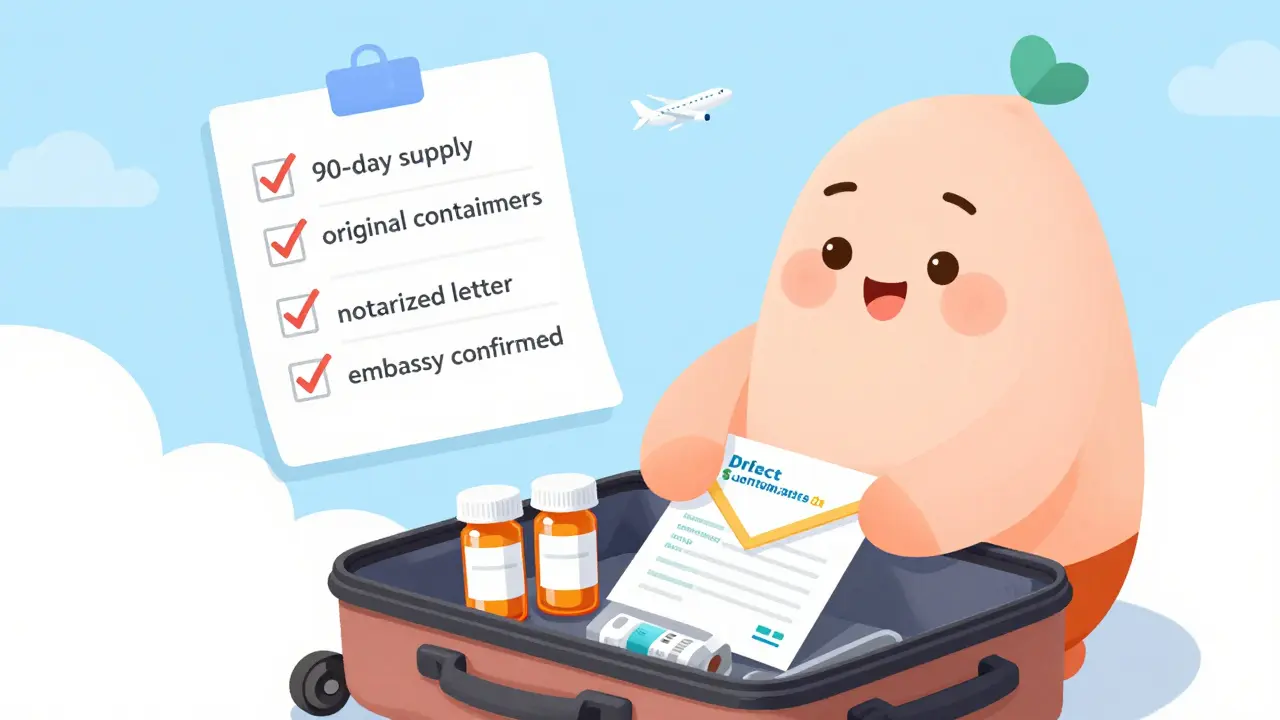
The U.S. Customs and Border Protection (CBP) says you can bring no more than a 90-day supply for personal use. But that’s not a guarantee. Some countries have stricter limits. For example, Thailand allows only a 30-day supply unless you have special permission. Always bring more than you think you’ll need. Delays happen. Flights get canceled. You might need to extend your trip. Experts recommend adding at least a 7-day buffer on top of your planned travel dates. Say you’re going to Europe for 10 days. Bring 17 days’ worth. If you’re on a monthly pill, that’s 17 pills-not 10. If you’re on a daily injection, bring 17 doses. Don’t count on refilling abroad. Many countries don’t fill foreign prescriptions.How to Pack Medications for the Plane
Airline rules and TSA guidelines can be confusing. Here’s what actually works:- Carry all medications in your carry-on. Checked bags get lost. If your insulin, EpiPen, or heart medication is in checked luggage and it disappears, you’re in danger.
- Keep pills in original bottles. This isn’t optional in some states. California, New York, Texas, Florida, and Illinois require controlled substances to be in original prescription containers-even for domestic flights.
- Liquids over 3.4 oz are allowed if they’re medically necessary. Declare them at security. Delta, United, and American Airlines all confirm this under TSA Directive 1544.4 (effective Jan 2025).
- Needles and syringes? Bring a doctor’s note. Even if you’re diabetic, you’ll be questioned. A note from your provider helps avoid delays.
Documents You Must Have
A prescription is not enough. You need:- A letter from your doctor on official letterhead. It should list your name, medication names (both brand and generic), dosage, and reason for use. Example: “Patient requires 10 mg of alprazolam daily for generalized anxiety disorder.”
- A notarized copy if you’re traveling to Thailand, Saudi Arabia, or the UAE. Some countries require this even for non-controlled substances.
- An International Certificate for Medicinal Products (ICMP) if your pharmacy offers it. About 68% of U.S. pharmacies can generate this for $25-$40. It’s in English and French and recognized in many countries.
- A copy of your prescription label with the pharmacy name, date, and your name.
How to Check If Your Medication Is Allowed
Don’t guess. Don’t ask a friend who “went to Japan last year.” Use official sources:- INCB Country Regulations Database (updated January 2025): The most reliable source. It lists banned substances by country and links to embassy contacts.
- U.S. State Department Travel Advisories (updated quarterly): Search for your destination and click “Health.”
- Destination country’s embassy website: Many have specific pages for travelers with medical needs. Japan’s embassy, for example, has a downloadable form for medication approval.
What to Do If Your Medication Is Banned
Some drugs simply aren’t allowed. If that’s the case, you have three options:- Switch to an approved alternative before you leave. Ask your doctor: “Is there another medication with the same effect that’s legal in [country]?” For example, instead of Adderall, some travelers switch to non-stimulant options like atomoxetine (Strattera), which is permitted in Japan.
- Apply for a special permit through the destination country’s health ministry. This can take 6-8 weeks. The INCB database now includes direct links to permit applications for 68 countries.
- Cancel or reschedule your trip if you can’t safely manage your condition without the medication. Your health comes first.
Real Stories: What Happens When You Skip the Prep
- A traveler from Florida was held for 4 hours at Bangkok Airport because she had 28 Xanax pills without a notarized letter. She missed her connecting flight and lost $800 in rebooking fees. - A man from Texas tried to refill his Vyvanse in Germany. The pharmacy refused. He had no documentation. He spent 3 days in a hotel, anxious and unable to work. - A woman from California brought her CBD oil to South Korea. It was confiscated. She was questioned for 6 hours. Her phone was searched. She was never arrested-but she was banned from re-entry for a year. These aren’t outliers. They’re common.Where to Get Help
You don’t have to figure this out alone:- International Society of Travel Medicine (ISTM): Offers a directory of clinics that specialize in travel health. They can help you plan your meds.
- MedPassport (online tool): A $49 subscription service that stores your meds, generates travel letters, and checks country rules.
- Delta Air Lines Accessibility Line (404-209-3434): They’ve trained staff to help with medication questions.
- INCB Emergency Hotline (+41 22 917 92 92): Available 24/7. They can confirm if a medication is banned in a country.
Final Checklist: 5 Steps Before You Go
1. Start 8-12 weeks before departure. Some permits take months. 2. Check every country you’ll visit-including layovers. Dubai, Frankfurt, and Singapore have strict rules too. 3. Call your doctor and pharmacy to get the right documents and enough supply. 4. Pack in carry-on, in original bottles, with copies of everything. Keep one set in your wallet, one in your bag. 5. Confirm with the embassy one last time 10 days before you leave. Rules change. If you’re managing a chronic condition-diabetes, epilepsy, depression, heart disease-your medication isn’t optional. It’s life-sustaining. Skipping these steps isn’t just inconvenient. It’s dangerous.What’s Changing in 2026
The U.S. State Department is testing a new system with Japan, Thailand, and the UAE to create standardized medication forms. It’s expected to launch in late 2025. But until then, the rules are still messy. Meanwhile, more countries are banning CBD, tightening ADHD drug rules, and cracking down on decongestants. The global travel market hit $1.2 trillion in 2024-and with it, enforcement is getting stricter, not looser. Don’t wait until you’re at the airport to learn the rules. Plan ahead. It’s the only way to travel safely with your meds.
Alexandra Enns
This article is basically a glorified panic attack in paragraph form. Like, wow, you didn’t know your Adderall might get you locked up in Tokyo? Newsflash: EVERYONE who’s ever flown internationally knew this. The real problem is Americans acting like the world owes them their prescription drug buffet. Stop being entitled and start researching. Or better yet-don’t travel. Stay home and take your little pills in peace.
Marie-Pier D.
Y’all, I just got back from Bali and I had my anxiety meds with me-original bottle, doctor’s letter, notarized copy, AND a PDF emailed to my mom. 😭 I cried when they let me through customs. Seriously, this guide saved me. If you’re nervous, DO THIS. Your future self will hug you. And yes, CBD is a NO in 19 countries-I learned that the hard way. ❤️
Sawyer Vitela
90 million Americans traveled. 1 in 7 had issues. That’s 12.8 million people who didn’t read this. The problem isn’t the rules-it’s the ignorance. Simple fix: don’t be one of them.
Izzy Hadala
While the article presents a comprehensive and empirically grounded framework for international pharmaceutical compliance, one must consider the epistemological asymmetry between U.S. regulatory paradigms and those of sovereign states with distinct pharmacopeial traditions. The assertion that 'a prescription is not enough' is not merely procedural-it is ontological, reflecting a fundamental divergence in the epistemic authority granted to Western medical documentation.
Furthermore, the reliance on the INCB database, while commendable, fails to account for subnational regulatory variations within federated states such as India and Brazil, where provincial jurisdictions may impose additional restrictions not reflected in federal embassy guidelines.
Elizabeth Cannon
omg i just realized i packed my xanax in a pill organizer and thought i was fine… like… i’m literally gonna die if i don’t take it. thanks for the wake up call. going to call my doc tomorrow and get that letter. also-i’m bringing 2 extra weeks just in case my flight gets delayed again. 🙏
blackbelt security
Travel smart. Don’t be the person who ruins their trip because they didn’t plan. Pack your meds like your life depends on it-because it does. Carry-on. Original bottles. Paperwork. Done. Simple. No drama. Just do it.
Patrick Gornik
Here’s the real metaphysical dilemma: if your medication is legal in your country but criminalized abroad, are you a criminal for carrying it-or a victim of geopolitical pharmaceutical colonialism? The U.S. exports not just goods and culture, but pharmacological imperialism. We assume our pills are universal rights. They’re not. They’re privileges wrapped in bureaucratic white noise. The airport is the new confession booth-and customs officers are the priests who judge your soul by the contents of your pill bottle.
And let’s not forget: the real crime isn’t bringing Adderall to Japan. It’s that we’ve turned mental health into a commodified, passport-dependent luxury. You need a notarized letter to breathe normally? That’s not regulation. That’s dystopia with a side of Visa.
Karen Conlin
I’ve been a travel nurse for 12 years and I’ve seen people get detained over Tylenol with codeine. Seriously. One woman cried because she thought ‘it’s just a cough syrup’-until they took her phone, searched her bag, and held her for 12 hours. This guide? It’s not just helpful-it’s life-saving. Please, if you take anything mental or chronic, treat this like you’re packing your oxygen tank. Double-check. Triple-check. Email your docs. Print everything. Bring extra. Don’t be the person who ruins their vacation-and maybe their future-because they were lazy. You owe it to yourself.
Also, if you’re going to Dubai? Don’t even think about bringing melatonin. It’s classified as a psychotropic there. I know. I’ve had to explain that to three people. You’re welcome.
Sushrita Chakraborty
Thank you for this meticulously researched and culturally sensitive guide. In India, we are acutely aware of how Western pharmaceutical norms clash with local regulations-especially regarding stimulants and opioids. I have personally assisted travelers in Delhi who were unaware that their ADHD medication was classified as a Schedule I drug under the NDPS Act. The inclusion of the INCB database and embassy contact protocols is particularly commendable. I would, however, respectfully suggest adding a note about the importance of carrying medication in English-labeled packaging, as many non-English-speaking customs officers rely on transliterated brand names for verification.
Heather McCubbin
Look I’m not saying this is wrong but like… why are we treating people like criminals for needing to survive? I have PTSD and if I don’t take my meds I turn into a screaming mess in public and I’m supposed to just… not travel? That’s not safety that’s punishment. The world is broken if my anxiety is illegal in Bangkok but my coffee isn’t. I’m not asking for permission I’m asking for humanity