
When your stomach hurts after eating dairy, or you feel bloated after a slice of pizza, it’s easy to assume you have a food allergy. But here’s the truth: most of the time, you don’t. Food intolerance and food allergy sound similar, but they’re completely different - and mixing them up can lead to unnecessary fear, wrong diets, or even dangerous mistakes.
What’s Really Happening in Your Body?
A food allergy is an immune system overreaction. Your body sees a harmless food protein - like peanut or egg - as an invader. It fires off IgE antibodies, which trigger mast cells to dump histamine and other chemicals into your bloodstream. That’s what causes hives, swelling, trouble breathing, or even anaphylaxis. This happens fast - usually within minutes to two hours after eating. Food intolerance? That’s a digestive issue. No immune system involved. It’s usually because your body lacks the enzyme to break down a certain food. Lactose intolerance is the classic example: you don’t make enough lactase, so milk sugar sits in your gut, ferments, and causes gas, cramps, and diarrhea. Or maybe you’re sensitive to sulfites in wine, or FODMAPs in onions and garlic. Symptoms show up slower - often 30 minutes to several hours after eating - and they stay in your gut. The difference isn’t just academic. One can kill you. The other just makes you miserable.GI Symptoms: How to Tell Them Apart
Both can cause stomach pain, nausea, and diarrhea. But the pattern tells the story. Food allergy GI symptoms:- Sudden vomiting or diarrhea (within minutes to two hours)
- Often paired with skin reactions (hives, swelling)
- May include throat tightness, wheezing, or dizziness
- Even tiny amounts - like a crumb - can trigger a reaction
- Bloating, gas, and cramping that build slowly
- Diarrhea or constipation, but no systemic signs
- Symptoms usually appear after larger portions
- You might handle a small amount - like a splash of cream - just fine
Testing: What Actually Works
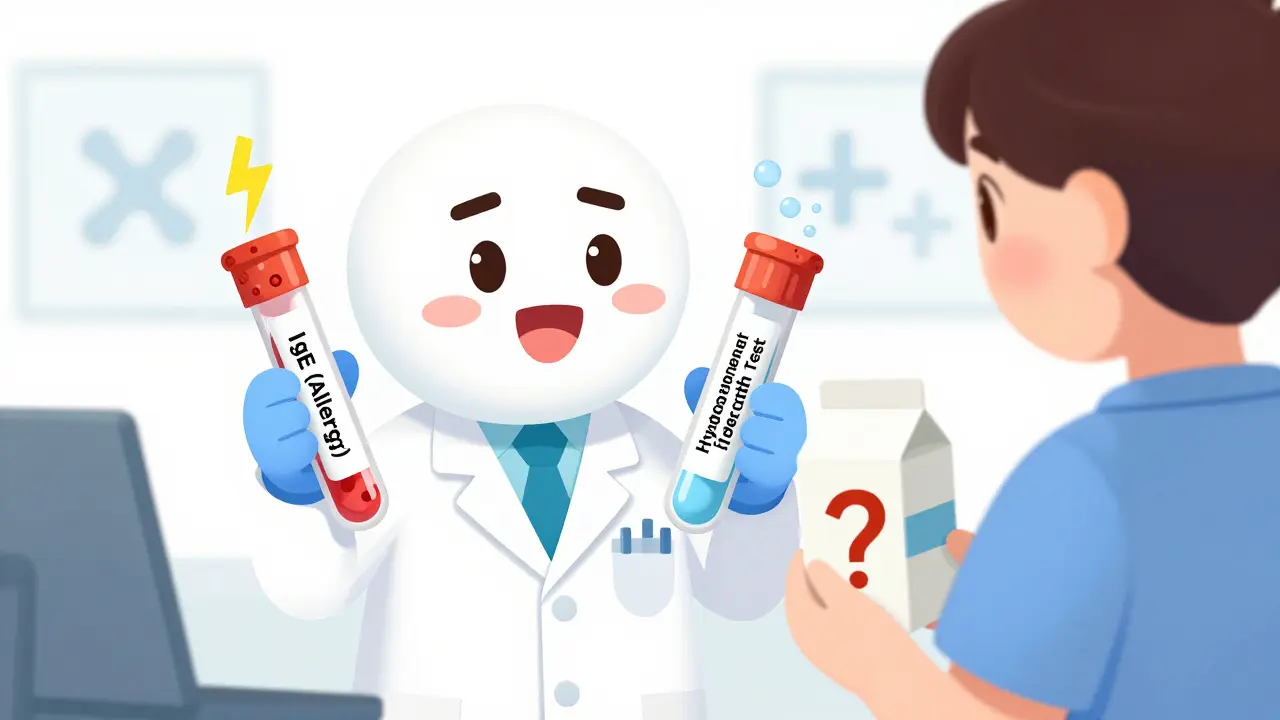
There’s a lot of junk out there. Don’t waste your money on those IgG blood tests sold online. The American Academy of Allergy, Asthma & Immunology says they’re useless - no scientific proof, false positives everywhere. For food allergies:- Skin prick test: A drop of allergen is placed on your skin, then lightly pricked. A raised bump (wheal) larger than 3mm usually means allergy.
- Specific IgE blood test: Measures IgE antibodies to specific foods. Levels above 0.35 kU/L suggest allergy, but it’s not definitive.
- Oral food challenge: The gold standard. You eat tiny, increasing amounts of the food under medical supervision. If you react, you know for sure. This is the only way to confirm a diagnosis.
- Component-resolved diagnostics: Newer tests look at specific proteins - like Ara h 2 in peanuts. If levels are above 0.23 kU/L, there’s a 95% chance you’re truly allergic.
- Hydrogen breath test: For lactose or fructose intolerance. You drink a sugar solution, then your breath is tested every 15-30 minutes. A rise of 20 ppm of hydrogen confirms malabsorption.
- Celiac disease testing: Requires a blood test for tissue transglutaminase IgA antibodies. If it’s above 10 U/mL, you need an endoscopy with biopsy. Marsh 3 damage on biopsy = celiac.
- Elimination and challenge: The go-to for non-celiac gluten sensitivity and FODMAP intolerances. Cut out the suspect food for 2-6 weeks. Then slowly reintroduce it. If symptoms return, you’ve found your trigger.
What’s Not Real - and Why You Should Avoid It
The internet is full of fake tests. You’ve probably seen ads for “food sensitivity panels” that claim to detect dozens of intolerances with a single blood draw. These test for IgG antibodies - which are normal. Everyone has them. They don’t mean you’re intolerant. A 2023 study showed these tests have sensitivity below 30% and specificity under 45%. In plain terms: they’re wrong more often than they’re right. Another myth: “gluten sensitivity” is real - but only if you’ve ruled out celiac disease and wheat allergy. Most people who think they’re gluten-sensitive are actually reacting to FODMAPs in wheat, not gluten itself. A 2024 study in Nature Communications found specific blood metabolites that can distinguish true non-celiac gluten sensitivity from IBS with 89% accuracy. But that’s still research - not yet routine testing.Management: What to Do After Diagnosis
If you have a food allergy:- Avoid the food completely. Always read labels - the FDA requires top 9 allergens to be clearly listed.
- Carry two epinephrine auto-injectors (EpiPen) at all times. Even if past reactions were mild, the next one could be deadly.
- Teach family, coworkers, and school staff how to use them.
- Epinephrine isn’t expensive - but without insurance, twin packs cost $550-$750. Check patient assistance programs.
- You don’t need to eliminate the food entirely - just reduce it.
- Lactose-intolerant people can usually handle up to 12g of lactose daily (about 1 cup of milk).
- Choose lactose-free dairy, take lactase enzymes before meals, or try hard cheeses and yogurt - they’re naturally low in lactose.
- For FODMAPs, a low-FODMAP diet under a dietitian’s guidance works better than random elimination.
- For sulfites, avoid wine, dried fruit, and processed meats with added sulfites above 10ppm.
Why Misdiagnosis Is So Common
A 2023 study found 80% of people who think they have a food intolerance are wrong. Their real diagnosis? Irritable bowel syndrome (IBS) in 45%, inflammatory bowel disease (IBD) in 12%, or functional dyspepsia in 23%. Many of these conditions have overlapping symptoms - bloating, cramps, diarrhea - so it’s easy to blame the food. Celiac disease is another big one. An estimated 75% of cases go undiagnosed because doctors don’t test for it. People think they’re gluten intolerant, but they have an autoimmune disease that damages their intestines. Left untreated, it increases cancer risk. And here’s the kicker: up to 90% of positive skin prick tests in kids with eczema are false positives. That’s why oral food challenges are so important. Don’t assume - test.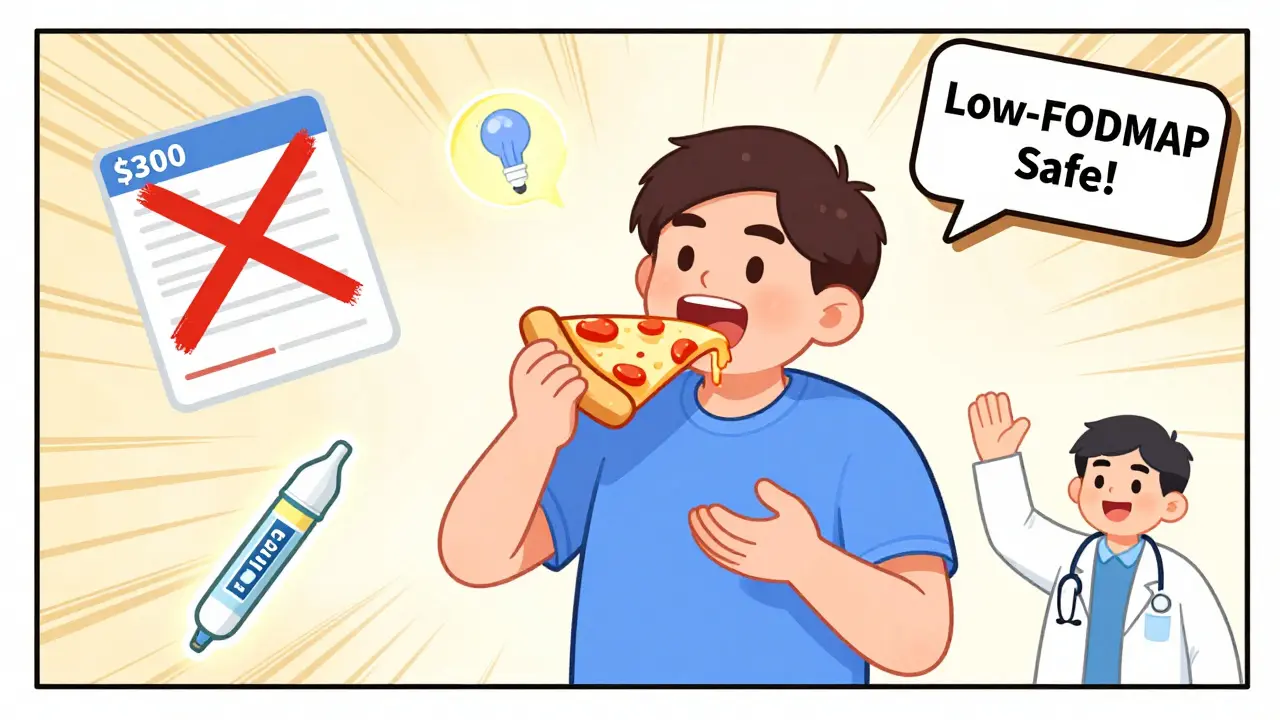
When to See a Doctor
See a specialist if:- You have any reaction that includes swelling, trouble breathing, or dizziness - even once.
- Your symptoms last more than a few days or keep coming back.
- You’ve lost weight or have blood in your stool.
- You’ve cut out multiple foods and feel worse, not better.
What’s Next in Research
Scientists are working on better tools. Basophil activation tests, which measure immune cell responses, are showing promise for predicting allergy severity. New biomarkers for non-celiac gluten sensitivity are being validated. And FARE (Food Allergy Research & Education) is funding 17 clinical trials as of 2024 to improve diagnostics. The goal? Personalized answers. Not “avoid everything.” But “here’s what you can safely eat - and what you really need to avoid.”Can food intolerance turn into a food allergy?
No. Food intolerance and food allergy are different biological processes. One is digestive, the other immune. You can’t develop an allergy just because you’re intolerant to something. But having one doesn’t protect you from developing the other - they’re separate risks.
Is it possible to outgrow a food intolerance?
Sometimes. Children with lactose intolerance often develop more lactase enzyme as they age. Some people with non-celiac gluten sensitivity find their sensitivity decreases after healing their gut - especially if they had underlying inflammation or SIBO. But for enzyme deficiencies like lactase deficiency, it’s usually lifelong.
Can you have both a food allergy and a food intolerance?
Absolutely. It’s not rare. Someone might be allergic to peanuts and also lactose intolerant. The symptoms can overlap, which makes diagnosis tricky. That’s why testing and professional guidance are critical - you need to know which reaction is which to manage them properly.
Do food allergies get worse over time?
They can, but not always. A person might have a mild rash one time and anaphylaxis the next. There’s no way to predict. That’s why even mild reactions require serious attention. The immune system doesn’t “learn” from past reactions - each exposure is a new risk.
Are at-home food sensitivity tests worth it?
No. Tests that measure IgG antibodies are not scientifically validated. They’re marketed as “sensitivity” tests, but IgG is a normal immune response to eating food - not a sign of intolerance. These tests cause more harm than good by leading people to cut out healthy foods unnecessarily. Stick to evidence-based methods: elimination diets and medically supervised challenges.
What’s the most common food intolerance?
Lactose intolerance. It affects about 65% of the global population. Other common ones include fructose malabsorption, histamine intolerance, and sensitivity to FODMAPs. Gluten sensitivity is often mislabeled - many people are reacting to wheat’s FODMAPs, not gluten.
Final Takeaway
If you’re having GI issues after eating, don’t jump to conclusions. Don’t assume it’s a food allergy. Don’t buy a $300 online test. See a doctor. Get tested properly. You might find out you can still enjoy your favorite foods - just in smaller amounts. Or you might discover you’re at risk for something serious. Either way, knowing the truth gives you control - not fear.
Luke Davidson
Been dealing with bloating after pizza for years thought it was gluten but turns out it was the onions and garlic 🤯 low FODMAP diet changed my life no more midnight bathroom runs
Karen Conlin
Y’all need to stop self-diagnosing. I had a friend who cut out dairy because she thought she was lactose intolerant turns out she had IBS and was just scared to see a doctor. Go see a GI specialist not your Instagram nutrition guru.
asa MNG
so like i took one of those $300 blood tests and it said i was allergic to broccoli and avocados?? 🤡 i still eat them and im fine. also why do doctors charge so much for the real tests??
Sushrita Chakraborty
While the article is scientifically accurate, I must emphasize that cultural dietary practices must also be considered. In many Asian households, lactose intolerance is normalized and managed through fermented dairy or plant-based alternatives. Medical testing should complement, not override, lived experience.
Josh McEvoy
my mom thinks she's gluten sensitive but she's just stressed and eats too much bread. also why is everyone so obsessed with food these days??
Heather McCubbin
Let me be the first to say this: the medical industrial complex is profiting off your confusion. They want you scared. They want you buying EpiPens. They want you on expensive tests. The truth? Your gut is smarter than your doctor's lab report
Sawyer Vitela
IgG tests are garbage. End of story. Stop wasting money.
Shanta Blank
I had a near-death experience with a peanut crumb at a birthday party. My EpiPen saved me. But now I’m paranoid about everything. Even the smell of peanut butter makes my heart race. This isn’t just about food-it’s about living in constant fear. No one gets it.
Tiffany Wagner
My sister was diagnosed with celiac after 5 years of misdiagnosis. She cried when she finally got the right test. Please don’t wait like she did.
Chloe Hadland
My dad used to get stomach cramps after milk but now he drinks almond milk and says he feels like a new man. Sometimes the fix is simple.
Amelia Williams
Just had my hydrogen breath test done and it confirmed I’m lactose intolerant. I used to think I was just ‘sensitive’ but now I know the exact amount I can handle. 12g of lactose is my magic number-so I sip my coffee with oat milk and live my best life. Knowledge is power!
Viola Li
Why are we still calling it ‘gluten sensitivity’? It’s FODMAPs. It’s always FODMAPs. The whole gluten panic is a scam cooked up by the paleo diet industry. Wake up.
Dolores Rider
Did you know the FDA is hiding the truth? They let sulfites in wine because Big Pharma wants you to buy antihistamines. I read a whistleblower blog and now I only drink organic sake. Trust no one. 🕵️♀️
venkatesh karumanchi
In India, we’ve been managing lactose intolerance for centuries with lassi and curd. Modern science is just catching up. The real answer is often in tradition, not a lab report.
Luke Davidson
That’s actually a good point. My grandma always said ‘fermented dairy is easier on the gut’ and she was right. I started eating Greek yogurt and boom-no more bloating. Maybe we’ve been overcomplicating this