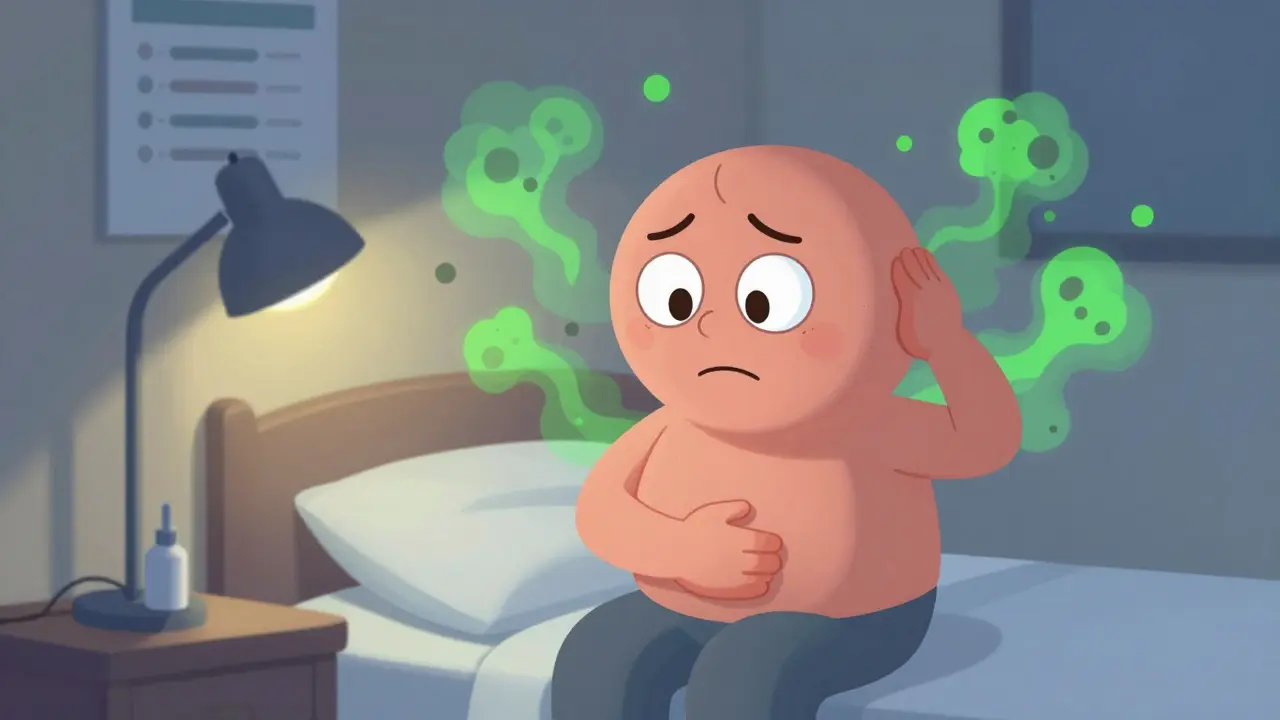
When your kidneys stop working, your body doesn’t just feel tired-it starts to poison itself. Uremic symptoms like constant nausea and unbearable itching aren’t just annoying; they’re warning signs your body is drowning in waste it can’t flush out. These aren’t vague discomforts. They’re measurable, life-altering signals that dialysis may be the only thing keeping you alive-and that timing matters more than most doctors admit.
What Exactly Are Uremic Symptoms?
Uremia isn’t a disease. It’s the result of kidney failure. When your kidneys drop below 10-15% function, they stop filtering toxins like urea, creatinine, and indoxyl sulfate from your blood. These waste products build up slowly, then suddenly overwhelm your system. The result? A cascade of symptoms that hit your stomach, skin, brain, and heart.
Nausea is one of the most common. Around 68% of people with stage 5 chronic kidney disease (CKD) report it. But it’s not just feeling queasy. It’s a metallic taste that makes food taste like dirt. One patient on Reddit described eating as “swallowing sand.” Weight loss follows fast-some lose 18 pounds in two months because food becomes unbearable. This isn’t laziness or stress. It’s toxins hitting the brain’s trigger zone for vomiting.
Then there’s the itch. Not a dry skin itch. Uremic pruritus, or CKD-associated pruritus, is a deep, burning, crawling sensation that doesn’t go away. It hits your back, legs, arms-often symmetrically, never just one spot. And it gets worse at night. Studies show 68.9% of hemodialysis patients have it. A 2022 study found patients with this itch had CRP levels nearly three times higher than those without it. That means inflammation is burning inside you, even if your skin looks normal.
Why Does Itch Happen When Kidneys Fail?
For years, doctors thought it was just dry skin. Then they realized: even patients with perfect skin still itch. The real culprit? Middle molecules-waste products that regular dialysis doesn’t fully remove. Indoxyl sulfate and p-cresyl sulfate stick to nerve endings and trigger itching signals. High phosphate and calcium levels make it worse. When your phosphate hits above 5.5 mg/dL and your calcium-phosphorus product goes over 55, your risk of severe itching spikes.
It’s not just physical. The itch changes your life. People stop sleeping. One patient tracked her sleep on a Fitbit: it dropped from 85 to 42 over six months before dialysis. Others quit jobs. Some scratch until they bleed. The 5-D Itch Scale measures this: duration, degree, direction, disability, distribution. A score above 12 means severe. Above 15? That’s when doctors start talking about dialysis-not just because your numbers are low, but because you can’t live like this anymore.
When Does Nausea Mean It’s Time for Dialysis?
Nausea doesn’t always mean dialysis is needed. But when it’s persistent, linked to weight loss, and doesn’t respond to anti-nausea meds, it’s a red flag. The 2023 KDOQI guidelines say: if you’ve lost 5% of your body weight in three months because you can’t eat, that’s a trigger. Your BUN might be over 70 mg/dL. Your creatinine over 8 mg/dL. Your eGFR below 10.5.
But here’s the twist: starting dialysis too early doesn’t save your life. The IDEAL trial found no difference in survival between starting at eGFR 10-14 versus 5-7. So why wait? Because early dialysis doesn’t fix the symptoms-it just adds needles, time, and cost. The real goal? Start when symptoms become unbearable, not when a number hits a line on a chart.
That’s why doctors now look at you, not just your labs. If you’re vomiting daily, skipping meals, losing muscle, and your nausea won’t respond to ondansetron or domperidone, then dialysis isn’t a choice-it’s a necessity. Waiting until you’re vomiting blood or collapsing from fluid overload is too late.
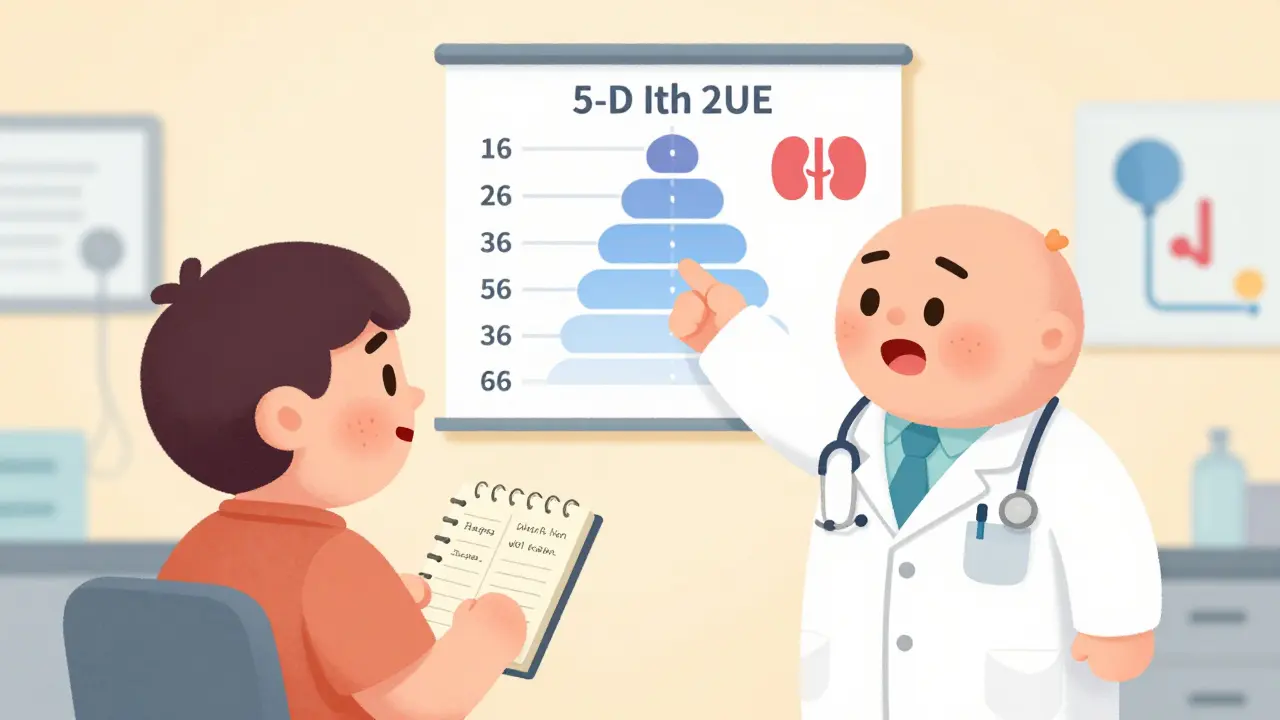
When Should You Start Dialysis? It’s Not Just About Numbers
The old rule was: start dialysis when your eGFR hits 5. That’s outdated. Today, the decision is personal. The 2023 KDOQI guidelines say: start when uremic symptoms are severe and unmanageable. That could be at eGFR 12. Or 8. Or even 6.
Here’s what actually pushes the trigger:
- Weight loss over 5% in 3 months from nausea
- Itch score over 15 on the 5-D scale
- Uremic pericarditis (fluid around the heart, seen on ultrasound)
- Severe fatigue that stops you from walking or working
- Confusion or trouble thinking clearly
Some doctors push for earlier dialysis-especially in places like Japan, where studies show fewer hospitalizations. But in the U.S., the data says: don’t rush. If you’re managing symptoms with meds, diet, and better dialysis, you can wait. The goal isn’t to hit a number. It’s to stop suffering.
And here’s the hard truth: many patients wait too long. A 2022 University of Michigan poll found 41% of people with uremic symptoms saw three or more doctors before being told, “Your kidneys are failing.” The average delay? 8.7 months. That’s months of sleepless nights, constant itching, and nausea while doctors misdiagnose it as anxiety, eczema, or GERD.
How Doctors Treat the Symptoms Before Dialysis
Before dialysis starts, you need relief. And it’s not just “take an antihistamine.”
For itching:
- Optimize dialysis-if you’re already on it, make sure your Kt/V is above 1.4. Poor dialysis = more toxins = worse itch.
- Gabapentin-start at 100mg at night. Many patients need up to 300mg three times a day. But watch for dizziness or confusion.
- Nalfurafine or difelikefalin-these are newer drugs that target the brain’s itch center. Difelikefalin (Korsuva) was FDA-approved in 2021. It cuts itch by 33% in two days. But it’s expensive and requires IV infusion three times a week.
For nausea:
- Ondansetron-4mg three times a day. Works well for most.
- Domperidone-10mg four times a day. Better than ondansetron for some, but risks heart rhythm problems. Your doctor will check your QTc before prescribing.
- Diet tweaks-cut phosphorus. Avoid dairy, processed meats, colas. Phosphorus worsens both nausea and itch.
These aren’t cures. They’re bandaids. But they buy you time-time to plan, to adjust, to avoid emergency dialysis.
The Hidden Costs of Ignoring Uremic Symptoms
There’s a financial toll. Patients with severe itching spend $8,432 more per year on healthcare. Why? More ER visits. More hospital stays. More sleep aids. More antidepressants. More skin infections from scratching.
And there’s a racial gap. Black patients wait 3.2 months longer than white patients before starting dialysis. That delay leads to 18% higher hospitalization rates. Why? Access. Bias. Lack of awareness. This isn’t just medical-it’s systemic.
New drugs are coming. Nemifitide, a selective kappa-opioid agonist, showed 45% better itch reduction than placebo in 2023 trials. The 2024 KDIGO guidelines may soon require patient-reported symptom scores-not just eGFR-to decide when to start dialysis.
That’s progress. But right now, the best tool you have is knowing your symptoms. Not your numbers. Not your doctor’s guess. Your real, daily experience.
What to Do If You’re Feeling This
If you have CKD and you’re:
- Scratching until you bleed, especially at night
- Loosing weight because food tastes like metal
- Too tired to walk to the mailbox
- Having trouble remembering names or names
Don’t wait for your next appointment. Call your nephrologist. Ask: “Is this uremia? Are we close to dialysis?” Bring your symptom log. Write down when the itch starts. How long it lasts. What makes it better or worse. Track your weight. Record meals you skip.
Don’t let them dismiss it as “just aging” or “stress.” Uremic symptoms are real. They’re measurable. And they’re treatable-if you act before it’s too late.
Dialysis isn’t a failure. It’s a reset. It doesn’t fix your kidneys. But it removes the poison. And for many, it brings back sleep. Appetite. Life.

Jodi Harding
This isn't just medical advice-it's survival. I watched my mom scratch her arms raw for months while doctors called it 'eczema.' She lost 20 pounds before anyone listened. When she finally got on dialysis, she slept for the first time in a year. No numbers matter if you're dying inside.
Stop waiting for labs to scream. Listen to your body before it breaks.
Zoe Brooks
I get it. I really do. But I also know people who started dialysis too early and ended up worse off-more infections, more depression, more feeling like a machine. It’s not about fear. It’s about balance.
My uncle waited until he couldn’t stand up. He started dialysis, and within two weeks, he was cooking again. Not because his numbers improved-but because the poison was gone.
Don’t rush. But don’t ignore. Just… be loud about your suffering. Doctors need to hear it, not just see it on a screen.
Kristin Dailey
Why are we letting foreigners dictate our healthcare? In Japan, they start dialysis early because they have no choice-overcrowded hospitals, bad infrastructure. Here? We have options. Stop copying them.
Our system works fine if you’re not lazy. Get a second opinion. Stop whining about itching. It’s not cancer.
Pat Dean
People like you think suffering is a badge of honor. No. It’s a sign you didn’t take care of yourself. High phosphorus? You ate junk. Nausea? You didn’t follow diet. Now you want the system to fix your choices?
Stop playing the victim. Dialysis isn’t a reward for ignoring your health.
And yes, I’ve seen it-people who waited, suffered, then blamed everyone else. You’re not special. You’re just irresponsible.
Jay Clarke
Okay but let’s be real-this post is basically a 10-page Reddit essay disguised as a medical guide. Who wrote this? A nephrologist with a blog? A patient with a thesaurus?
And don’t get me started on Korsuva. $12,000 a month for a drug that makes you dizzy? That’s not medicine. That’s corporate exploitation wrapped in a pretty infographic.
Meanwhile, my cousin’s grandma got relief with coconut oil and a cold shower. No IVs. No $$$.
Stop selling fear. Start selling common sense.
Selina Warren
I was that patient. Scratching until my skin peeled. Eating one meal a day because everything tasted like ash. My husband cried when he saw me in the mirror.
We waited too long because the doctor said, ‘Wait until your eGFR hits 6.’ But I didn’t need a number-I needed to breathe again.
Dialysis didn’t cure me. But it gave me back my life. Not my kidneys. My sleep. My joy. My ability to hug my granddaughter without wanting to scream.
You don’t need to be a statistic to deserve relief. You just need to speak up.
And if your doctor won’t listen? Find another one. Your life isn’t a waiting list.
Robert Davis
Interesting data. But I’ve read the IDEAL trial. And the 2023 KDOQI guidelines. And the KDIGO drafts. And the 2022 Michigan poll. And the CRP correlation studies.
You missed the part where patients with higher BMI have worse pruritus but better survival on conservative management. Also, indoxyl sulfate levels aren’t routinely measured outside academic centers.
And difelikefalin? It’s not FDA-approved for non-dialysis patients. So if you’re not on dialysis yet, it’s off-label. And insurance won’t cover it.
So… what’s your actual point? That we should start dialysis based on subjective reports? That’s dangerous. And unscientific.
Eric Gebeke
My sister died waiting for dialysis. They told her it was ‘anxiety.’ She was 49. Her eGFR was 3. She had uremic pericarditis. They didn’t see it until her heart stopped.
So no. I don’t care about your ‘balance.’ I don’t care about your ‘costs.’ I don’t care about your ‘lifestyle choices.’
If you’re itching, vomiting, losing weight, and your doctor isn’t listening-you are being failed. By the system. By the silence. By the arrogance.
Call your nephrologist today. Bring this post. And if they roll their eyes? Go to the ER. Say: ‘I think I’m dying from kidney failure.’
They’ll listen then.