Drug Reaction Checker
Identify Your Reaction Type
Based on CDC guidelines and clinical evidence, answer these questions to determine if your reaction was a side effect, true allergy, or intolerance.
Ever taken a pill and felt sick - maybe nauseous, dizzy, or itchy - and immediately thought, "I’m allergic to this"? You’re not alone. But here’s the truth: most people who say they have a drug allergy don’t actually have one. In fact, 90% of what people call an "allergy" is something else entirely. And mislabeling it can put your health at risk - not just now, but for years to come.
What Exactly Is a Side Effect?
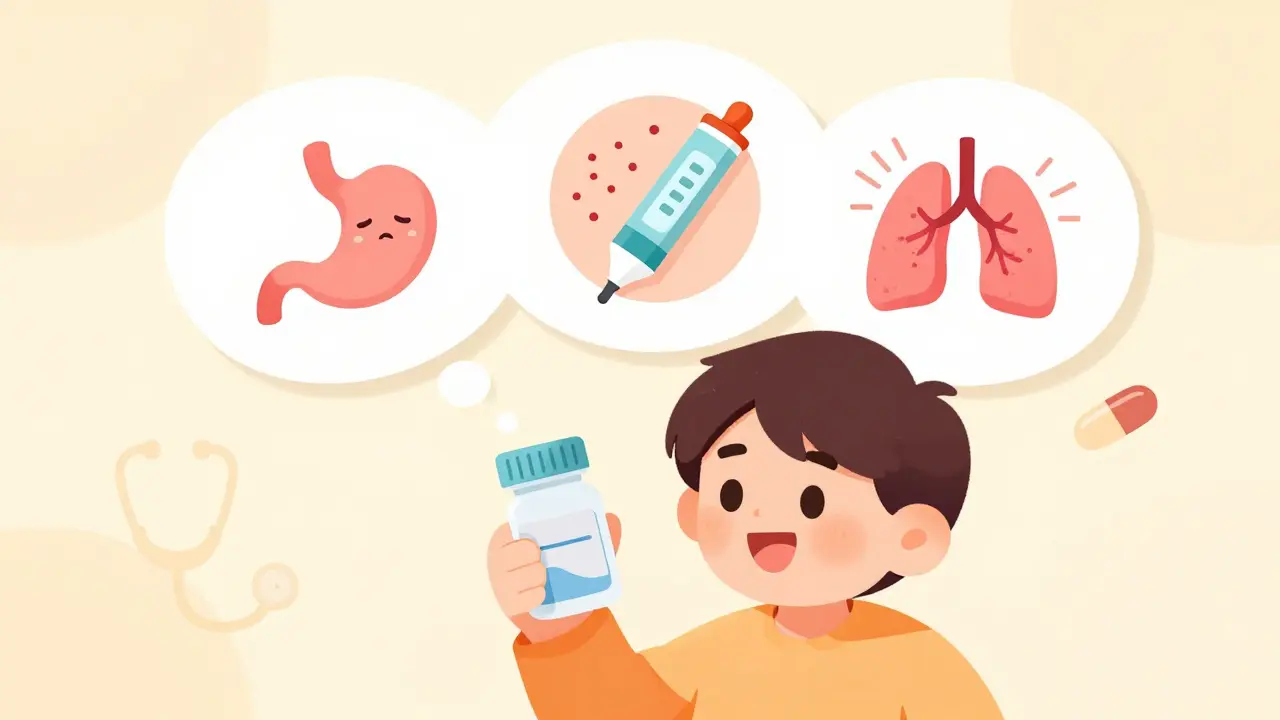
Side effects are the predictable, non-immune reactions your body has to a drug because of how that drug works. They’re listed in the package insert for a reason: they happen to a lot of people. Think of them like the cost of doing business when you take medicine. For example:- NSAIDs like ibuprofen cause stomach upset in 25-30% of users - that’s a side effect.
- SSRIs like sertraline lead to dizziness in about 15% of people - side effect.
- First-generation antihistamines make you sleepy - that’s in the label for a reason.
What Is a True Drug Allergy?
A true drug allergy is your immune system reacting like it’s under attack. It’s not about how the drug works - it’s about your body mistaking it for a threat. This triggers histamine release, inflammation, and potentially life-threatening responses. Symptoms of a real allergy show up fast - usually within minutes to an hour. They include:- Hives (raised, itchy red welts)
- Swelling of the face, lips, or tongue (angioedema)
- Wheezing or trouble breathing
- Dropping blood pressure
- Anaphylaxis - a full-body emergency that needs epinephrine right away
What Is Drug Intolerance?
Intolerance is the middle ground - not immune, not a classic side effect, but still a problem. It’s when your body reacts unusually badly to a standard dose that most people handle fine. Think of it like this: everyone can drink coffee. But for some, even one cup gives them heart palpitations. That’s not an allergy - no immune system involved. But it’s not a "side effect" either, because it’s not listed on the label. It’s your personal sensitivity. Examples:- Aspirin or ibuprofen triggers asthma attacks in 7% of adults with asthma - this is called AERD (aspirin-exacerbated respiratory disease). It’s intolerance, not allergy.
- Codeine causes vomiting in some people because their liver turns it into morphine too fast (ultra-rapid metabolizers). That’s a genetic intolerance.
- Some people get terrible nausea from metformin even at low doses - not because it’s toxic, but because their gut is unusually sensitive.
How to Tell Them Apart
Here’s your quick cheat sheet:| Feature | Side Effect | True Allergy | Intolerance |
|---|---|---|---|
| Caused by immune system? | No | Yes | No |
| Onset time | Hours to days | Minutes to 1 hour | Minutes to hours |
| Worsens with repeat use? | Usually improves | Yes | Yes |
| Common symptoms | Nausea, dizziness, headache, drowsiness | Hives, swelling, trouble breathing, low BP | Asthma flare, severe nausea, rash, nasal congestion |
| Can you take a different dose? | Yes - often helps | No - avoid completely | Maybe - try a different drug in same class |
| Can you be tested? | No | Yes - skin test, blood test, challenge | Not directly - diagnosis by elimination |
If you had diarrhea after taking amoxicillin? That’s a side effect. If you broke out in hives 20 minutes after the first pill? That’s an allergy. If you got wheezing every time you took ibuprofen but never had swelling? That’s intolerance.
Why It Matters - The Real Cost of Mislabeling
Getting this wrong isn’t just confusing - it’s dangerous and expensive. - People labeled "penicillin allergic" are 30% more likely to get a C. diff infection. Why? Because doctors give them stronger, broader antibiotics instead of the simple, safe one. - They’re 50% more likely to get MRSA. - One study found mislabeling adds $2,500 per patient per year in unnecessary costs. - In hospitals, patients with false penicillin labels stay 1.2 extra days on average. And here’s the kicker: you don’t have to live with a wrong label. The CDC and American College of Allergy recommend testing for anyone with a past "allergy" that didn’t involve breathing trouble or swelling. Skin tests are safe, quick, and accurate. A simple oral challenge under medical supervision can clear your name - and open up better treatment options.
What Should You Do?
If you think you have a drug allergy:- Write down exactly what happened: timing, symptoms, how you felt, what you took.
- Ask yourself: Did I have hives? Swelling? Trouble breathing? Did I need epinephrine?
- If the answer is no - it’s probably not an allergy.
- Bring this info to your doctor or an allergist. Don’t say "I’m allergic to penicillin." Say: "I got sick after taking amoxicillin. Here’s what happened."
- If you’ve never been tested, ask about a drug allergy evaluation. It’s covered by most insurance.
And if you’re a patient who’s been avoiding antibiotics for years because of a stomachache you had in college? You might be able to take them safely again. One Mayo Clinic patient said she avoided all antibiotics for 15 years - then got tested, cleared her label, and took amoxicillin eight times since without issue.
Final Thought
Medications save lives. But fear of side effects - mistaken for allergies - can stop them from working. You don’t need to suffer through nausea. You don’t need to avoid life-saving drugs. You just need to know the difference. It’s not about being "sensitive." It’s about being accurate. And that accuracy? It could save your life - or at least, your next prescription.Can I outgrow a drug allergy?
Yes, especially with penicillin. Studies show that 80% of people who had a true penicillin allergy as children lose it within 10 years. But without testing, you’ll never know. The only way to confirm you’ve outgrown it is through a supervised skin test or oral challenge.
If I’m allergic to one antibiotic, am I allergic to all?
Not necessarily. Allergies are specific. Being allergic to penicillin doesn’t mean you’re allergic to all antibiotics. Many people with penicillin allergies can safely take cephalosporins or azithromycin. Cross-reactivity is rare - only about 10% of penicillin-allergic patients react to cephalosporins, and even then, it’s often not a true allergy. Always get tested before assuming.
Can I have an allergic reaction the first time I take a drug?
Yes. While some allergies develop after repeated exposure, your immune system can react the first time if you’ve been sensitized before - maybe through environmental exposure to similar molecules, or even cross-reactive foods. That’s why even first-time users can have severe reactions.
Are food allergies the same as drug allergies?
The mechanism is similar - both involve IgE and mast cells - but the triggers are different. A peanut allergy won’t cause a reaction to amoxicillin. But some people with food allergies (especially to latex or certain fruits) are more likely to have drug allergies, possibly due to shared proteins or immune system overactivity. Still, they’re not the same thing.
Should I wear a medical alert bracelet if I have a drug allergy?
Only if you’ve had a severe reaction - like anaphylaxis, swelling, or breathing trouble - confirmed by testing. If you just had nausea or a rash that went away, you don’t need one. Overuse of medical alerts can lead to confusion in emergencies. Always confirm with an allergist before getting one.

Gloria Ricky
I used to think I was allergic to ibuprofen because I got a rash once. Turns out it was just a heat reaction and I was sweating too much. Took the same dose two years later in a cool room-zero issues. So glad I didn’t just avoid it forever.
Stacie Willhite
This is such an important post. I had a friend who avoided all antibiotics for 12 years because she got a stomachache once as a kid. Last year she got tested-turns out she’s fine. Got treated for pneumonia with amoxicillin and didn’t miss a beat. It’s wild how much fear can shape our health choices.
Jason Pascoe
Just had my penicillin skin test done last month. Negative. Took the full course of amoxicillin for a sinus infection without a hitch. I’ve been avoiding it since I was 12 because of a "rash" that was probably eczema. So much unnecessary anxiety over something that could’ve been cleared up with a 15-minute test.
Jack Havard
90% of people who think they’re allergic aren’t? That’s the same percentage that think vaccines cause autism. If you can’t trust the numbers here, why trust them anywhere else? Maybe the real issue is that doctors don’t listen enough.
Sonja Stoces
LOL. "Just get tested." Like that’s easy when your doctor doesn’t even know what an AERD is. I’ve had 3 different GPs tell me "it’s probably just anxiety" after I wheezed on ibuprofen. Now I carry an inhaler for my "non-allergic intolerance." Good luck getting insurance to cover that.
Annie Joyce
That table? Chef’s kiss. I’ve been telling my patients for years: if it didn’t involve swelling, hives, or airway closure, it’s probably not an allergy. It’s just your body going, "Hey, that’s weird. Let’s not do that again." But now I have a visual to hand them. Thank you.
Rob Turner
Interesting how we treat drug reactions like moral failings-"you’re allergic, so you’re fragile." But the truth? Our bodies are just weirdly individual. One person’s trigger is another’s non-event. Maybe the real lesson isn’t about drugs-it’s about humility in medicine. We don’t know everything, and that’s okay.
Luke Trouten
The most dangerous part isn’t the misdiagnosis-it’s the institutional inertia. Hospitals still flag "penicillin allergy" in charts even when patients say "I think" or "I had a rash once." No one challenges it. We need a standardized re-evaluation protocol. Not optional. Mandatory.
Gabriella Adams
As someone who’s worked in ER for 18 years, I can tell you: the most common mistake isn’t the patient. It’s the chart. Someone writes "allergic to penicillin" in 2007. Next doc sees it in 2024 and assumes it’s gospel. No one ever updates it. We need a system where these labels expire unless reconfirmed.
Brad Ralph
So basically, stop being a baby and take the pill.
christian jon
YOU’RE ALL IGNORANT. I had anaphylaxis on amoxicillin at age 7. I have the medical records. I have the EpiPen. I have the scars. And now you’re telling me I’m just "misinterpreting a side effect"? You don’t get to erase my trauma because your stats say "90%". I’m not a number. I’m a person who nearly died.
steve sunio
lol so u mean to say if u feel sick after meds u r just weak? what about the ppl who get liver damage? u think that's just "side effect"? u r dumb
Robert Petersen
This made me feel so much better. I’ve been avoiding codeine for 10 years because I threw up once. Turns out I’m an ultra-rapid metabolizer. My sister has the same thing. We’re not allergic-we’re just genetically weird. So glad I finally understood why.
Jack Havard
And yet, the FDA still lists "nausea" as a side effect for 80% of drugs. So why trust them when they can’t even define what "side effect" means? Maybe the whole system is broken.
Craig Staszak
One thing I’ve learned in the UK NHS-doctors don’t test because they’re not paid to. If you want to get tested, you’re on a 6-month waitlist. So the labels stick. Not because people are dumb. Because the system is broken.