Diabetes Emergency Decision Guide
Emergency Assessment
Emergency Assessment Result
Recommended Action
When your blood sugar drops too low or spikes too high, it’s not just inconvenient-it’s life-threatening. Severe hypoglycemia and hyperglycemia from diabetes medications don’t wait for convenient hours. They strike at night, during school, at work, or while driving. And if you don’t know what to do, the consequences can be fatal.
What Counts as a Severe Emergency?
Severe hypoglycemia means your blood glucose has fallen below 54 mg/dL (3.0 mmol/L), and you’re too confused, shaky, or unconscious to treat yourself. You need someone else to step in-immediately. This isn’t just a low sugar episode. It’s a medical crisis. The body can’t function without glucose. The brain shuts down. Seizures, coma, and even death can follow within hours if untreated. Severe hyperglycemia is different. It’s not just high blood sugar. It’s when that high sugar triggers dangerous chemical imbalances in your blood. Diabetic ketoacidosis (DKA) happens when your body starts breaking down fat for energy because it lacks insulin. This produces toxic ketones. Blood sugar is usually over 250 mg/dL, ketones are present, and your blood becomes acidic (pH under 7.3). Hyperosmolar hyperglycemic state (HHS) is even more dangerous: blood sugar often exceeds 600 mg/dL, your blood thickens like syrup, and you become severely dehydrated. Both can lead to organ failure.Glucagon: The Lifesaver You Might Not Know How to Use
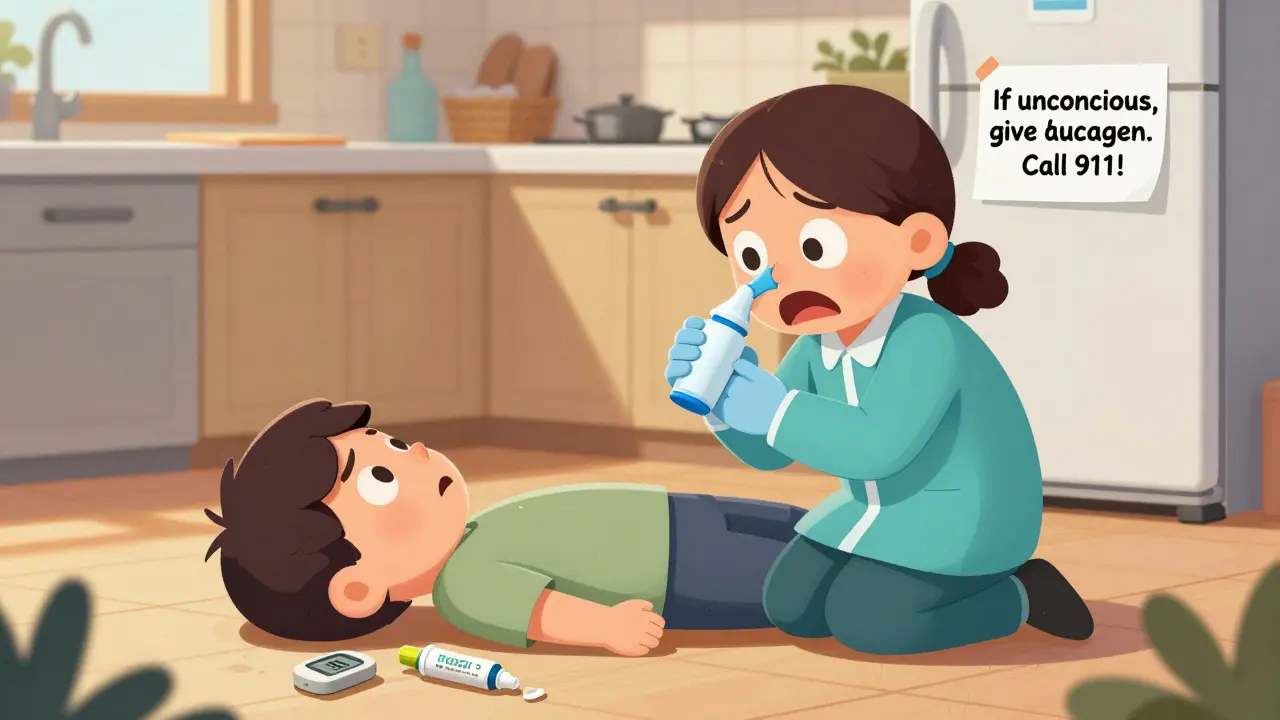
For severe hypoglycemia, glucagon is the only medication that can save you when you can’t swallow or are unconscious. For decades, the only option was a messy, hard-to-use kit: a vial of powder and a syringe of liquid you had to mix by hand. Most people never learned how. A 2021 study showed only 42% of caregivers could successfully use the old kit. That’s why new versions changed everything. Today, you have two simple choices: Baqsimi (a nasal powder) or Gvoke (a pre-filled autoinjector). Both work in under 15 minutes. No mixing. No needles. Just press and go. Baqsimi goes into the nose. Gvoke is injected into the thigh or arm. Both are FDA-approved, effective in over 90% of cases, and designed for people who’ve never used medical equipment before. But here’s the problem: many people still don’t carry it. A 2022 survey found only 41% of type 1 diabetes patients always had glucagon on hand. Why? Fear. Confusion. They think they’ll mess it up. Or they don’t believe it’ll work. But training changes everything. A 30-minute video tutorial boosted successful administration from 32% to 89%.What NOT to Do in a Hypoglycemia Emergency
Don’t put food or drink into the mouth of someone who’s unconscious. That’s not helpful-it’s deadly. You risk choking or aspirating liquid into the lungs. Don’t try to force a glucose gel between their teeth. Don’t shake them or pour water on them. These are myths that cost lives. If someone is unconscious or seizing, call 911 immediately. Then give glucagon. Even if you’re unsure, it’s safer to give glucagon than to do nothing. Glucagon won’t hurt someone with normal or high blood sugar. It only works when glucose is low. And never, ever give insulin during a hypoglycemic episode. That’s like pouring gasoline on a fire. Insulin drops blood sugar even further. It’s a catastrophic mistake.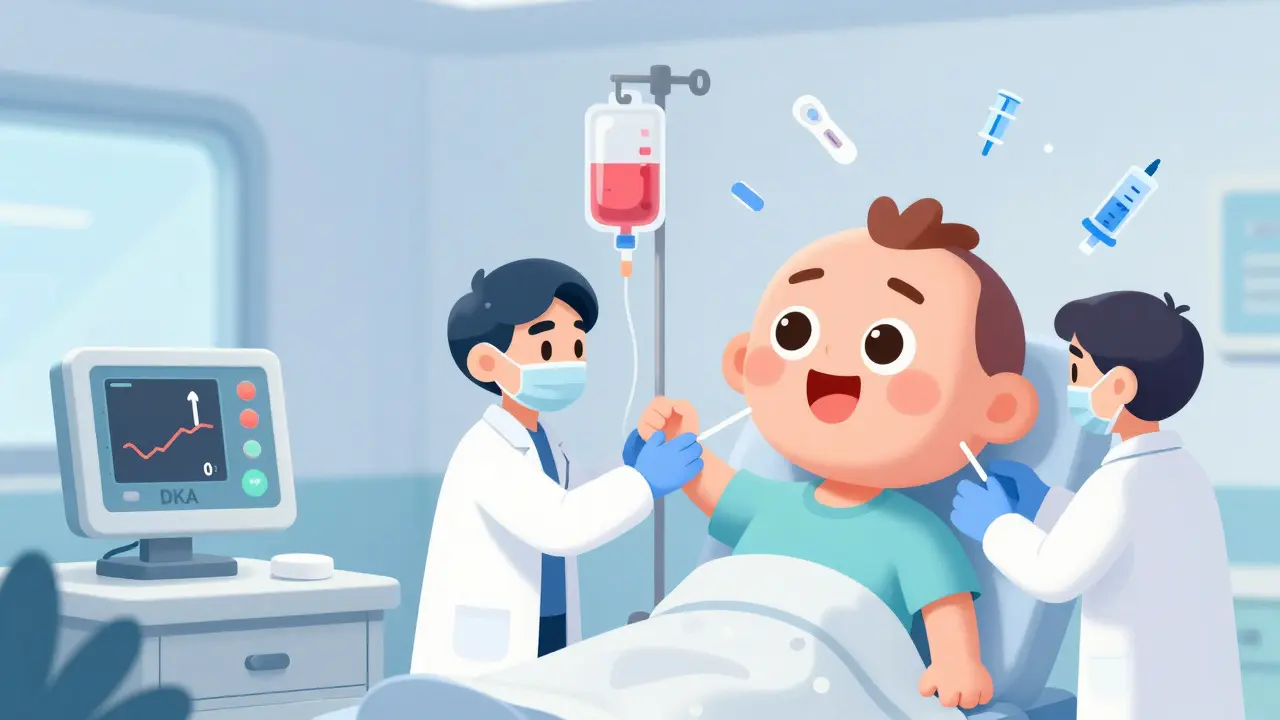
Hyperglycemia Emergencies: It’s Not Just About Insulin
When blood sugar is above 250 mg/dL and ketones are present, you’re in DKA territory. This isn’t something you can fix with extra insulin at home. You need fluids, electrolytes, and IV insulin in a hospital setting. Giving more insulin alone without fluids can cause your potassium to crash, leading to heart rhythm problems or cardiac arrest. The standard hospital protocol starts with 1-2 liters of IV saline in the first hour to rehydrate you. Then, potassium is added to your IV if your levels are low. Finally, insulin is given as a continuous drip-not a shot. The goal isn’t to drop sugar fast. It’s to correct the acid imbalance slowly and safely. Rushing this can cause brain swelling, which is often fatal. For HHS, the same principles apply, but the blood sugar is often higher-sometimes over 800 mg/dL. Dehydration is extreme. People can go days without realizing how sick they are because symptoms like fatigue and confusion creep in slowly. By the time they get to the ER, they’re near collapse.Why People Wait Too Long-And Why That’s Deadly
Many patients delay seeking help for hyperglycemia. They think, “I’ll just take more insulin.” Or, “I’ll wait until morning.” A T1D Exchange survey found 58% of DKA cases happened after people waited more than 12 hours. Early signs-frequent urination, extreme thirst, nausea-are easy to ignore. But ketones don’t care how busy you are. Blood ketone testing is now standard in hospitals. A reading above 1.5 mmol/L means you’re heading toward DKA. At-home ketone strips or meters can catch this early. If you’re on insulin and your ketones are high, go to the ER. Don’t wait. Don’t call your doctor first. Go.What to Keep in Your Emergency Kit
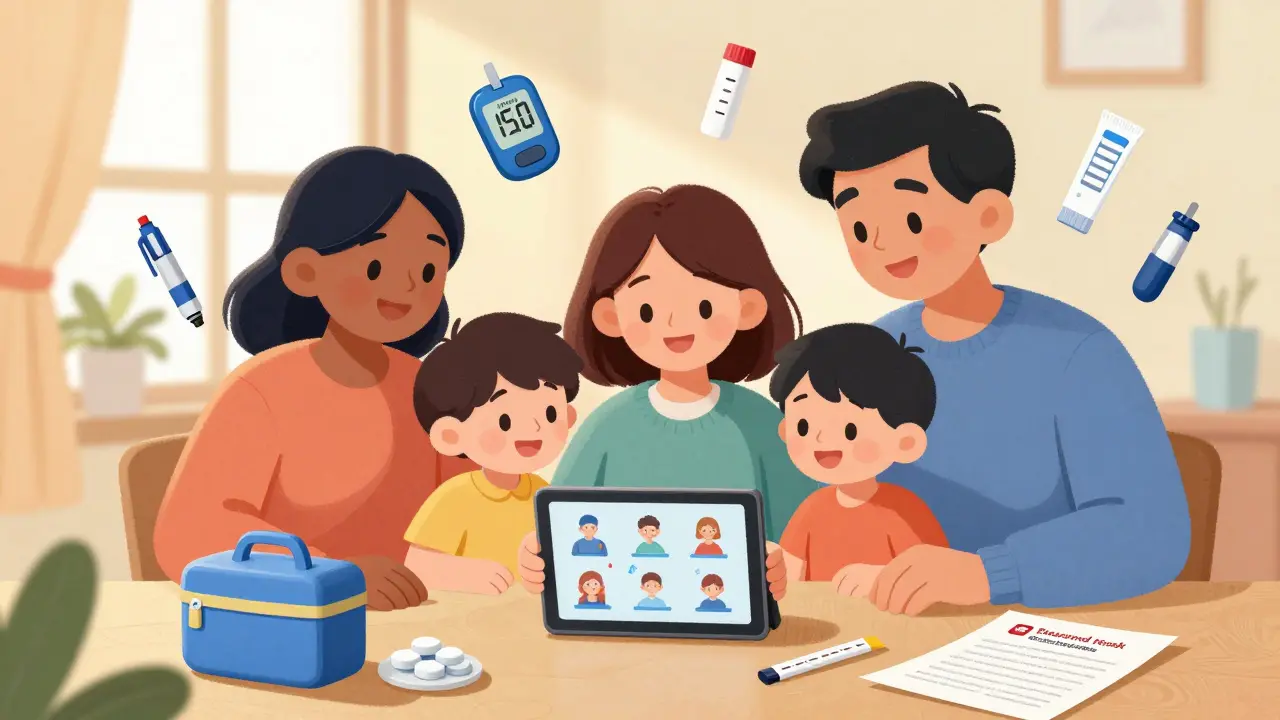
Your emergency kit isn’t just glucagon. It’s a full system:- One ready-to-use glucagon (Baqsimi or Gvoke)-check expiration dates every 3 months
- Glucose tablets (4g each)-keep at least four on hand
- Fast-acting carbs: 4 oz regular soda, juice, or honey packets
- Ketone test strips or meter
- Glucose meter with extra test strips
- Emergency contact list with names, numbers, and your doctor’s info
- A note: “I have diabetes. If I’m unconscious, give glucagon. Call 911.”
Who’s at Risk-and Who’s Being Left Behind
Type 1 diabetes patients face a 30% annual risk of severe hypoglycemia. But type 2 patients on insulin are just as vulnerable-and often less prepared. Only 34% of type 2 insulin users carry glucagon, even though their risk is nearly the same. And disparities are stark. Black and Hispanic patients are 2.3 times more likely to be hospitalized for severe hypoglycemia than white patients. Why? Limited access to glucagon, lack of education, insurance barriers. Medicaid patients face prior authorization 31% of the time. Private insurance? Only 12%. New tools are coming. The FDA approved the first dual-hormone artificial pancreas in 2023. It automatically releases glucagon when it predicts low blood sugar. In trials, it cut severe hypoglycemia by 72%. But only 12 U.S. centers offer it right now. Cost and access remain huge hurdles.What’s Changing in 2026
The FDA now requires all new diabetes drugs to include hypoglycemia risk plans. The European Medicines Agency mandates emergency training with every insulin prescription. Glucagon sales are growing 22% a year. By 2025, 60% of new prescriptions will come with companion apps that walk you through administration step-by-step. But the biggest shift? The mindset. Emergency care isn’t about being perfect. It’s about being ready. You don’t need to be a doctor. You just need to know what to do when things go wrong.Final Rule: If You’re Unsure, Act
If someone with diabetes is acting strangely-confused, sweaty, slurring words-and you can’t check their blood sugar right away, give glucagon. It’s safe. It’s fast. It’s lifesaving. If their blood sugar is above 250 mg/dL and they’re vomiting, breathing fast, or smell fruity, go to the ER. Don’t wait. Don’t call your doctor first. Don’t try to fix it yourself. Diabetes emergencies don’t announce themselves. They happen. And the people who survive are the ones who had a plan-and followed it.Can glucagon be given to someone who doesn’t have diabetes?
Yes, glucagon is safe for someone without diabetes. It works by telling the liver to release stored glucose. In a person with normal blood sugar, this causes a temporary rise, but it won’t cause dangerous spikes or harm. In an emergency, if you’re unsure whether someone has low blood sugar, giving glucagon is safer than doing nothing.
What should I do if glucagon doesn’t work?
If the person doesn’t respond to glucagon within 15 minutes, call 911 immediately. Glucagon works in most cases, but not all. The person may have a different condition, like a seizure disorder or a metabolic issue. Never delay calling emergency services. Even if glucagon helps, they still need medical evaluation to find out why the episode happened.
Can I use insulin to treat high blood sugar at home during a hyperglycemic emergency?
No. In a true hyperglycemic emergency-especially with ketones present-giving insulin alone at home is dangerous. Without IV fluids and electrolyte support, insulin can cause your potassium levels to crash, leading to heart rhythm problems or cardiac arrest. Always go to the ER for DKA or HHS. Home insulin adjustments are only for mild, non-emergency high blood sugar.
How do I know if I have ketones?
Use a blood ketone meter or urine ketone strips. Blood ketones above 1.5 mmol/L indicate danger. Urine strips can be less accurate, especially if you’re dehydrated. If your blood sugar is over 250 mg/dL and you have ketones, treat it as an emergency. Don’t wait for symptoms like nausea or vomiting to appear.
Is there a new glucagon coming soon?
Yes. Dasiglucagon, a next-generation glucagon analog, showed 98% effectiveness in lowering blood sugar within 2 minutes in clinical trials. It’s currently under FDA review and expected for approval in late 2024. It’s designed to work faster and more reliably than current options, especially in children and older adults.

Lauren Wall
I can't believe people still don't carry glucagon. It's not rocket science. If you're diabetic, you're responsible for your own survival. Period.
Tatiana Bandurina
The data here is solid, but let's be honest: 41% of Type 1 patients don't carry glucagon because the system is designed to fail them. Insurance hurdles, lack of provider education, and pharmaceutical pricing are the real culprits-not ignorance.
Philip House
America leads in diabetes tech, but we're still letting people die because we treat health like a luxury. The fact that Medicaid patients face 31% prior authorization for glucagon while private insurers only hit 12%? That's not a glitch. That's policy.
Ryan Riesterer
The pharmacokinetics of dasiglucagon are noteworthy-faster receptor binding affinity, reduced aggregation propensity, and improved thermal stability compared to native glucagon. Clinical trials show a 98% efficacy rate within 120 seconds, which is a significant advancement over current formulations.
Akriti Jain
So the FDA approves a nasal glucagon but then doesn't make it free? 😂 Maybe Big Pharma just wants us to keep buying $400 vials while we wait for the 'next-gen' version that's still 3 years away. #DiabetesTax
Mike P
Look, if you're a Type 2 on insulin and you don't have glucagon, you're not just unprepared-you're playing Russian roulette with your life. And don't give me that 'I'm not Type 1' crap. Your pancreas is broken too. Get your shit together.
Alec Amiri
I had a friend pass out at work last year. We didn't have glucagon. We called 911. He survived. But the ER bill? $18,000. If we'd just had that little nasal spray, he'd have been back at his desk in 20 minutes. Don't wait until it's too late.
Lana Kabulova
I just want to say-why is it that every single time someone writes about diabetes emergencies, they ignore the fact that people without insurance or with unstable housing can't even get test strips, let alone glucagon? This isn't just about education-it's about access. And access is a human right.
Rob Sims
People still think insulin is the answer to everything? Bro. If your blood sugar's over 250 and you're vomiting, insulin isn't magic-it's a death sentence without fluids. I've seen it. Don't be that guy.
Patrick Roth
Actually, the 2021 study showing 42% success with old glucagon kits? That was in the U.S. In the UK, where they train people from diagnosis, it's over 80%. So maybe the problem isn't the device-it's the culture of neglect.
Sarvesh CK
The philosophical underpinning of emergency diabetes care reveals a deeper societal tension: between individual responsibility and collective care. While personal preparedness is essential, the systemic failures-economic, racial, institutional-create conditions where even the most diligent patient is set up for failure. True safety lies not in individual vigilance alone, but in equitable access to life-saving tools and education. We must ask not only, 'Are you ready?' but also, 'Was the system ever ready for you?'
Margaret Khaemba
I'm from Kenya and we don't have access to nasal glucagon or even basic ketone strips in rural clinics. But we do have sugar water and community. When someone collapses, we don't wait for a device-we give them juice, we call for help, we hold their hand. Sometimes, care doesn't need tech. It needs people.
Malik Ronquillo
Glucagon is expensive. But so is an ambulance ride. And an ER visit. And a coma. Just buy the damn thing.
Brenda King
I teach diabetes self-management and I make every patient practice with the training pen. I keep extra glucagon kits in my office. I give them out if someone can't afford it. You don't need a degree to save a life. You just need to care enough to act. 🙏