
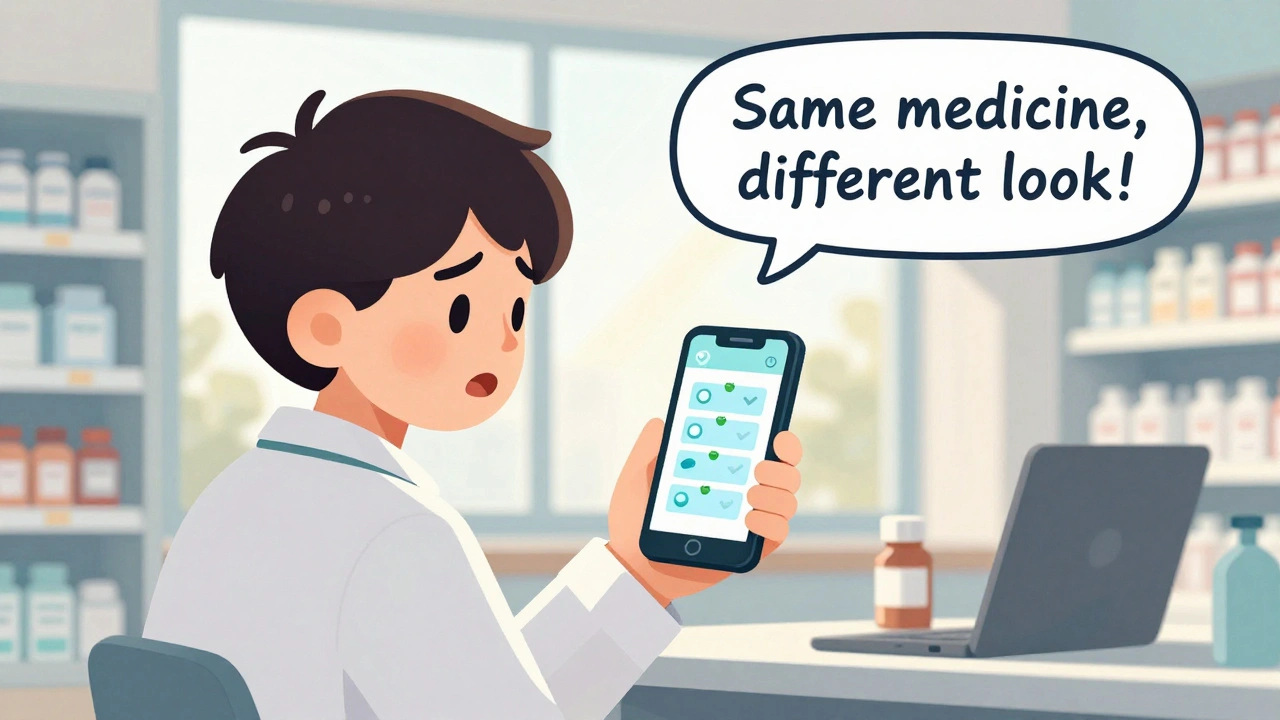
When a patient picks up a prescription and sees a pill that looks completely different from what they’ve been taking, panic can set in. Generic medication isn’t a lesser version-it’s the same active ingredient, same dose, same effect. But if the pharmacist doesn’t explain that clearly, the patient might stop taking it altogether.
In 2023, 90.7% of all prescriptions filled in the U.S. were generics. Yet, nearly half of patients still believe generics are less effective. That gap between science and perception isn’t a patient problem-it’s a counseling problem. And it’s the pharmacist’s job to close it.
Why Generic Counseling Isn’t Optional
It’s not just good practice-it’s the law. Since 1990, the OBRA ’90 federal mandate requires pharmacists to counsel patients on all new prescriptions, including when switching to a generic. Every state enforces this, though how they document it varies. California requires a checkbox confirming the discussion happened. Texas just needs a note saying counseling was offered. But the core expectation is the same: patients must understand what they’re taking and why.
And it matters. A 2024 NIH study found that patients who received clear counseling on generics were 68% more likely to trust their medication than those who didn’t. Those who didn’t understand the switch were twice as likely to skip doses or quit altogether. One Reddit user shared how they stopped blood pressure meds for two weeks because the new pills looked different. They thought it was a mistake. Another said their pharmacist showed them side-by-side photos of the brand and generic-and that one minute saved their treatment.
What Pharmacists Must Say: The 5 Essential Points
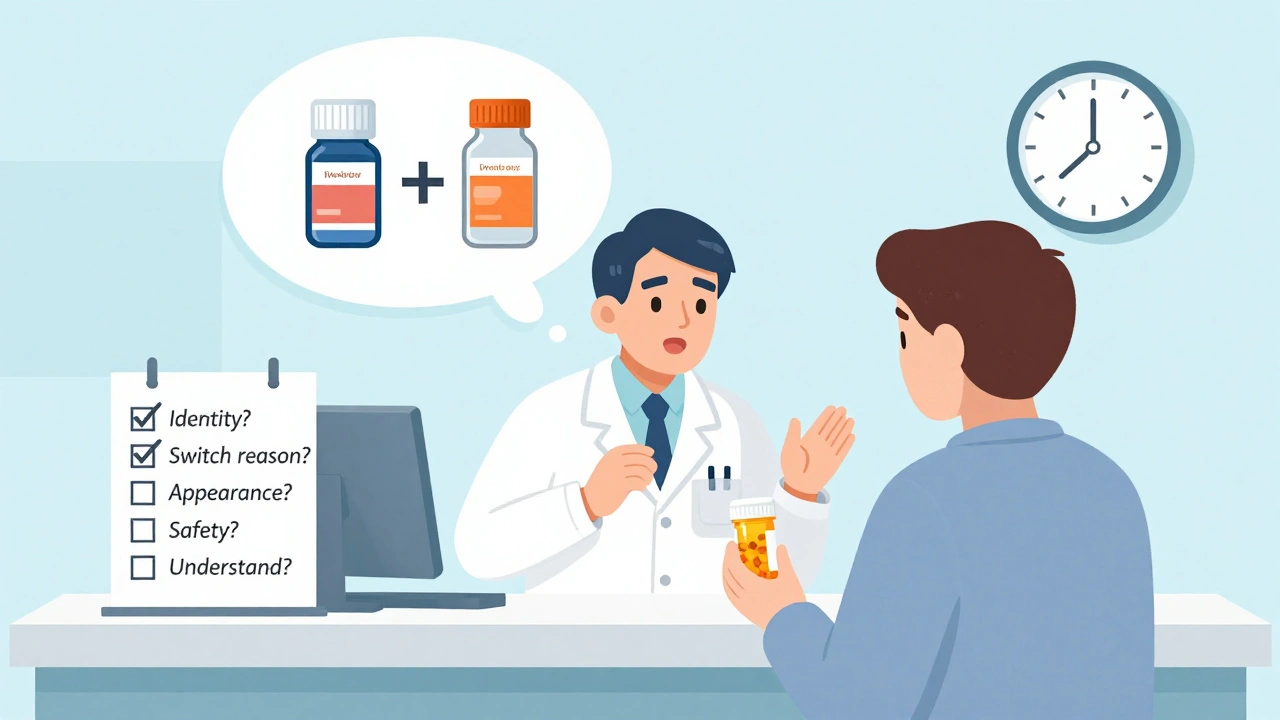
Generic counseling isn’t about reading from a script. It’s about answering the unspoken fears patients don’t even know how to voice. Here’s what you need to cover every time:
- Confirm the patient’s identity. Don’t assume. Ask their name and date of birth. This isn’t bureaucracy-it’s safety. You’re about to give them a new medication, even if it’s the same chemical.
- Explain why the switch happened. Say it plainly: “Your insurance or the law allows us to give you a generic version. It has the same active ingredient as the brand-name drug you were on.” Avoid jargon like “bioequivalent.” Say “same effect, same safety, same results.”
- Describe the physical differences. This is where most breakdowns happen. “The brand was blue and oval. This one is white and round. That’s because the fillers and coatings changed-nothing in the medicine itself changed.” Show pictures if your pharmacy has them. Use your phone if you don’t. A picture beats a hundred words.
- Reaffirm safety and effectiveness. “The FDA requires generics to work the same way as the brand. They go through the same testing. Thousands of people take these every day. If the brand worked for you, this will too.” Cite data if needed: “Studies show no difference in outcomes between brand and generic for blood pressure, cholesterol, or diabetes meds.”
- Verify understanding with the teach-back method. Don’t ask, “Do you have any questions?” Ask, “Can you tell me how you’ll take this pill and why it’s the same as before?” If they say, “I take one at night because it’s for my blood pressure,” that’s good. If they say, “I think this one doesn’t work as well,” you’ve got work to do.
What Patients Think-And Why They’re Wrong
Surveys show the biggest myths about generics:
- 43% believe they’re less effective.
- 37% think they cause more side effects.
- 28% believe they take longer to work.
These aren’t random fears. They’re shaped by experience. A patient might have taken a brand-name drug for years. Then, without warning, they get a different-looking pill. They don’t know it’s the same. They assume the pharmacy made a mistake. Or worse-they assume the drug is cheap because it’s inferior.
One patient told a pharmacy reviewer: “I threw out my new pills because I thought they were expired. They looked old.” The pills were new. Just packaged differently. That’s the kind of misunderstanding that leads to hospital visits.
Time Is the Enemy-But Tech Can Help
Pharmacists average just 1.2 minutes per patient for counseling. That’s not enough to explain bioequivalence, side effects, and dosing-let alone address fears.
But it’s not impossible. Many pharmacies now use digital prompts. When a generic is dispensed, the system flashes: “Discuss appearance change and bioequivalence.” Some even auto-generate a one-page handout with images of the brand and generic side-by-side. CVS trains staff 45 minutes a year on this. Walgreens does 30. The difference? Those who use structured tools report 28% higher patient understanding.
AI is coming. By 2026, 75% of pharmacies will use systems that flag patients with past concerns about generics-maybe someone who returned a prescription last time, or a patient over 65 who’s had multiple switches. The system alerts the pharmacist: “This patient stopped clopidogrel after a generic switch. Recommend extra counseling.”
Documentation: It’s Not Just Paperwork
Starting in 2024, CMS tightened the rules. You can’t just write “counseling provided.” You have to document what you actually discussed. Did you explain the shape change? Did you confirm they knew it was the same drug? Did you use the teach-back method?
This isn’t about avoiding liability. It’s about proving you did your job. And if you’re audited? You’ll need proof you didn’t just check a box-you actually talked.
What Happens When You Skip It
Patients don’t stop taking meds because they’re noncompliant. They stop because they’re confused.
One study found that 57% of negative pharmacy reviews mentioned being “rushed during the generic explanation.” That’s not about service-it’s about safety. A patient who doesn’t understand their generic might:
- Stop taking it and suffer a stroke or heart attack.
- Double-dose because they think the new pill is weaker.
- Refuse future generics and pay 10x more for the brand.
That’s not just bad for the patient. It’s bad for the system. Generics save the U.S. healthcare system $370 billion a year. But if patients don’t take them, those savings vanish.
Final Thought: Your Role Is Bigger Than You Think
You’re not just filling prescriptions. You’re the last line of defense between a patient and a medical error. When you explain that a white pill is just as powerful as a blue one, you’re not just giving information-you’re rebuilding trust. You’re preventing hospitalizations. You’re saving lives.
And it doesn’t take long. One minute. Two at most. But if you skip it, you risk more than a complaint. You risk a patient’s health.
Do I have to counsel every time a generic is dispensed?
Yes. Federal law under OBRA ’90 requires counseling on all new prescriptions and refills. Even if the patient has taken the generic before, you must offer counseling each time. Some states require it even for refills of existing generics. Skipping it puts you at legal risk and harms patient safety.
What if the patient says they don’t want to talk?
You still have to offer it. Say: “I’m required to explain your medication, including any changes. I can do it now, or you can call us later. But I need to document that you were offered this information.” If they refuse, document that clearly: “Counseling offered and declined.” Never assume silence means understanding.
Can a pharmacy technician do the counseling?
No. Only a licensed pharmacist can provide counseling. Technicians can inform patients that counseling is available, but they cannot explain the medication, answer questions about effectiveness, or discuss substitution. That’s a legal boundary-and crossing it can lead to fines or license suspension.
How do I explain bioequivalence without using technical terms?
Say: “The FDA makes sure generics work the same way as the brand name. They have to release the same amount of medicine into your body at the same speed. It’s like two identical cars-one made in Germany, one made in the U.S. Same engine, same fuel, same speed. Just different paint.”
What if the patient insists the generic doesn’t work?
Don’t argue. Ask: “What’s different since you started this pill?” Maybe their sleep changed, or they feel more tired. It could be a coincidence-or it could be a real reaction. Offer to contact their doctor. But first, remind them: “The active ingredient is the same. If you felt better on the brand, this should work the same. But let’s figure out what’s going on.” Then document everything. Sometimes, it’s the placebo effect. Other times, it’s a real issue with inactive ingredients. Either way, you’ve opened the door for the right conversation.

Shayne Smith
Just saw my grandma’s blood pressure med switch to a generic last week. She cried because she thought they gave her the wrong pills. Took 10 minutes to show her the FDA page with side-by-side pics. She’s fine now. Just needs to see it.
Nigel ntini
This is exactly why pharmacists are unsung heroes. Most people don’t realize how much trust is at stake here. A one-minute conversation can prevent hospitalization, overdose, or worse. The fact that this is legally required but still inconsistently done is a systemic failure. We need better training, better tools, and more respect for the profession.
Dan Cole
Let’s be real-this isn’t about counseling. It’s about liability. The FDA doesn’t care if you understand your meds; they care that the pharmacy documented that you were told something. That’s why the teach-back method exists: not to help patients, but to create paper trails for lawsuits. The real problem? Pharma companies profit from fear. They spend billions convincing people generics are ‘inferior’ so they can charge $500 for a pill that costs $0.50 to make.
And don’t get me started on the ‘same active ingredient’ lie. The fillers? The coatings? The dissolution rates? They’re not identical. The FDA allows a 20% variance. That’s not ‘same.’ That’s a gamble.
Billy Schimmel
Wow. So you’re saying pharmacists are now part therapist, part detective, part legal compliance officer? And they get paid $35/hour for this? Yeah, no wonder people get rushed. The system’s broken. But hey-at least we know who to blame now: the insurance companies and the FDA for letting this happen.
Katie O'Connell
It is, of course, axiomatic that the pharmacist’s role in patient education is not merely advisory but constitutive of therapeutic integrity. The OBRA ’90 mandate, while ostensibly well-intentioned, reveals a profound epistemological deficit in contemporary pharmacoeconomics: the assumption that laypersons can comprehend bioequivalence without formal training in pharmaceutical sciences. The reliance on visual aids and colloquial analogies-‘same engine, different paint’-is not only reductive but dangerously misleading. The pharmacokinetic variance between generics, even within the FDA’s 20% tolerance, introduces non-linear therapeutic outcomes that are statistically significant in vulnerable populations. One must question whether such counseling, when delivered in 1.2 minutes, is not merely performative.
Karen Mitchell
So now pharmacists are expected to be psychologists, marketers, and legal guardians all at once? And if they don’t? They get fined. Meanwhile, the same people who demand this counseling are the ones who complain about $15 co-pays. It’s not the pharmacist’s fault that the system is rigged. It’s the government’s. And the pharmaceutical giants. And the insurers. And the patients who refuse to read the damn label. Someone needs to fix the system-not make the pharmacist do 17 jobs for minimum wage.
olive ashley
Wait… so you’re telling me the white pill isn’t actually the same as the blue one? That’s what they told me. But I’ve been on this med for 8 years. Last month, I switched to generic. I felt weird. Like… foggy. My husband said I was ‘acting different.’ I didn’t sleep for three nights. I thought they swapped my meds with someone else’s. I Googled it. Turns out, the fillers in generics can cause anxiety in sensitive people. They don’t tell you that. The FDA doesn’t test for that. They just test if it dissolves in water. That’s not medicine. That’s a magic trick.
And why do they always use white pills? It’s like they’re trying to make us feel like we’re taking something cheap. Like we’re poor people now. I’m not poor. I pay my premiums. Why does my medicine look like it came from a discount bin?
And what about the ones who get different generics every time? One month it’s Actavis, next month it’s Teva, then Mylan. All ‘same.’ But I swear, each one feels different. My doctor says I’m crazy. But I’m not. I know my body. They’re just hiding the truth behind ‘bioequivalent’ jargon.
Ashish Vazirani
India has been using generics for decades-and we don’t have this problem. Why? Because we trust our doctors. We don’t question the medicine. We don’t care what color the pill is. We care if it works. In America, you turn every medical decision into a psychological drama. A pill changes color? Panic. A label changes? Conspiracy. You people need to stop treating your meds like fashion items. If the doctor says take it, take it. Stop overthinking. Stop Googling. Stop making everything a trauma. We don’t have time for this in India. We have real problems.
Akash Takyar
As a pharmacist in Mumbai, I can confirm: generics are the backbone of affordable healthcare. In India, 95% of prescriptions are generics. Patients rarely question them. Why? Because we don’t have the luxury of brand loyalty. We have mothers choosing between insulin and groceries. We don’t have time for panic. We have time for trust. And trust is built through consistency-not over-explaining. A simple, clear statement: ‘This is the same medicine. Just cheaper.’ That’s enough. Americans overcomplicate everything. The system is broken-not the patients.
Max Manoles
Let me tell you about my uncle. He was on a brand-name statin. Got switched to generic. Said he felt ‘off.’ Went to his doctor. Doctor said, ‘It’s the same.’ He didn’t believe it. So he went to a private clinic, paid $400 for a blood test. Turns out-his cholesterol was identical. The generic worked perfectly. He cried. Not because he was wrong-but because he realized how much fear had been controlling him. That’s the real cost here: not money. It’s the erosion of trust. And it’s not the pharmacist’s fault. It’s the culture.
pallavi khushwani
I think this is less about generics and more about how we’ve lost touch with the human side of medicine. We treat pills like products, not part of a person’s life. I’ve seen people cry because their pill changed color. Not because they’re irrational-but because they’ve been through so much already. A pill is a symbol. It’s hope. It’s control. When it changes, it feels like the world changed too. Maybe we need to stop thinking of counseling as a task and start thinking of it as a ritual.
Arjun Deva
They’re lying. The FDA doesn’t test for long-term effects of generic fillers. They test for 28 days. What about after a year? What about when your liver starts failing? What about when your kidneys can’t process the talc? They don’t tell you. They don’t test for that. And if you complain? They say, ‘It’s bioequivalent.’ But bioequivalent doesn’t mean safe. It means it dissolves. That’s it. I’ve seen people die after switching. They don’t report it. They just say ‘natural causes.’ You think that’s a coincidence? It’s not. It’s a cover-up.
Jackie Petersen
My cousin works at a Walgreens. Says they get fined if they spend more than 90 seconds on counseling. So they hand you a pamphlet and say ‘You good?’ That’s not counseling. That’s a slap in the face. And now they’re gonna use AI to flag ‘high-risk’ patients? So the system’s gonna know who’s paranoid and ignore them? Brilliant. Just brilliant. We’re turning healthcare into a surveillance game.
Inna Borovik
As a former pharmacy tech who got fired for trying to explain generics to a patient who yelled, ‘I’m not taking that white pill!’-I can tell you this: it’s not about the pill. It’s about control. Patients don’t trust the system. They don’t trust the insurance company. They don’t trust the doctor. So they distrust the pill. No amount of pictures or teach-backs fixes that. What fixes it? Time. And respect. And someone who actually listens. Not just checks a box.