
If you're taking a bisphosphonate like Fosamax for osteoporosis and also popping a magnesium supplement for muscle cramps or sleep, you might be quietly sabotaging your treatment. It’s not a myth. It’s not a rumor. It’s science-and it’s costing people their bone health.
Why Magnesium and Osteoporosis Drugs Don’t Mix
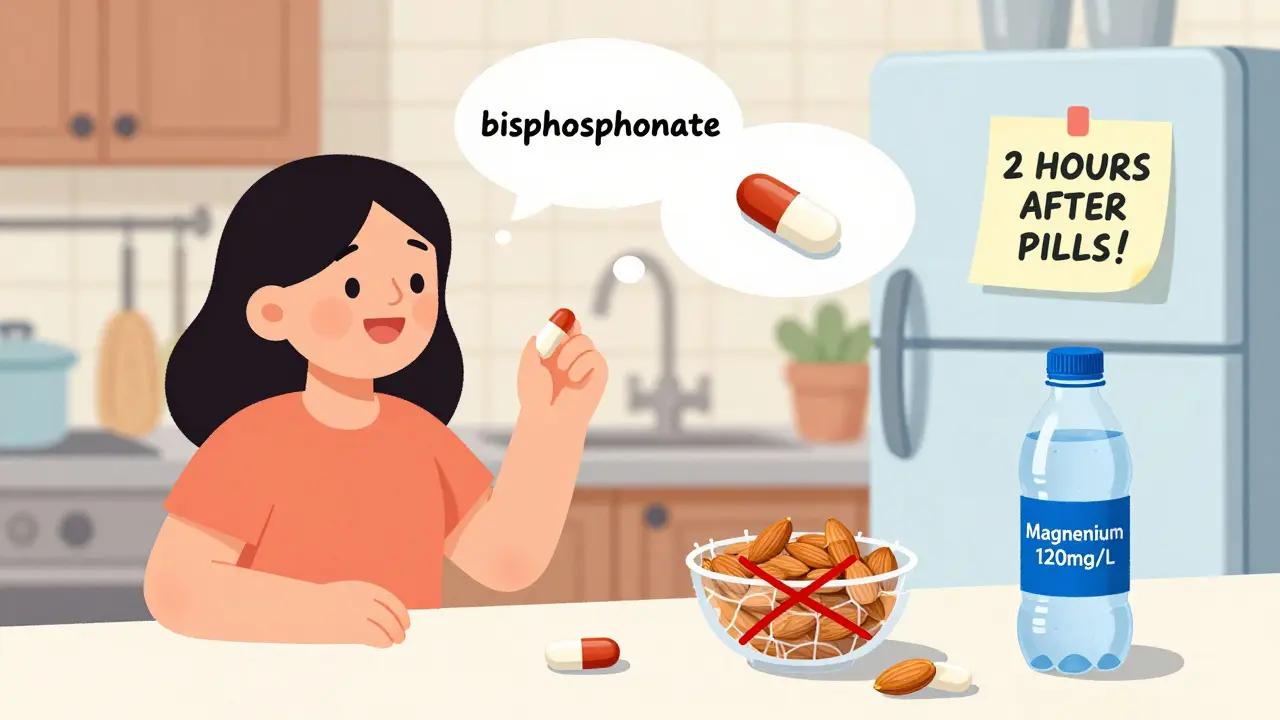
Bisphosphonates-drugs like alendronate (Fosamax), risedronate (Actonel), and ibandronate (Boniva)-are designed to slow bone loss by targeting cells that break down bone. But they’re notoriously picky about how they’re absorbed. These drugs need an empty stomach, plain water, and no other minerals nearby. Magnesium, whether from a pill, antacid, or even some bottled water, binds tightly to bisphosphonates in your gut. The result? A chemical handshake that turns the drug into an insoluble lump your body can’t absorb.Under perfect conditions, only about 0.6% to 12% of a bisphosphonate dose gets into your bloodstream. Add magnesium, and that number drops by 40% to 60%. That’s not a small hit-it’s enough to make your medication useless. The National Osteoporosis Foundation estimates 10.2 million Americans have osteoporosis. If half of them are taking magnesium without knowing the timing rules, you’re looking at nearly a million people whose treatment isn’t working.
The 2-Hour Rule: What It Really Means
The standard advice from the FDA, NIH, and major medical societies is simple: take your bisphosphonate and your magnesium at least two hours apart. But “two hours apart” doesn’t mean you take your pill at 7 a.m., eat breakfast at 8 a.m., and then take magnesium at 9 a.m. That’s not enough.Here’s how it actually works:
- Take your bisphosphonate first thing in the morning, with a full glass of water, on an empty stomach.
- Wait 30 minutes before eating, drinking, or taking anything else (this is required for the drug to work at all).
- Wait another 90 minutes after that-so a total of two hours-before taking magnesium.
- Only then can you safely take your supplement, antacid, or even a snack high in magnesium.
This timing isn’t arbitrary. It’s based on how long it takes for your stomach to empty and for the bisphosphonate to pass into the small intestine, where absorption happens. Magnesium stays in the stomach longer than you think, especially if you’ve eaten. Even a small amount of magnesium in an antacid like Maalox can interfere-just one tablespoon contains 800 mg of magnesium hydroxide. That’s more than most supplements.
What Counts as a Magnesium Source?
Most people know about magnesium pills. But many don’t realize how many everyday products contain magnesium:- Antacids: Maalox, Mylanta, Milk of Magnesia
- Laxatives: Many over-the-counter bowel cleansers
- Mineral water: San Pellegrino, Perrier, and other brands list magnesium on the label
- Multi-vitamins: Often include magnesium without clear labeling
- Protein powders and meal replacements: Some are fortified with magnesium
One patient on Reddit shared that after six months of taking Fosamax and a daily magnesium supplement, her bone density didn’t improve. She later found out she was also taking Milk of Magnesia for constipation-twice a week. That was enough to block her treatment. She didn’t even think of it as a “supplement.”
What About Natural Sources Like Spinach or Almonds?
Some integrative health blogs suggest that magnesium from food doesn’t cause the same problem. That’s misleading. The interaction isn’t about whether the magnesium is “natural” or “synthetic.” It’s about concentration and timing. Food-based magnesium is usually spread out through meals and absorbed slowly. But if you’re eating a big handful of almonds or a spinach salad right after your bisphosphonate, you’re still introducing magnesium into your gut at the wrong time.The American College of Rheumatology’s 2023 position statement says there’s no evidence that dietary magnesium is exempt from this interaction. If you’re taking a bisphosphonate, treat all magnesium sources the same: wait two hours after your dose before eating anything with significant magnesium.
What If You’re on IV Medication?
If you’re getting zoledronic acid (Reclast) or ibandronate via IV infusion, you’re off the hook. These forms bypass your gut entirely. Magnesium supplements won’t interfere. But if you’re on the pill form-no exceptions. The rule applies whether you take it once a week, once a month, or daily.Why People Keep Getting It Wrong
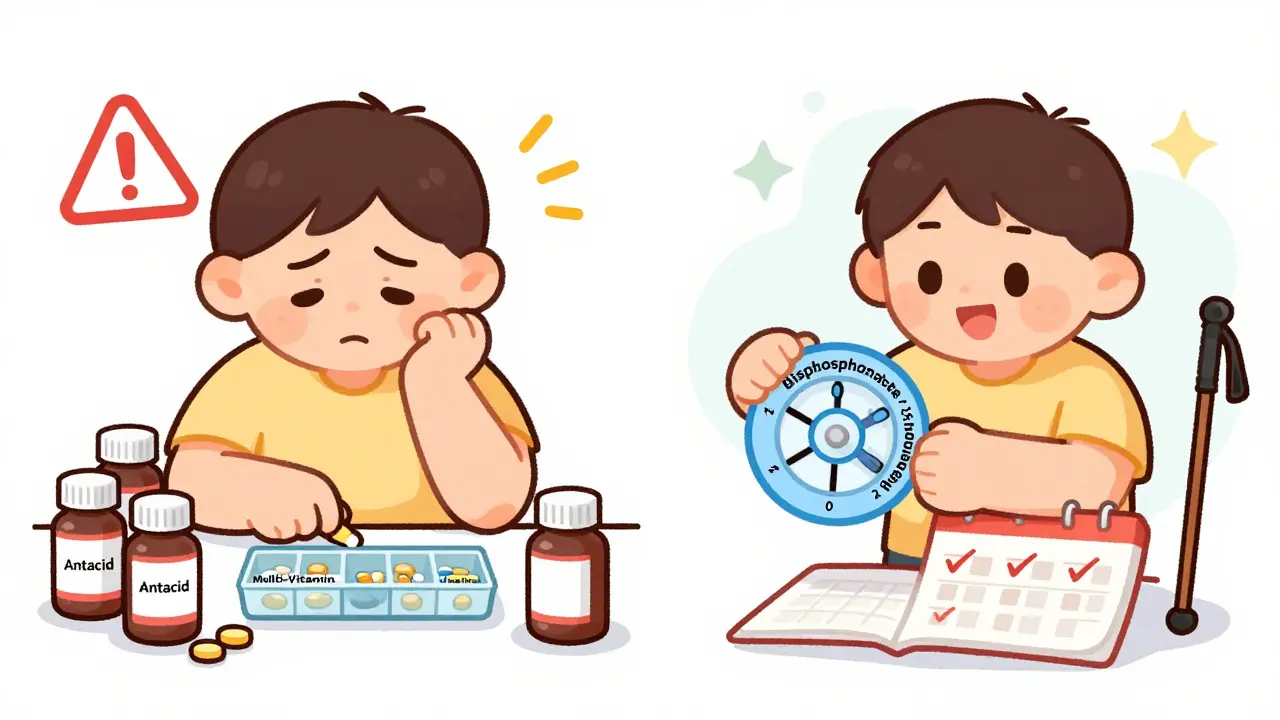
A 2022 survey by the National Osteoporosis Foundation found that 37% of patients taking both magnesium and bisphosphonates didn’t know they couldn’t take them together. Even worse, 22% admitted they took them at the same time.Why? Because doctors don’t always explain it clearly. Pharmacists are overwhelmed. Patients are managing five or six medications. A pill organizer with just AM and PM compartments won’t cut it. One Kaiser Permanente study showed that patients who got written, visual instructions-like a timing wheel showing exact hour gaps-had an 89% adherence rate. Those who only got verbal advice? Just 43%.
How to Get It Right
Here’s a simple, foolproof system:- Morning: Take bisphosphonate with water. Don’t eat, drink, or take anything else for 30 minutes.
- Wait 2 hours total: After your bisphosphonate, wait two full hours before taking magnesium or eating a magnesium-rich meal.
- Afternoon or evening: Take your magnesium supplement with dinner or before bed. This also helps with sleep and muscle relaxation.
- Check every product: Read labels on antacids, laxatives, and even bottled water. Look for “magnesium hydroxide,” “magnesium citrate,” or “magnesium oxide.”
- Use a log: Write down when you take each medication. Even a sticky note on your bathroom mirror helps.
Some pharmacies now offer “timing wheels”-plastic discs that show hour intervals between meds. One study found these increased compliance by over 100% compared to printed instructions.
What’s Changing in 2026?
The FDA now requires clearer labeling on bisphosphonate and magnesium supplement packaging. By 2025, every box should say “Take at least 2 hours apart.” Electronic health records like Epic and Cerner now automatically flag this interaction when a doctor prescribes both. In 2023, these alerts cut co-prescribing errors by 73%.New time-release bisphosphonates are in late-stage trials. These could one day eliminate the need for strict timing. But until then, the two-hour rule is non-negotiable.
What Happens If You Ignore This Rule?
It’s not just about “less effective” treatment. It’s about broken bones.Studies show patients who don’t separate magnesium and bisphosphonates have up to a 50% drop in drug effectiveness. That means their bone density doesn’t improve. Their fracture risk stays high. One 2021 study found patients who followed the timing rule improved their lumbar spine density by 8.2% more over two years than those who didn’t.
That’s not a minor difference. That’s the difference between walking without fear and needing a cane. Between living independently and needing a hip replacement. Between peace of mind and constant worry.
This isn’t about being perfect. It’s about being consistent. One slip-up won’t ruin everything. But doing it wrong every day? That’s how osteoporosis wins.
Can I take magnesium at night and my bisphosphonate in the morning?
Yes, that’s actually the ideal schedule. Take your bisphosphonate first thing in the morning on an empty stomach, wait two hours, then eat breakfast. Later in the evening, take your magnesium supplement with dinner or right before bed. This avoids any overlap and even helps with sleep.
What if I forget and take them together?
If you accidentally take magnesium within two hours of your bisphosphonate, don’t panic. Skip the next dose of your bisphosphonate and wait until the following day to resume your normal schedule. Never double up on your bisphosphonate to make up for it-that can irritate your esophagus. Just get back on track.
Do all magnesium supplements interfere?
Yes. Whether it’s magnesium citrate, oxide, glycinate, or chloride, they all contain magnesium ions that bind to bisphosphonates. The form doesn’t matter-only the presence of magnesium. Even low-dose supplements (100 mg) can reduce absorption if taken too close to your medication.
Can I take calcium with my bisphosphonate?
No. Calcium also interferes with bisphosphonate absorption. Take calcium supplements at least two hours after your bisphosphonate. The same timing rule applies to iron, zinc, and other minerals. Stick to water only for the first 30 minutes after your dose, then wait two hours before taking anything else.
Is there a bisphosphonate that doesn’t need this timing?
Only the IV versions-like Reclast or Prolia (though Prolia isn’t a bisphosphonate)-don’t require timing adjustments because they’re injected directly into the bloodstream. If you’re taking a pill, the two-hour rule applies. Always confirm with your doctor or pharmacist whether your specific medication is oral or injectable.
If you’re managing osteoporosis and taking magnesium, the two-hour separation rule isn’t optional. It’s the line between treatment success and failure. Get it right, and you’re protecting your bones. Get it wrong, and you’re risking fractures you could have avoided. Don’t guess. Don’t assume. Ask your pharmacist. Write it down. Set a phone reminder. Your future self will thank you.

brooke wright
I took Fosamax for years and never knew about the magnesium thing. I was also taking Milk of Magnesia every other day for constipation. No wonder my bone density stayed the same. I just found out last month and switched to a stool softener. My doctor was shocked I didn’t know. I feel dumb, but at least I’m not doing it anymore.
Also, I had no idea bottled water had magnesium. I drink San Pellegrino like it’s water. Guess I’m switching to Dasani now.
evelyn wellding
OMG I’m so glad I found this!! 🙌 I’ve been taking magnesium at night for sleep and Fosamax in the morning and thought I was golden. Turns out I was waiting like 90 minutes and thought that was enough. I just set a phone alarm for 2 hours after my pill. My bones will thank me 😊💪
Chelsea Harton
so like... magnesium bad. bisphos good. wait 2 hrs. duh. but no one tells you. also why is this even a thing? why not just make a pill that works? 🤷♀️
Corey Chrisinger
It’s wild how something so simple-timing-can make or break a treatment. We treat meds like they’re just pills, not complex biochemical actors with their own schedules.
And yet, we’re surprised when things don’t work. Maybe we need to stop thinking of our bodies as machines you just feed the right fuel and expect performance. They’re ecosystems. Even magnesium ions have a social calendar.
Also, emoji for the win: 🧪⏳
Bianca Leonhardt
Of course you didn’t know. You probably also think ‘natural’ magnesium from almonds is safe. Newsflash: your body doesn’t care if it came from a tree or a lab. It’s still magnesium. If you can’t follow a two-hour rule, maybe you shouldn’t be on prescription meds. You’re not special. You’re just lazy.
And yes, I’ve seen your Instagram stories with your spinach smoothie at 8:15 a.m. after your pill. You’re doing it wrong.
Travis Craw
Wow, I never realized antacids counted. I’ve been taking Tums like candy for heartburn. Guess I’m switching to Zantac or something. Thanks for the heads up-I really didn’t know this was a thing. I’ll start using a sticky note on my mirror too. Small changes, right?
Also, I think this should be on the pill bottle. Like, printed right there. Not everyone reads Reddit.
Christina Bilotti
Oh my god, I can’t believe you’re all acting like this is groundbreaking. This interaction has been in the prescribing info since 2008. If you didn’t read the damn leaflet, don’t act surprised you’re failing treatment. Also, ‘bottled water’? Please. If you’re drinking mineral water and expecting your bisphosphonate to work, you’re not just uninformed-you’re actively ignoring science.
And yes, I’m a pharmacist. And yes, I’m judging you.
Cheryl Griffith
I had a similar experience. My mom was on Fosamax and took her magnesium at night like she was supposed to, but she also had a protein shake with magnesium in it after her evening walk. She didn’t think it counted because it was ‘protein.’ She had two hip fractures in three years. We finally figured it out after her second fall.
It’s not just about the pill-it’s about everything that touches your gut in those two hours. I made her a little chart with colors. Green for safe, red for danger. She still forgets, but it’s better now.
Also, I love that you mentioned the timing wheel. I ordered one for my dad. He’s 78 and uses a pill organizer with AM/PM. He needs visuals. We all do.
Nick Cole
My dad’s on Reclast now because he kept messing up the timing. He was taking magnesium with breakfast and wondering why his bones weren’t healing. We switched him to IV and he’s been doing great. No more anxiety about meals, no more wondering if his tea had magnesium in it.
Maybe the real solution isn’t better instructions-it’s better meds. IVs are expensive, but if they prevent fractures, isn’t that worth it? Just saying.
Bobbi-Marie Nova
Okay but can we talk about how wild it is that we have to be scientists just to take a pill? Like, I take 7 meds a day. I have a spreadsheet. I set 5 alarms. And I still forget half the time. This isn’t a personal failure-it’s a system failure.
Also, sarcasm: yes, I took magnesium with my Fosamax. And yes, I’m still walking. Barely. 😅
Allen Davidson
This is one of those posts that could literally save someone’s independence. I’ve seen too many older patients fracture because they thought ‘it’s just a supplement’ or ‘I’ll just take it later.’
Here’s what I tell my patients: if you’re on an oral bisphosphonate, treat your gut like a VIP lounge. Only water gets in for the first two hours. Everything else? Line up at the back door.
And if you’re overwhelmed? Talk to your pharmacist. They’re not just pill dispensers-they’re your secret weapon. Most will even print you a free timing chart. No shame in asking. Your bones aren’t going to wait for you to figure it out.