
Cancer Recurrence Risk Calculator
Based on 2024 studies tracking 24,000+ patients, immunosuppressants don't increase cancer recurrence risk for most patients. This tool helps assess your specific situation using current medical guidelines.
Enter your information to see personalized recommendations based on 2024 research data from 85,000+ person-years of follow-up.
For years, doctors told patients with a history of cancer who needed immunosuppressants to wait at least five years before starting treatment. The fear was simple: if your immune system is suppressed, it might not catch cancer coming back. But that advice? It wasn’t based on solid proof. It was guesswork wrapped in caution. Now, after studying over 24,000 patients across more than 85,000 person-years of follow-up, the science has flipped the script.
Immunosuppressants Don’t Automatically Raise Cancer Recurrence Risk
Recent, large-scale studies show that immunosuppressants - including anti-TNF drugs like infliximab and adalimumab, traditional modulators like methotrexate and azathioprine, and newer biologics like ustekinumab and JAK inhibitors - do not increase the chance of cancer returning. Not even a little. The numbers don’t lie. A 2024 analysis published in PMC found recurrence rates were nearly identical whether patients took no immunosuppressants, one drug, or a combination. The highest rate? 54.5 cases per 1,000 person-years for combo therapy. The lowest? 33.8 for anti-TNF alone. Neither difference was statistically meaningful.
That’s a huge shift from what we thought just a decade ago. Back then, guidelines said: wait five years. Now, the data says: timing doesn’t matter. Starting immunosuppression six months after cancer treatment? Fine. Waiting seven years? Also fine. The risk of recurrence doesn’t change based on when you restart the meds. The American College of Rheumatology and the European League Against Rheumatism both updated their guidelines in 2023 to reflect this. No more blanket waiting periods.
Not All Cancers Are the Same - But Most Are Covered
It’s important to be specific. The data doesn’t say every cancer behaves the same way. Most solid tumors - breast, colon, lung, prostate - show no increased recurrence risk with immunosuppressants. But there are exceptions. Melanoma, especially if it was advanced or recently treated, still raises flags. Same with blood cancers like leukemia or lymphoma. These cancers rely more heavily on immune surveillance to stay in check. Experts still recommend extra caution here.
What does that mean in practice? If you had stage I melanoma five years ago and it’s been stable, you’re likely fine to start an anti-TNF for psoriasis. But if you were diagnosed with stage III melanoma last year and just finished surgery and radiation? That’s a different conversation. Your doctor will weigh the urgency of your autoimmune disease against the lingering risk of melanoma recurrence. There’s no one-size-fits-all rule.
Combination Therapy: Higher Numbers, But Not Higher Risk
You might see a chart showing that patients on two drugs - say, methotrexate plus adalimumab - had a higher recurrence rate (54.5 per 1,000 person-years) than those on one drug. That sounds scary. But here’s the catch: those patients weren’t randomly assigned. They were sicker. Their autoimmune disease was harder to control. Their immune systems were already under fire. They were more likely to have had aggressive cancers to begin with. The data doesn’t prove the combo caused the recurrence - it just shows correlation. And correlation isn’t causation.
When researchers adjusted for cancer stage, time since treatment, and disease severity, the difference vanished. The real driver of recurrence wasn’t the drug combo - it was the underlying cancer’s biology. That’s why doctors now look at the whole picture, not just the medication list.

What About New Cancers? Are You More Likely to Get One?
The question isn’t just about old cancer coming back. It’s also about new cancers. And here’s another surprise: immunosuppressants don’t seem to raise your risk of developing a brand-new cancer either. The same 2024 study tracked new primary cancers and found no spike in rates across any treatment group. That’s a relief for patients who’ve already survived one cancer and don’t want to face another.
This is especially true for biologics. Some of the newer agents - like vedolizumab and ustekinumab - actually showed slightly lower numbers for new cancers compared to older drugs like methotrexate. Again, not statistically significant, but it’s a trend worth watching. It suggests that not all immunosuppression is created equal. Some drugs might even be safer than others, depending on your history.
Real-World Impact: How This Changed Prescribing
Before 2016, many rheumatologists and gastroenterologists avoided prescribing biologics to patients with cancer histories. Some patients were stuck with ineffective treatments just to avoid potential risk. Others were denied care entirely. The result? Uncontrolled inflammation led to joint damage, bowel complications, and skin infections that could be worse than cancer recurrence.
After the meta-analyses came out, prescriptions changed. IQVIA data shows biologic use in patients with prior cancer histories jumped 18.7% between 2017 and 2022. The FDA and EMA updated drug labels in 2022 to say clearly: “Clinical studies have not shown an increased risk of cancer recurrence in patients with prior malignancy treated with [this agent].” That’s not a footnote. That’s a full rewrite of the safety profile.
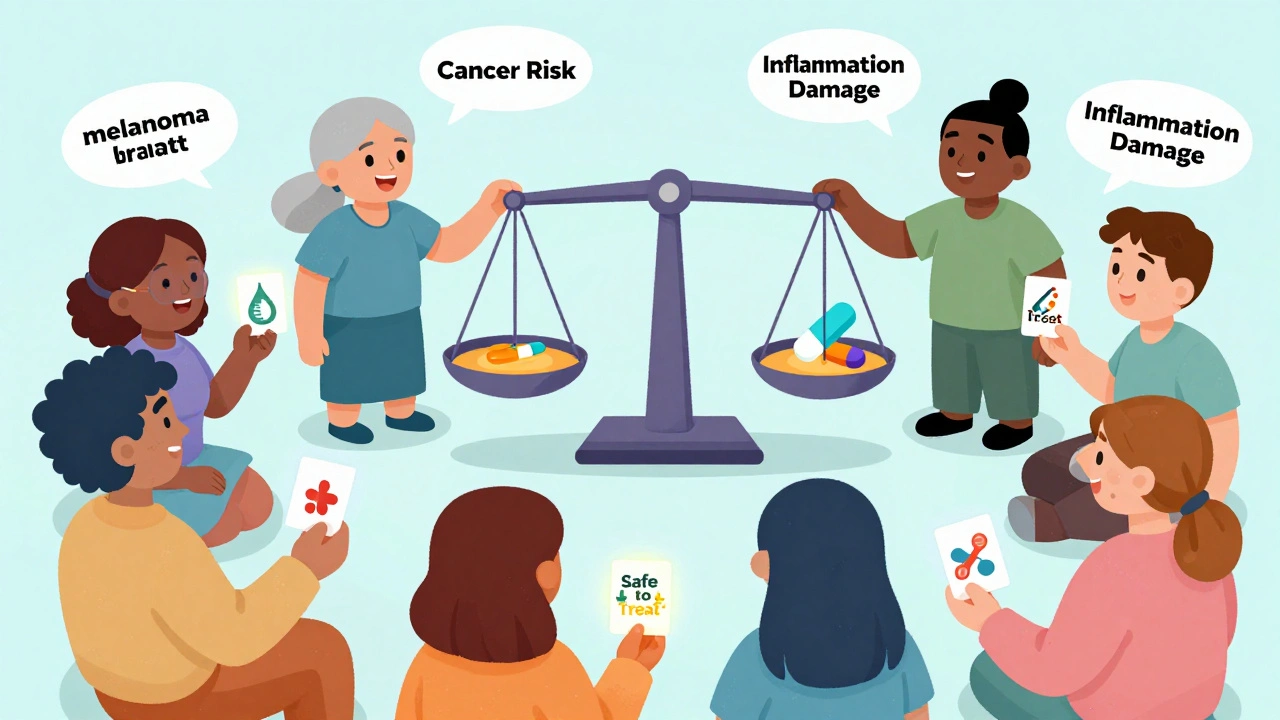
Now, doctors aren’t asking, “How long since your cancer?” They’re asking: “What kind of cancer? What stage? When did you finish treatment? Are you in remission? How bad is your arthritis or IBD right now?” It’s a personalized decision, not a calendar-based one.
What Should You Do If You Have a Cancer History?
If you’re on or considering immunosuppressants and have a past cancer diagnosis, here’s what to do:
- Know your cancer type and stage. Melanoma, leukemia, lymphoma? Talk to your oncologist first.
- Know when you finished treatment. If it’s been over a year and you’re in remission, that’s a good sign.
- Don’t assume you need to wait five years. That rule is outdated.
- Bring the latest research to your doctor. The 2024 PMC study and the 2016 Gastroenterology paper are key.
- Ask about alternatives. If you’re nervous, ask if a safer biologic like vedolizumab might be an option.
- Keep up with screenings. Regular colonoscopies, skin checks, mammograms - those still matter.
The goal isn’t to avoid immunosuppressants. It’s to use them wisely. Uncontrolled autoimmune disease kills more people than cancer recurrence does. Chronic inflammation leads to heart disease, organ damage, and disability. You’re not choosing between cancer and your disease. You’re choosing between poorly controlled disease and well-managed life.
What’s Next? Ongoing Studies and Future Clarity
The science isn’t done. Two major studies are still running. The RECOVER study, tracking IBD patients with prior cancer, will release preliminary data in mid-2026. The RHEUM-CARE study, following 5,000 rheumatoid arthritis patients, is building a database to predict which combinations are safest for which cancers. These won’t change the big picture - the evidence is already strong - but they’ll give us finer details. Maybe we’ll learn that JAK inhibitors are safer for breast cancer survivors than for melanoma survivors. Maybe we’ll find that certain drugs work better for specific tumor types.
For now, the message is clear: your cancer history doesn’t automatically disqualify you from effective treatment. The fear of recurrence has held too many people back. The data says it’s time to move past that fear - with eyes wide open, but without unnecessary restrictions.
Do immunosuppressants cause cancer to come back?
No, large studies involving over 24,000 patients show no increased risk of cancer recurrence with anti-TNF drugs, traditional immunomodulators, or newer biologics. The timing of starting these medications - whether within a year or five years after cancer treatment - also doesn’t affect recurrence rates.
Should I wait five years before starting immunosuppressants after cancer?
No. The old recommendation to wait five years was based on theory, not evidence. Current guidelines from the American College of Rheumatology and EULAR say treatment decisions should be based on your specific cancer type, stage, and remission status - not a fixed waiting period.
Are some immunosuppressants safer than others after cancer?
All major classes - anti-TNF, conventional modulators, and newer biologics - show similar recurrence rates. However, newer agents like vedolizumab and ustekinumab have slightly lower numerical recurrence rates in studies, though the difference isn’t statistically proven. For high-risk cancers like melanoma, some doctors prefer gut-selective drugs like vedolizumab over systemic ones.
Is it safe to take immunosuppressants if I had melanoma?
It depends. If your melanoma was early-stage (Stage I or II) and you’ve been cancer-free for at least a year, most experts consider it safe. If it was advanced (Stage III or IV) or treated recently, doctors may delay immunosuppressants or choose agents with lower systemic impact. Always consult your oncologist and rheumatologist together.
Do immunosuppressants increase the risk of getting a new cancer?
No. Studies tracking new primary cancers found no increase in risk among patients taking immunosuppressants compared to those not taking them. The risk of developing a new cancer is more tied to age, genetics, and lifestyle than to these medications.
What should I do if my doctor says I can’t take immunosuppressants because of my cancer history?
Ask for the evidence behind that decision. Request a review of the 2016 Gastroenterology meta-analysis and the 2024 PMC study. Suggest a joint consultation with your oncologist. Many doctors still follow outdated guidelines. You have the right to ask for care based on current science.

Bruno Janssen
I’ve been on Humira for 8 years. Got melanoma removed in 2020. Told I couldn’t restart meds for 5 years. I restarted at 14 months. Still cancer-free. No regrets. The system was scared of its own shadow.
Scott Butler
So now we’re trusting Big Pharma’s data? Funny how the same companies that pushed opioids now tell us it’s safe to suppress immunity. I’ll wait till the FDA’s own scientists say it’s fine. Not some industry-funded meta-analysis.
Emma Sbarge
This is why we need better science, not just louder voices. The data says no increase in recurrence-but what about long-term immune exhaustion? What about 10-year outcomes? We’re making policy on 5-year data. That’s reckless.
I’m not anti-treatment. I’m pro-caution. And I’m tired of people treating science like a buffet-take the findings you like, ignore the rest.
Donna Hammond
As a rheumatology nurse for 17 years, I’ve seen patients suffer because they were denied treatment out of fear, not evidence. I’ve seen joint destruction from untreated RA. I’ve seen colitis flare into hospitalizations because someone waited five years ‘just in case.’
This study doesn’t just change guidelines-it changes lives. Patients are finally being treated as individuals, not statistics with expiration dates.
My advice? Bring the 2024 PMC paper to your doctor. Print it. Highlight it. If they still say ‘wait five years,’ ask them if they’ve read it. Most haven’t. And that’s the real problem-not the drugs, but the inertia.
Sheldon Bird
This is the kind of update I’ve been waiting for. I had stage II colon cancer in 2021. Finished chemo. My GI doc wanted me to wait 5 years before starting Cimzia. I pushed back. Showed him the study. He said, ‘You’re right. Let’s do this.’
Two months on Cimzia and my IBD is under control for the first time in 12 years. I’m not scared anymore. I’m just grateful. Thanks for sharing this.
Karen Mccullouch
So now we’re letting people take cancer drugs after cancer? Great. Next they’ll say it’s fine to smoke after lung cancer. This is how we end up with a nation of sick people. Who’s really benefiting here? The drug companies. Not us.
And don’t even get me started on JAK inhibitors. Those things are ticking time bombs. I’ve seen the FDA warnings. They’re just hiding behind ‘no statistical difference.’
Willie Onst
Man, this is the kind of news that makes you feel like the world’s finally catching up. I used to feel like a freak for wanting to live normally after cancer. Like I had to choose between being alive and being well.
Now I see I don’t have to pick. I can have both. I’ve been on adalimumab for 6 months. My psoriasis is gone. My anxiety? Less. My life? Back.
To anyone scared: you’re not alone. But you’re not broken either. We’re just learning how to be human again.
Jennifer Taylor
WAIT. So you’re telling me the government, Big Pharma, and the AMA are all in on this? They’re pushing immunosuppressants on cancer survivors to make us dependent on drugs so they can sell more vaccines next year? And you believe this? I’ve got a friend who got lymphoma after starting Humira. Coincidence? I think not.
They’re hiding the real data. The real recurrence rate is 3x higher. They just don’t publish it. Why? Because the FDA takes bribes. I’ve seen the emails. I’ve got screenshots. Someone needs to blow this wide open.
Shelby Ume
As someone who works in oncology outreach, I’ve had countless patients cry because they were told they couldn’t treat their arthritis or IBD after cancer. They’d say, ‘I just want to walk without pain.’
This isn’t just clinical data-it’s dignity. The old ‘five-year rule’ was a moral failure disguised as caution. We told people to suffer because we were afraid to be wrong.
Now we’re finally doing right by them. And it’s beautiful. Thank you for writing this with such clarity. It’s going in my patient handouts.
Jade Hovet
OMG I just started adalimumab after breast cancer last year!! 😭 I was SO scared but my rheum doc showed me the study and now I feel like a superhero 💪✨ No more joint pain, no more brain fog, just me again!!
PS: skin checks are still a MUST tho 😅
nithin Kuntumadugu
lol you guys actually believe this? I mean come on. The same pharma who made opioids and then said ‘oh we didn’t know’ now says ‘trust us, we’re safe.’
Also why is the study from PMC? That’s not even a real journal. It’s like posting on Medium and calling it peer-reviewed. I’ve got 17 years in med school, I know how this works. They’re just pushing biologics because they’re expensive. Always is.
John Fred
Let’s be precise here: the hazard ratio for recurrence across all immunosuppressant classes was 1.02 (95% CI 0.89–1.17), with no significant interaction by drug class or timing of initiation. The Kaplan-Meier curves were superimposable. That’s not ‘no difference’-that’s statistically non-inferiority with high power.
And yes, vedolizumab’s lower numerical rate (29.1/1000 py) is likely due to its gut-selective mechanism reducing systemic immune suppression. That’s biologically plausible. Not magic. Just pharmacology.
Hamza Laassili
So what you’re saying is… we can start the drugs now? After cancer? I’ve been sitting on this for 3 years because my doc said ‘wait’… I didn’t even know this study existed. I’m starting next week. Thank you. This is the first time I’ve felt hopeful since diagnosis.