Before 1984, if you needed a generic version of a prescription drug, you were out of luck. Even if the chemical formula was identical, the law forced generic manufacturers to repeat every single clinical trial done by the brand-name company. That meant years of delays and costs so high that most companies gave up. The result? Less than 19% of prescriptions filled in the U.S. were generics. Today, that number is over 90%. The shift didn’t happen by accident. It was built on a single law: the Hatch-Waxman Amendments.
What the Hatch-Waxman Act Actually Did
The Drug Price Competition and Patent Term Restoration Act of 1984 - better known as the Hatch-Waxman Amendments - didn’t just tweak the system. It rebuilt it from the ground up. Sponsored by Senator Orrin Hatch and Representative Henry Waxman, the law was a rare moment of bipartisan compromise between two opposing forces: brand-name drug makers who wanted to protect their patents, and generic manufacturers who wanted to get their products to market faster.The law had two clear goals: make it easier for generic drugs to enter the market, and give brand-name companies extra time on their patents to make up for delays caused by FDA reviews. That’s it. No grand theories. No vague promises. Just two practical fixes that changed everything.
The ANDA: The Secret Weapon Behind Generic Drugs
Before Hatch-Waxman, a generic company had to file a New Drug Application (NDA) - the same full-scale application as the original maker. That meant running expensive clinical trials, even though the drug was chemically identical. It was like forcing every car manufacturer to build its own crash test dummy every time they made a Honda Accord.Hatch-Waxman changed that by creating the Abbreviated New Drug Application, or ANDA. Suddenly, generic makers didn’t need to prove safety and effectiveness again. They just had to show their version was bioequivalent - meaning it worked the same way in the body as the brand-name drug. That cut development costs by 80-90%. It also cut approval time from years to months.
Today, over 10,000 generic drugs are approved in the U.S. And they cost 80-85% less than their brand-name counterparts. That’s not luck. That’s the ANDA at work.
Patent Term Restoration: Why Brand-Name Companies Agreed
If you’re a drug company that spent $1 billion and 12 years developing a new medicine, you don’t want to lose your monopoly right when you finally start making money. The FDA approval process alone can take 5-7 years. That eats up a big chunk of your 20-year patent life.Hatch-Waxman fixed that. It allowed brand-name companies to extend their patents by up to five years - but only to make up for time lost during FDA review. Not for marketing delays. Not for patent filings. Just for the time the FDA was sitting on their application.
This was the trade-off: we’ll give you back some of your patent life, if you let us approve generics faster. It wasn’t perfect, but it was fair enough for both sides to sign on.
The Orange Book and Patent Challenges
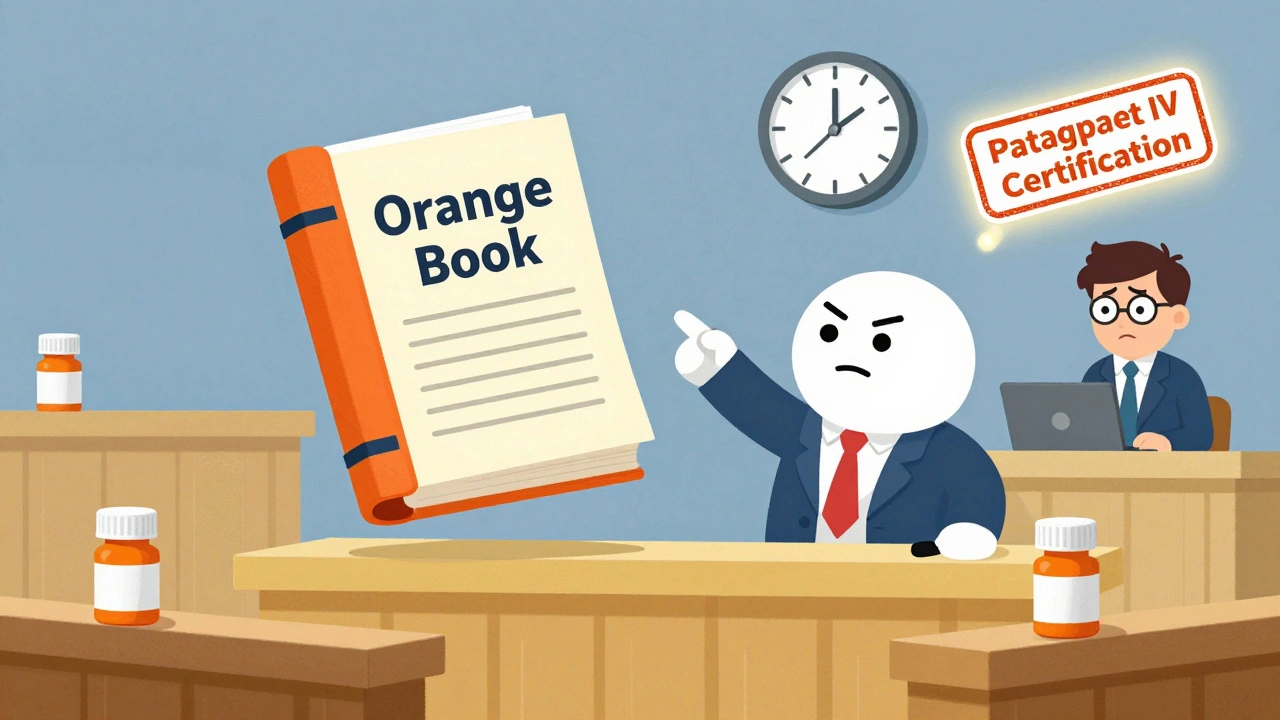
To make sure generic companies knew what patents they were up against, Hatch-Waxman created the Orange Book - the FDA’s official list of patents tied to brand-name drugs. Generic manufacturers had to check this list and certify how they planned to handle each patent.There were four types of certifications. The most important? Paragraph IV. That’s when a generic company says: “This patent is invalid, or we’re not breaking it.”
Why does that matter? Because if you’re the first to file a Paragraph IV certification, you get 180 days of exclusive rights to sell your generic - no competition. That’s a huge financial incentive. One company could make hundreds of millions in those six months.
This part of the law created the modern generic industry. Companies started hiring patent lawyers and scientists to dig into brand-name patents, looking for weaknesses. It turned patent law into a high-stakes game of chess - and gave consumers the best possible deal: lower prices, sooner.
The Safe Harbor: Letting Generics Start Early
Before 1984, a court ruled that even testing a generic version of a patented drug before the patent expired was illegal. That meant generic companies couldn’t even begin preparing until the day after the patent expired. That delay cost patients years of access.Hatch-Waxman changed that with a simple, powerful rule: activities done “reasonably related to the development and submission of information” to the FDA are not patent infringement. That’s the “safe harbor” provision.
Now, a generic company could start bioequivalence studies, tweak formulations, and prepare paperwork while the brand-name drug was still under patent. That shaved years off the timeline. It didn’t break patents - it just let generics get ready to hit the market the moment the patent ran out.
The 30-Month Stay: A Legal Pause Button
The 180-day exclusivity for first filers was powerful. But brand-name companies weren’t going to let go without a fight. So Hatch-Waxman gave them a tool: the 30-month stay.If a brand-name company sues a generic maker for patent infringement within 45 days of being notified of a Paragraph IV certification, the FDA can’t approve the generic for 30 months - unless the court rules in favor of the generic first.
This wasn’t meant to block generics forever. It was meant to give courts time to sort out patent disputes without letting the generic company rush to market and risk massive liability later.
But here’s the catch: some brand-name companies filed lawsuits just to delay, even when their patents were weak. And sometimes, they settled - paying the generic company to stay off the market. These “pay-for-delay” deals became so common that the Federal Trade Commission found 668 of them between 1999 and 2012. They cost consumers an estimated $35 billion a year.
What’s Broken Today - And What’s Still Working
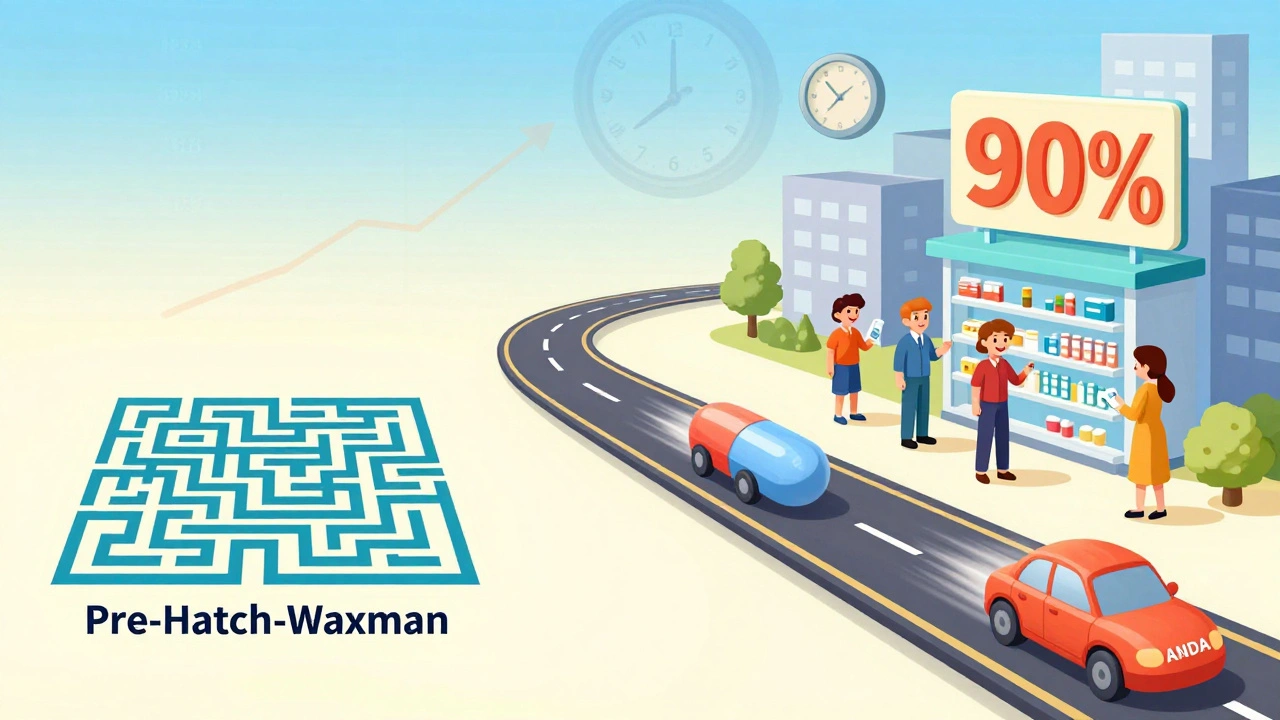
The Hatch-Waxman system worked brilliantly for decades. By 2023, generics accounted for 90% of all prescriptions in the U.S. and saved the healthcare system hundreds of billions.But the system is under strain. Brand-name companies now use tactics the law never anticipated: filing dozens of weak patents (“evergreening”), submitting citizen petitions to delay approvals, and using the 30-month stay as a permanent roadblock.
The FDA has tried to fix this. Through the Generic Drug User Fee Amendments (GDUFA), they’ve cut the average ANDA review time from 30 months in 2012 to under 12 months in 2022. They’ve also clarified rules on first-filer exclusivity - if two companies file on the same day, they share the 180-day window.
But the biggest problem remains: the 180-day exclusivity period still incentivizes strategic gaming. Some companies file Paragraph IV certifications not to challenge patents, but just to be first in line - even if they have no intention of launching the drug. The FDA can’t force them to produce it.
The Legacy: Cheaper Drugs, But at What Cost?
There’s no denying the success of Hatch-Waxman. It turned a broken system into the most efficient generic drug market in the world. Millions of Americans now take life-saving medications because they’re affordable.But the law also gave brand-name companies tools to protect profits longer than intended. High drug prices today aren’t just about R&D costs - they’re about exploiting loopholes Hatch-Waxman didn’t foresee.
That’s why new bills like the 2023 Preserve Access to Affordable Generics and Biosimilars Act aim to ban “pay-for-delay” deals outright. The goal isn’t to tear down Hatch-Waxman. It’s to fix what’s been bent.
The original compromise still holds. Generics are cheaper. Innovation is still rewarded. But the balance has tilted. The question now isn’t whether Hatch-Waxman worked - it’s whether we’re still playing by the same rules.
How It All Fits Together
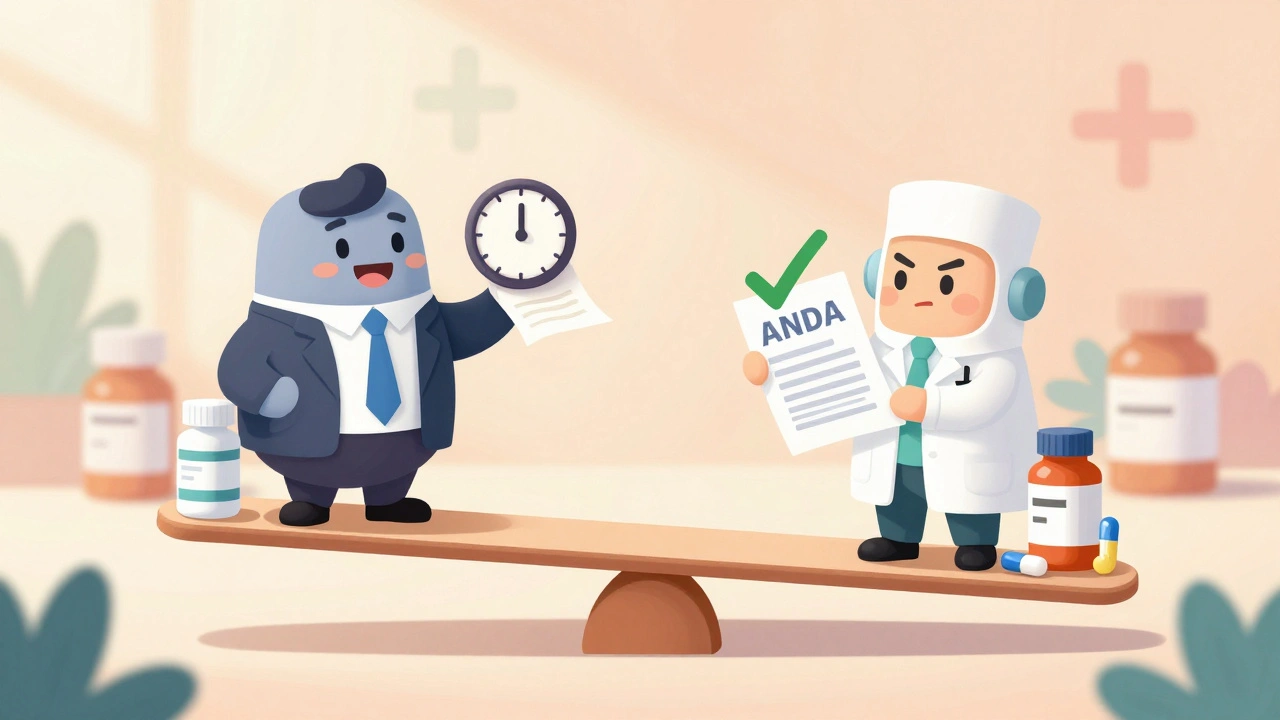
Think of Hatch-Waxman as a seesaw. On one side: brand-name companies get patent extensions and legal protection. On the other: generic companies get fast-track approval, patent challenges, and market exclusivity. The law balanced them - for a while.Today, the seesaw is uneven. But the structure is still sound. The fixes don’t need to be radical. They just need to be honest: close the loopholes, enforce the rules, and remember why the law was written in the first place - so people could afford their medicine.
What is the main purpose of the Hatch-Waxman Amendments?
The main purpose of the Hatch-Waxman Amendments was to balance two goals: speeding up access to affordable generic drugs while giving brand-name drug makers extra patent time to make up for delays in FDA approval. It created the ANDA pathway for generics and allowed patent term restoration for innovators.
How did Hatch-Waxman change the generic drug approval process?
Before Hatch-Waxman, generic companies had to run full clinical trials to prove safety and effectiveness. After the law, they only needed to show bioequivalence to the brand-name drug through an Abbreviated New Drug Application (ANDA). This cut approval time from years to months and reduced costs by 80-90%.
What is Paragraph IV certification?
Paragraph IV certification is when a generic drug company tells the FDA it believes a brand-name drug’s patent is invalid or that its product won’t infringe on it. The first company to file a Paragraph IV certification gets 180 days of exclusive market rights - a major financial incentive to challenge patents.
Why do brand-name drug companies file lawsuits against generic makers?
When a generic company files a Paragraph IV certification, the brand-name company has 45 days to sue for patent infringement. If they do, the FDA must delay approval for up to 30 months - giving the brand time to defend its patent. Some companies use this to delay competition, even when the patent is weak.
What is the 30-month stay in Hatch-Waxman?
The 30-month stay is a legal pause that stops the FDA from approving a generic drug if the brand-name company files a patent lawsuit within 45 days of being notified of a Paragraph IV certification. It gives courts time to resolve patent disputes without letting the generic product enter the market prematurely.
Are pay-for-delay deals still happening today?
Yes, though they’re under more scrutiny. Between 1999 and 2012, the FTC documented 668 pay-for-delay agreements, where brand-name companies paid generics to delay launching cheaper versions. These deals cost consumers an estimated $35 billion annually. New laws aim to ban them outright.
How many generic drugs are available in the U.S. today?
As of 2024, more than 10,000 generic drug products are approved and available in the U.S. market. They make up about 90% of all prescriptions filled and cost 80-85% less than their brand-name equivalents.
Did Hatch-Waxman reduce drug prices?
Yes - dramatically. Before 1984, generics made up less than 19% of prescriptions. Today, they account for over 90%. Generic drugs save the U.S. healthcare system an estimated $300 billion every year. The law made affordable medication the norm, not the exception.
Despite the challenges, Hatch-Waxman remains the backbone of how Americans access affordable medicine. The system isn’t perfect, but it’s still the best we’ve got - if we fix the leaks.

Jessica Baydowicz
This law is why my insulin costs $25 instead of $300-plain and simple. Hatch-Waxman didn’t just change the market, it saved lives.
Martyn Stuart
It’s fascinating how such a technically dry piece of legislation-written by two politicians who barely liked each other-created one of the most successful public health interventions in modern history. The ANDA pathway? Genius. The 180-day exclusivity? Brilliant incentive design. The 30-month stay? A double-edged sword, yes-but the trade-off was worth it. And yet, here we are, decades later, watching brand-name pharma twist the rules like a lawyer drafting a loophole in a prenup. The Orange Book was meant to be a map, not a maze.
The safe harbor provision? That’s the quiet hero. It allowed generics to prep while the patent still stood-no need to wait until the clock hit zero. That’s not just efficiency; it’s foresight. And now? Companies file 50 patents on one drug, each one a minor tweak, just to reset the clock. Evergreening isn’t innovation-it’s legal stagnation.
And don’t get me started on pay-for-delay. It’s not a settlement; it’s collusion with a receipt. The FTC tried to stop it. Courts kept watering it down. The system was built to lower prices, not to create a casino where the house always wins.
Still-90% of prescriptions filled with generics? That’s not magic. That’s policy working as intended. We just need to remember: the law wasn’t designed to protect profits. It was designed to protect patients.
And if we let the loopholes swallow the intent? We’ll be back to 1983: rationing pills, skipping doses, choosing between food and refills. No thanks.
zac grant
Let’s be real-the ANDA system is the only reason I can afford my statins. Before this, I’d have been paying $500/month for Lipitor. Now? $12. That’s not a win for capitalism-it’s a win for rational regulation.
And the patent term restoration? Totally fair. If you spend $1.2B and 14 years developing a drug, and the FDA takes 6 of those years to approve it, you’re not getting your ROI. But the moment you start gaming the system with 17 overlapping patents on the same molecule? That’s where it turns toxic.
The 180-day exclusivity was meant to reward first movers who actually challenged weak patents. Now? It’s a shell game. Some companies file Paragraph IV just to sit on it. No launch. No product. Just a $200M payout from the brand-name guy to stay quiet. That’s not competition. That’s bribery with a FDA form.
And yet, the system still works. Over 10,000 generics. 90% of scripts. Hundreds of billions saved. The structure holds. We just need to cut the rot.
Pavan Kankala
Wake up. This whole system is a corporate puppet show. The FDA? Controlled by Big Pharma. The patents? Bought and paid for. The 30-month stay? A delay tactic engineered to keep prices high. They let generics in-but only after they’ve milked the patent dry. And now they’re suing anyone who tries to fix it. This isn’t medicine. It’s a monopoly masquerading as innovation.
They call it ‘balance’? Nah. It’s control. And if you think this law was written for patients, you’re not paying attention. The real winners? Shareholders. The losers? The 1 in 4 Americans who skip meds because they can’t afford them.
And don’t tell me ‘it’s better than before.’ Better doesn’t mean good. It just means we’re still alive while they profit.
Carolyn Ford
Let me just say-I’ve read this entire post, and I’m still not convinced Hatch-Waxman was a net positive. Sure, generics are cheaper-but they’re also less reliable. I’ve had three different generic versions of my thyroid med, and each one made me feel like a zombie. The FDA says they’re ‘bioequivalent’-but bioequivalent doesn’t mean identical. It means ‘close enough.’
And what about the quality control? You think all those generic factories in India and China are held to the same standards as Pfizer? Please. I’ve seen the reports. Contamination. Subpotent batches. The FDA can’t inspect them all.
So yes, I get the math. $300 to $12. But what’s the cost to my health? I’d rather pay more and know my pill isn’t going to make me hallucinate.
Also-why is it that every time someone mentions Hatch-Waxman, no one talks about the fact that brand-name companies now spend more on marketing than R&D? That’s the real problem. Not the law. The culture.
Gareth Storer
So we’re celebrating a law that let corporations game the system for 40 years? Congrats. You’re the person who cheers when the bank changes the fine print on your mortgage and calls it ‘financial innovation.’
The 180-day exclusivity? A loophole designed to be exploited. The 30-month stay? A legal smoke screen. And the Orange Book? A taxidermy exhibit of patent nonsense.
It’s not ‘balance.’ It’s a rigged game where the house prints its own money-and we’re the ones paying for the chips.
Libby Rees
The Hatch-Waxman Amendments represent a rare instance of legislative precision. The structure was intentionally modular: patent term restoration to incentivize innovation, ANDA to enable competition, Paragraph IV to challenge weak intellectual property, and the safe harbor to permit preparatory activity without infringement.
These mechanisms functioned as designed for decades. The current challenges arise not from flaws in the law, but from its misapplication. The rise of evergreening, pay-for-delay settlements, and strategic Paragraph IV filings are market behaviors, not legislative failures.
Reform should target behavior, not structure. Amend the antitrust enforcement, clarify the standards for patent validity, and mandate transparency in settlement agreements. The foundation remains sound.
Gillian Watson
I’m from the UK, and I’ve seen how this compares to our NHS system. We don’t have patent extensions or 180-day exclusivity. Generics hit the market fast, and prices drop hard. But we also don’t have the same level of innovation in new drugs.
Hatch-Waxman gave us both: cheap meds and new treatments. It’s messy, sure. But it’s the only system that’s managed to do both.
Fix the abuses. Don’t throw the baby out with the bathwater.
Dematteo Lasonya
My dad’s on a generic blood thinner. He used to pay $400 a month. Now it’s $12. He doesn’t know what Hatch-Waxman is. But he knows he can breathe easier. That’s all that matters.
People get lost in the jargon. But real people? They just want to afford their pills.
Ollie Newland
Let’s not romanticize this. The ANDA pathway didn’t just cut costs-it broke the monopoly model. Before Hatch-Waxman, brand-name companies didn’t just sell drugs-they sold fear. ‘If you don’t take our version, you’re risking your life.’ Now? We know the science. The molecules are the same. The packaging is different. The price? A fraction.
The real villains? The patent trolls who buy expired patents just to sue generics. The CEOs who lobby to extend exclusivity by rewriting the Orange Book. The law didn’t fail. The players did.
And the 180-day exclusivity? Still the most brilliant, dangerous incentive ever written. It turned patent law into a sport. And the fans? Us.
Jordan Wall
Look, I’m a pharmacokinetics nerd, so I’ll say this: bioequivalence is a statistical fiction. The Cmax and AUC tolerances? 80-125%. That’s a 45% window. Two drugs can be ‘equivalent’ but still behave differently in a patient with renal impairment, or a 70-year-old with polypharmacy.
And the Orange Book? A labyrinth designed by lawyers, not scientists. I’ve seen generics with the same API but different excipients cause adverse reactions-because the FDA doesn’t require reformulation disclosure.
So yes, prices are down. But safety? Not always. Hatch-Waxman was a necessary evil. But we’re now living in the unintended consequences.
Benjamin Sedler
Oh, so now we’re giving medals to a law that let pharma companies pay generics to NOT sell their products? That’s not a compromise. That’s a crime scene with a PowerPoint.
And you call this ‘balance’? The balance is 90% generics and 10% innovation. But the innovation? It’s all happening overseas because U.S. prices are too high to justify R&D here. So we get cheaper pills… but fewer new ones.
Also-why do you think the FDA approves 10,000 generics but only 20 new drugs a year? The incentives are backwards. Hatch-Waxman didn’t fix the system. It just made it more efficient at extracting money from patients.
Emmanuel Peter
Bro, the whole system is rigged. The FDA approves generics faster than ever, but the brand-name companies just tweak the drug slightly-change the coating, add a flavor-and call it ‘new.’ Then they get another 7 years of exclusivity. It’s not innovation. It’s fraud with a patent number.
And don’t even get me started on the 30-month stay. That’s not a pause. That’s a hostage situation.
People think this law helped them? Nah. It helped the CEOs buy private islands.
Shofner Lehto
Let’s not forget the human cost of the 180-day exclusivity loophole. Companies file Paragraph IV not to challenge patents, but to lock out competition. One company did it with a diabetes drug-filed the certification, sat on it for 15 months, then sold the rights to the brand-name company for $200 million. No generic was ever produced. Patients paid more. The system failed.
But here’s the thing: we still have 90% generic use. That’s not because of loopholes. It’s because the core of Hatch-Waxman still works. The ANDA is still the gold standard. The safe harbor still lets generics prepare. The Orange Book still informs.
Fix the abuses. Don’t dismantle the architecture.
We don’t need a revolution. We need enforcement.
Carolyn Ford
And yet, the FDA just approved its 10,000th generic last month. That’s not luck. That’s the ANDA working. The law didn’t break. The players did.